
Building the knowledge processes, culture, and feedback loops that determine whether AI systems stay accurate, trusted, and in use
1. Introduction: Why Knowledge Management Determines AI Success
The service technician is standing in front of a broken machine. The answer to the problem exists somewhere in the organization: in a service manual, in a senior technician's head, in the notes from a repair two years ago that nobody wrote up. Whether the AI assistant on the technician's phone can produce that answer has very little to do with the model it runs on. It depends on whether the organization ever captured the knowledge, validated it, kept it current, and built a way for the technician to say "that answer was wrong" and have someone act on the correction.
That is knowledge management, and it is the discipline most enterprise AI programs skip.
The evidence for the cost of skipping it keeps accumulating. MIT Media Lab's Project NANDA found that 95 percent of enterprise generative AI pilots produce no measurable return, and identified a "learning gap" as a core cause: most GenAI systems do not retain feedback, adapt to context, or improve over time (The GenAI Divide: State of AI in Business 2025, July 2025)1. Gartner predicted that at least 30 percent of generative AI projects would be abandoned after proof of concept by the end of 2025, citing poor data quality, inadequate risk controls, and unclear business value (July 2024)3. McKinsey's August 2026 State of AI survey2 found that while 88 percent of organizations now use AI regularly, fewer than half have scaled it beyond isolated functions, and the organizations getting real financial impact are distinguished by how they redesign workflows, not by which models they buy.
Read those three findings together and a pattern emerges. AI systems fail in the enterprise for knowledge reasons: the knowledge was never captured, nobody owns keeping it current, and there is no working loop that turns user feedback into corrected content. All three are knowledge process failures, and they existed long before generative AI. AI made them visible and expensive.
This page covers enterprise knowledge management as an AI readiness discipline: the knowledge lifecycle and the processes that govern it, the conversion of tacit expertise into explicit knowledge, the cultural and organizational conditions that make capture and reuse actually happen, the field feedback loops that keep AI systems learning, and the measured outcomes organizations have achieved when they treated knowledge as infrastructure. It also draws a boundary that current AI programs badly need: the distinction between knowledge management and knowledge engineering.
2. Knowledge Management and Knowledge Engineering: Two Disciplines, One Pipeline
The terms get used interchangeably. They should not be. Conflating them is one reason AI programs stall: organizations fund the engineering and assume the management will take care of itself, or run a traditional KM program and wonder why their retrieval accuracy is poor.
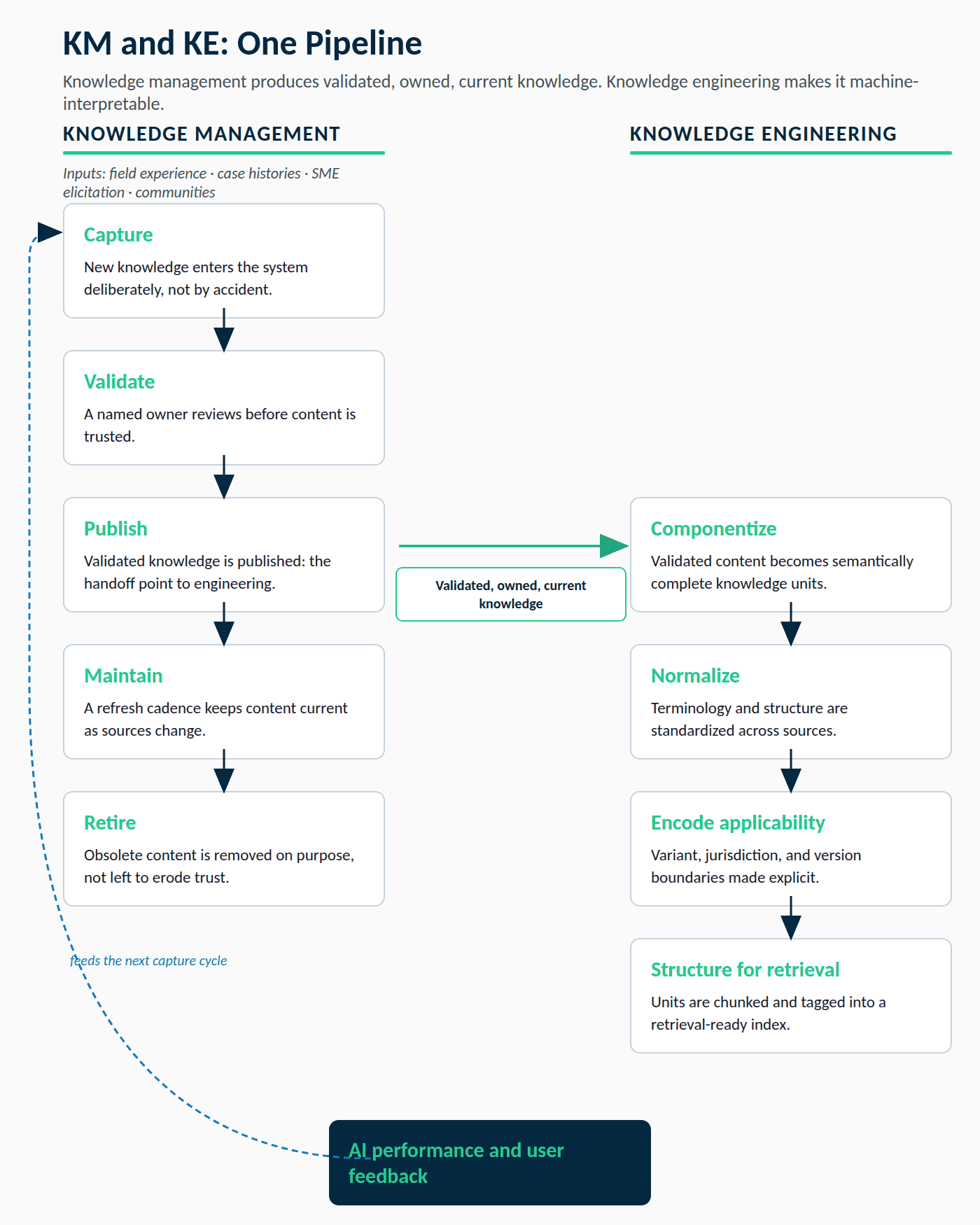
Knowledge management is an organizational discipline. It governs how knowledge is created, captured, validated, shared, maintained, and retired across the enterprise. Its raw material is human expertise and its instruments are processes, roles, incentives, communities, and governance. KM answers questions like: Who owns this knowledge? How does what the service team learned in the field this week get into the knowledge base? What happens when two sources conflict? Who reviews content before an AI system is allowed to serve it? Why would a busy expert bother to contribute?
Knowledge engineering is a technical discipline. It transforms validated knowledge into structured, machine-interpretable form: semantically complete knowledge units, consistent terminology, explicit applicability boundaries, preserved procedural sequence, encoded conditions and constraints. Knowledge engineering is what makes content safe for AI retrieval.
The relationship between them is a pipeline with a handoff:
| Knowledge management | Knowledge engineering | |
|---|---|---|
| Primary question | What does the organization know, and is it captured, current, and trusted? | Can a machine retrieve and interpret it safely? |
| Raw material | Human expertise, experience, judgment | Validated content and knowledge assets |
| Core work | Capture, validation, ownership, lifecycle, culture, incentives, feedback loops | Structuring, chunking, normalization, applicability encoding, ontology alignment |
| Failure mode | Knowledge missing, stale, contradictory, or locked in people's heads | Knowledge fragmented, mixed across variants, unsafe to retrieve |
| Who does it | Knowledge owners, SMEs, communities, KM and operations leaders | Knowledge engineers, taxonomists, information architects |
| Where it is covered | This page | Knowledge Engineering for RAG and Information Architecture for AI Systems |
The dependency runs in both directions. Knowledge engineering cannot structure knowledge that was never captured, and no amount of chunking discipline fixes content that is wrong, outdated, or contradicts the source of truth. Knowledge management without engineering produces well-governed content that AI still cannot retrieve reliably. Organizations need both, staffed and funded as distinct workstreams, connected by an explicit handoff: KM produces validated, owned, current knowledge; engineering makes it machine-interpretable; and the feedback from AI performance flows back to KM to drive the next round of capture and correction.
A useful way to hold the distinction: knowledge management decides and maintains what the organization knows. Knowledge engineering determines what the machine can do with it. As we argued when the discipline first collided with AI, the knowledge management work you do today is the AI capability you get tomorrow.
This page deliberately does not cover chunking strategy, knowledge unit design, applicability encoding, or ontology development. Those are knowledge engineering topics, treated in depth on the Knowledge Engineering for RAG page, with the structural foundations on the Information Architecture for AI Systems page.

Figure 1. Knowledge management and knowledge engineering are one pipeline with an explicit handoff at publication, and a feedback loop that closes back into capture.
3. Knowledge Processes: The Operating System of Enterprise Knowledge
Every organization has knowledge processes. In most, they are informal, inconsistent, and invisible: knowledge gets captured when someone happens to write it down, validated when someone happens to notice an error, and retired never. That informality was survivable when the consumer of knowledge was a human who could ask a colleague, apply judgment, and recognize that a document looked out of date. AI removes that safety margin. A retrieval system serves whatever the corpus contains, with equal confidence, whether it is authoritative or abandoned.
Making knowledge processes explicit means defining, for each significant knowledge domain, how the lifecycle actually runs:
Creation and capture. Where does new knowledge originate: engineering changes, field incidents, support cases, project retrospectives, regulatory updates? Which of those events trigger capture, and who is responsible when they do? The most common enterprise pattern is that knowledge is created constantly and captured almost never, because capture is nobody's job.
Validation and ownership. Every knowledge asset needs a named owner and a review gate. Content generated or mined by AI makes this more important, not less: drafts are never final, and the SME review gate is what turns probable content into reliable knowledge. Ownership also resolves conflicts. When the service manual and the field bulletin disagree, source-of-truth rules decide which one the AI is allowed to serve.
Publication and access. Validated knowledge has to reach the systems and people that use it, tagged and structured well enough to be findable. This is the handoff point to knowledge engineering.
Maintenance and retirement. Knowledge decays. Products change, regulations update, procedures get superseded. A defined refresh cadence, triggered reviews when upstream sources change, and deliberate retirement of obsolete content are what keep an AI corpus trustworthy. One construction firm we worked with found, during its knowledge platform overhaul, that half of what its intranet served was outdated or low-value content.
Two properties separate knowledge processes that work from those that exist on paper. First, they are embedded in the flow of work rather than bolted alongside it. A capture step that requires an expert to leave the workflow, open another system, and reconstruct context will lose to the deadline every time. Second, they are governed in a way that enables rather than blocks. Governance that consists of annual review cycles and single points of approval cannot keep pace with AI-scale content operations. Governance that enables looks different: continuous monitoring, distributed ownership with guardrails, and a clear answer to the diagnostic question, when the AI gives a wrong answer, what happens next? If the answer is nothing, the governance model is broken.
4. Tacit Knowledge: Converting Experience Into Explicit Knowledge
The hardest and most valuable knowledge in the enterprise is not written down anywhere. It is tacit: the diagnostic instinct of a technician who has seen a thousand failures, the underwriter's feel for a risk that does not fit the rules, the reasons behind a design decision that only the original engineer remembers. Explicit knowledge is a procedure; tacit knowledge is the experience that tells you when the procedure does not apply. People know more than they say, and say more than they can write down.
The distinction has been central to knowledge management since Nonaka and Takeuchi described the spiral of conversion between tacit and explicit knowledge in The Knowledge-Creating Company (1995)6. What AI changes is the economics. An AI assistant can only serve what has been made explicit. Every piece of expertise that stays in someone's head is a question the assistant will answer badly, and the expert who holds it is often within a decade of retirement. Seventy percent of service organizations told the Service Council5 that knowledge loss from workers retiring over the next five to ten years would create a significant burden. APQC's 2026 knowledge management predictions (December 2025)4 put proactive knowledge capture and intentional transfer among the top priorities for exactly this reason.
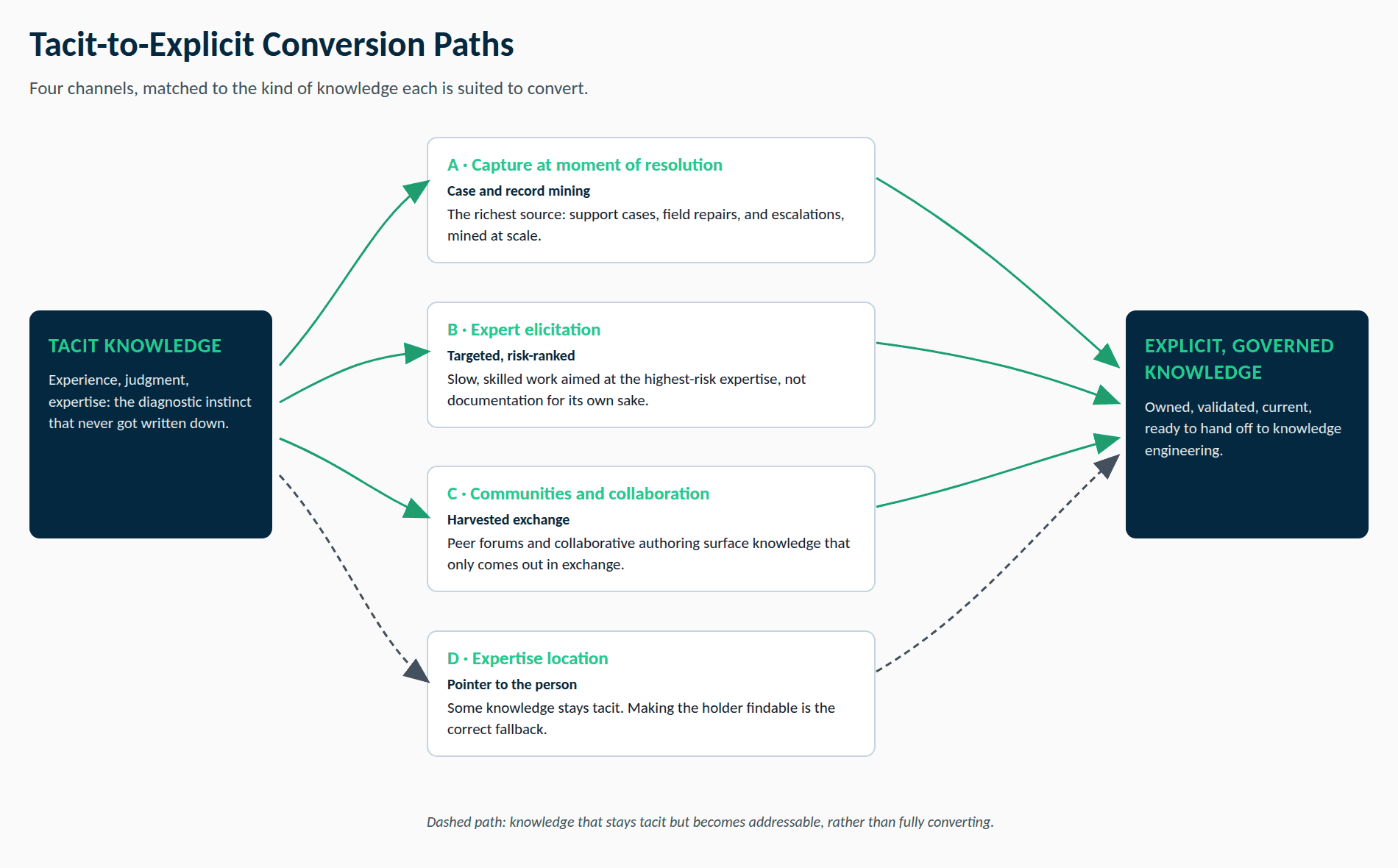
Tacit knowledge does not convert through mandates to "document everything." It converts through specific mechanisms, each suited to a different kind of knowledge:
Structured capture at the moment of resolution. The richest source of tacit knowledge is the daily stream of solved problems: support cases, field repairs, escalations, project saves. Mining case histories, service records, and correspondence recovers knowledge that formal documentation never contained. AI accelerates this dramatically: extraction pipelines can draft knowledge articles from thousands of historical cases, with SMEs validating rather than authoring. The knowledge was always there; harvesting it was never economical before.
Elicitation from experts. For deep expertise, someone has to sit with the expert and pull the reasoning out: the decision points, the exceptions, the "it depends" conditions that experts apply without noticing. This is slow, skilled work, which is why it should target the knowledge domains where the risk of loss is highest, identified deliberately rather than discovered at the retirement party.
Communities and collaboration. Much tacit knowledge surfaces only in exchange: a technician describes a strange failure and a peer three regions away recognizes it. Communities of practice, peer forums, and collaborative authoring convert individual experience into shared knowledge, and they leave a written trail that capture processes can harvest. APQC's 2026 outlook expects communities to evolve into AI-assisted networks that connect expertise across organizational lines; the collaborative feedback and knowledge sharing features built into a semiconductor equipment manufacturer's field service platform (Section 7.1) show what this looks like in production.
Expertise location. Some knowledge will never be fully explicit, and the correct fallback is knowing who holds it. A well-designed knowledge system refers people not only to documents but to the people who carry the knowledge that documents miss. Expertise profiles, contribution histories, and network analysis make the organization's tacit knowledge addressable even where it is not yet captured.
The practical stance is progressive: capture what the workflow surrenders cheaply, elicit what is critical and at risk, connect people for the rest, and let AI-era feedback loops (Section 6) tell you which gaps actually matter, because they show up as questions the assistant could not answer.

Figure 2. Four conversion channels, each suited to a different kind of knowledge. The dashed path is knowledge that stays tacit but becomes addressable.
5. Culture, Incentives, and Adoption: Why Knowledge Management Is an Organizational Discipline
Knowledge management programs rarely fail on method. They fail on participation. The taxonomy is sound, the platform works, and the experts still do not contribute, the content still goes stale, and users still route around the system. Organizations mature in KM capability and yet, as we have put it before, people still can't find their stuff. The gap between capability and adoption is cultural, and no amount of engineering closes it.
Several organizational conditions decide whether knowledge processes actually run:
Contribution has to be rational. Experts are busy, and knowledge sharing competes with billable work, production targets, and service calls. If capturing knowledge costs an expert twenty minutes and returns nothing, the rational choice is not to do it. Programs that work make contribution cheap (capture embedded in the workflow, AI drafting from what the expert already produced) and make it pay: recognition, performance goals that include knowledge outcomes, and visible evidence that contributed knowledge gets used. What gets measured and rewarded gets captured.
Trust has to be earned in both directions. Users abandon knowledge systems after a few bad answers, and experts stop contributing when their corrections disappear into a void. Trust is built by quality gates that keep bad content out of the corpus, by visible freshness, and by closing the loop with contributors so they see their input land. Bad content in the index is worse than missing content, because it produces confident wrong answers that poison trust in everything else.
Leadership has to treat knowledge as an asset, not overhead. Knowledge management gets cut when it is framed as content housekeeping, and funded when it is framed as what it is: the substrate that determines AI accuracy, onboarding speed, service quality, and resilience against workforce turnover. The reframing is not spin. The same taxonomy work that sounded administrative in 2019 is now the difference between an AI assistant that answers correctly and one that hallucinates.
Silos are a knowledge problem before they are an org-chart problem. Different units running different knowledge tools with different terminology inject friction into every decision that crosses a boundary, and they accumulate knowledge debt: inconsistent terms, duplicated content, undocumented local practice. Cross-functional alignment on shared vocabulary and shared processes is unglamorous work, and it is a precondition for any AI system meant to serve the whole enterprise.
Change management is part of the program, not an afterthought. Weaving knowledge work into daily practice means demonstrating benefit in the user's own terms, establishing baseline metrics around real tasks, and iterating with users rather than deploying at them. Adoption is the last mile of every knowledge initiative, and it is where most of them are won or lost.
6. Field Capture and Feedback Loops: How AI Systems Keep Learning
MIT's Project NANDA identified the learning gap as a defining cause of GenAI pilot failure: systems that do not retain feedback, adapt to context, or improve over time. The finding is usually read as a critique of the technology. It is more accurately a critique of the organizations deploying it. A model does not learn from field experience unless the organization builds the process that carries field experience back into the knowledge base. The learning gap is a knowledge management gap.
Closing it means treating the users of an AI system as participants in the knowledge lifecycle, not just consumers of it. The most complete example we have deployed comes from a commercial refrigeration and HVAC field service company whose AI assistant now supports technicians across its service operation.
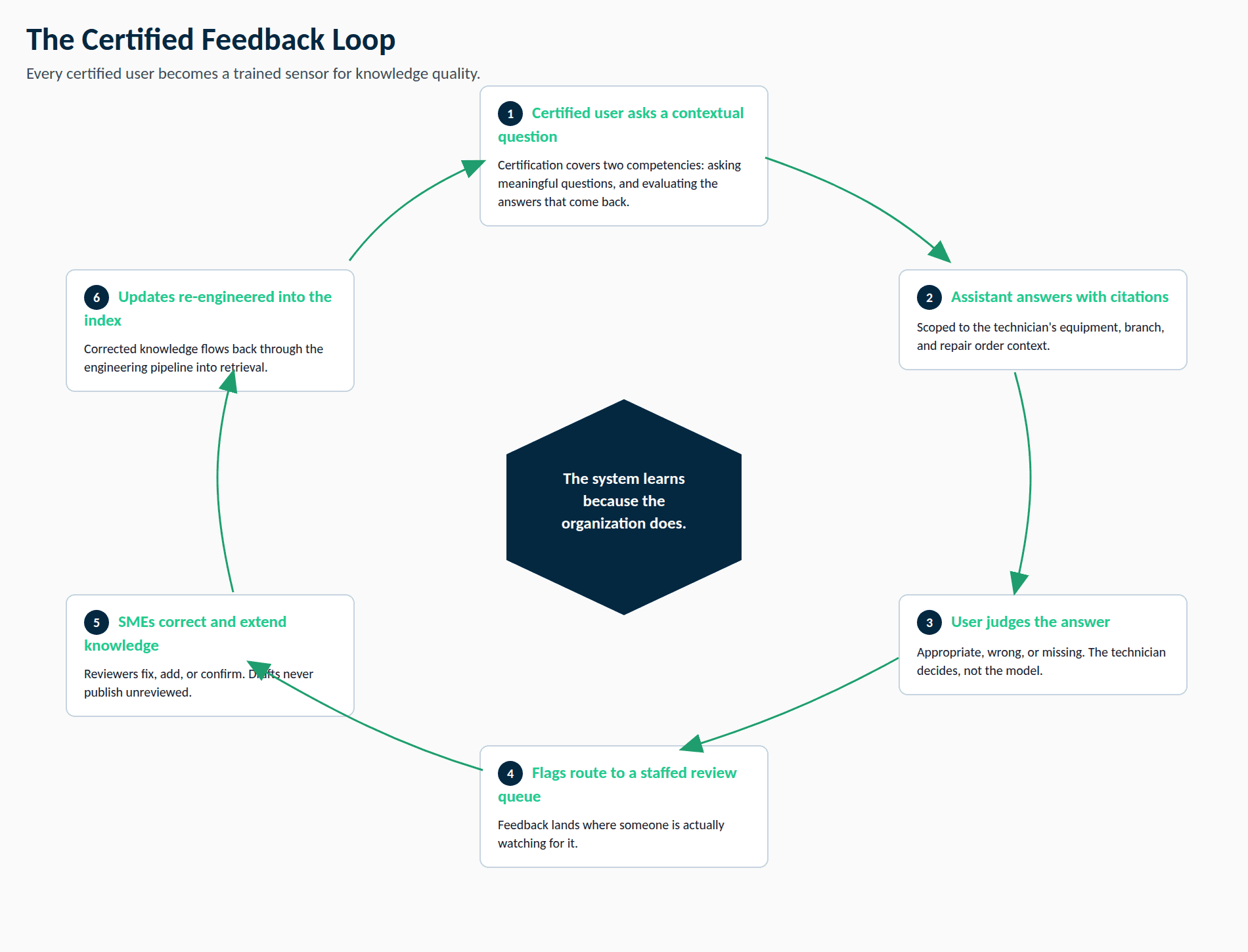
The organization made a decision that looks small and is not: technicians must be certified before they can use the assistant. The certification covers two competencies. First, how to ask meaningful questions: how to give the assistant the context that makes an answer retrievable and specific (the equipment, the symptom, the conditions) rather than a vague query that invites a vague answer. Second, how to evaluate and respond to what comes back: technicians are trained to judge whether an answer is appropriate, and to flag answers that are wrong, incomplete, or missing entirely, so the knowledge team can correct and extend the corpus.
That certification requirement changes the character of the system. Every certified technician becomes a trained sensor for knowledge quality. Feedback flags flow into a review queue where knowledge staff and SMEs correct content, fill gaps, and push updates back through the engineering pipeline into the index. Questions the assistant could not answer become the capture agenda: a ranked, evidence-based list of what the organization knows in its heads but not in its knowledge base. On-the-ground experience, which used to evaporate at the end of every service call, now accumulates.
Context integration reinforces the loop. The assistant is tied to the company's operational system of record, so answers are scoped to the specific repair order, branch, and equipment the technician is working on; in production, 99.3 percent of sessions are opened against a specific repair order. Context arrives from the system instead of being retyped, which raises answer relevance and lowers the effort of asking well.
The results are measurable. The assistant delivers 96 percent citation accuracy, and technicians spend 50 percent less time searching for information. Accuracy is verified continuously against an independent evaluation framework rather than self-reported, which is what lets the numbers survive executive scrutiny. And the mechanism generalizes far beyond field service: the same loop (trained users, structured feedback, a staffed review queue, updates flowing back into retrieval) is what keeps any enterprise AI system improving after the pilot glow fades. It is also the direct answer to the learning gap: the system learns because the organization does.
Two disciplines make the loop durable. Staff the receiving end: feedback that lands in an unstaffed queue teaches users to stop giving it, so review capacity and turnaround expectations are part of the operating model, not a volunteer activity. And instrument the system: knowledge systems degrade silently, so retrieval accuracy, answer quality, and usage need continuous monitoring against baselines, with degradation treated as an operational incident rather than a mystery.

Figure 3. The certified feedback loop. Every certified user becomes a trained sensor for knowledge quality.
7. Case Evidence: Knowledge Management Programs With Measured Outcomes
The following engagements span three decades of EIS knowledge management work, from pre-AI knowledge portals to current AI assistants. The technology changed; the discipline did not. In every case the outcome came from treating knowledge processes, ownership, and structure as the work, with the platform as the delivery mechanism.
7.1 Global semiconductor equipment manufacturer: field knowledge at the point of service
The company's field service engineers keep semiconductor fabrication plants running, where a down fab can cost the owner millions of dollars a day. The knowledge they needed was scattered across 14 systems, and up to 40 percent of technician time went to searching for information. With 3,000 technicians in the field, hedging against missing information tied up tens of millions of dollars in spare parts inventory. Three internal attempts to fix the problem over five years had failed.
The engagement built the knowledge foundation the previous attempts had skipped: process models for how formal and collaborative content flowed through the organization, an ontology and taxonomy designed around how technicians actually looked for answers, metadata and social tagging for findability, and a search-based delivery portal that respected customer intellectual property boundaries. The design also included collaborative features so engineers could contribute field knowledge, give feedback, and share practices with peers: field capture, a decade before AI assistants made it fashionable.
The outcome: a 50 percent reduction in time spent searching, saving roughly 18,000 hours per week across the technician population, worth close to $50 million per year. The program was recognized in the InformationWeek 500, and the knowledge architecture outlived multiple generations of the underlying technology.
7.2 Allstate Business Insurance: knowledge processes behind a virtual assistant
Allstate Business Insurance needed to make it easier for field agents, most of whom focused on consumer lines, to research and write commercial policies. Help content was hard to find, telephone support was costly and overused, and the content creation process itself was part of the problem.
EIS designed the knowledge foundation for an avatar-based intelligent assistant: a taxonomy used both for tagging content in the CMS and for retrieval in the help application, conversion of PDF and Word content into structured DITA components, a new content management process, and, just as important, a governance model and change management program so the content operation could sustain itself after launch.
The outcome: manual help desk operations fell 30 percent in the first six months, agents got quick, relevant answers in text or spoken form, and the structured content foundation positioned the business to open new lines to infrequent users. The lesson that carries into every AI assistant project since: the assistant is the visible ten percent; the knowledge processes and structure behind it are what make it answer correctly.
7.3 National health insurer: knowledge portal for complex claims
At a national health insurer, customer service representatives and claims processors handling complex claims had to find answers inside reimbursement policy documents that ran to hundreds of pages, kept as single documents for compliance reasons. The result was long hold times, inconsistent answers, and processing errors.
The engagement analyzed how claims staff actually worked across systems, developed content models that exposed answer-sized units within the compliance-bound documents, and validated the taxonomy, search experience, and tagging processes against 12 scenarios and 25 use cases across four distinct audiences before migrating content to the new knowledge portal.
The outcome: call handling time for complex claims fell 20 percent, answer accuracy improved as measured by call sampling, and content update costs dropped. The case illustrates a pattern that AI retrieval has since made universal: regulated industries cannot restructure their source documents, so the knowledge layer has to carry the structure the source cannot.
7.4 Employee-owned construction company: rebuilding trust in enterprise knowledge
A multibillion-dollar employee-owned construction company ran its institutional knowledge (checklists, business guides, policies, building codes, technical reports, safety information) through an intranet whose search behaved so erratically that employees called it a random document generator. When the search infrastructure failed outright and took two weeks to restore, leadership confronted how dependent the business was on a system nobody trusted.
The rebuild started from knowledge architecture, not platform features: identification of 240 audiences, requirements gathering through surveys, interviews, and collaborative design sessions, and a foundation of 11 standard content types, 50 metadata attributes, and 11 controlled vocabularies, with governance to keep them current. The company's leadership explicitly recognized the parallel to their own trade: engineering standards for the virtual world matching those they applied to physical construction.
The outcome: user satisfaction rose from 20 percent to 80 percent, and the overhaul retired roughly half the content as outdated or low-value, which did as much for trust as the new capabilities did. Findability improved enough that employees could locate not just documents but knowledgeable colleagues, putting expertise location into daily practice.
7.5 Commercial refrigeration and HVAC field service company: the certified feedback loop
The field service AI assistant described in Section 6 is the current-generation expression of the same discipline. Beyond the certification model and feedback loop, the engagement demonstrated what knowledge structure contributes independent of the model: the first phase, built on off-the-shelf retrieval over the existing corpus, reached 86 percent groundedness and 68 percent relevance. Rebuilding retrieval on knowledge architecture (domain-informed content processing, structure-preserving handling of tables and procedures, chunk-level metadata, terminology normalization across equipment vendors) took relevance to 98 percent with the model held essentially constant. Tabular content, the hardest case in technical documentation, reached 96 percent groundedness against an industry baseline of 65 to 75 percent.
Production metrics are verified continuously through an independent evaluation framework, and the operating loop (certified users, feedback flags, staffed review, corpus updates) is what keeps them from decaying. The case is the practical rebuttal to the assumption that a better model fixes accuracy: the accuracy came from the knowledge, and the durability comes from the knowledge management.
8. Measuring Knowledge Management: From Activity to Outcomes
Knowledge management earns durable funding only when it is measured in business outcomes, and AI has made those outcomes easier to instrument than they have ever been. APQC's 2026 guidance is blunt on this point: move beyond activity tracking (articles published, tags applied) to decision speed, AI accuracy, cost, and revenue effects, and the organizations that measure rigorously report healthy returns alongside better engagement and change outcomes.
A workable measurement stack has three layers:
Baseline metrics, captured before the program starts. Time spent searching, support ticket volume and handle time, onboarding time to proficiency, escalation rates, rework caused by missing or wrong information. Without baselines there is no provable ROI, and without provable ROI knowledge programs return to the budget-cut list.
System and process metrics, monitored continuously. Retrieval accuracy and groundedness against evaluation sets, content freshness and coverage, feedback volume and time-to-resolution, contribution rates by domain. These are the operational gauges that show whether the knowledge lifecycle is actually running.
Business outcomes, reported in the language of the P&L. The cases above show the pattern: 50 percent search-time reduction worth $50 million a year; 30 percent fewer help desk interventions; 20 percent faster complex-claims handling; user satisfaction quadrupled. None of these numbers mention taxonomies, and that is the point. Executives do not buy activities; they buy outcomes.
9. Where Knowledge Management Fits in AI Readiness
In the EIS four-domain AI readiness model (knowledge, operational, technical, governance), knowledge readiness is the domain organizations score weakest, and the one that most reliably caps what the other three can deliver. Assessment across hundreds of engagements shows the same profile: reasonable technical readiness, growing governance attention, and knowledge processes that are ad hoc, unowned, and unmeasured.
Maturity progresses through recognizable stages: from ad hoc (haphazard curation, navigation-only architecture, search as random document generator) through competent and synchronized stages (defined KM governance, workflow-driven curation, expertise mapped to search) toward choreographed knowledge operations where metadata flows with content and knowledge arrives in task context. Two practical realities govern the climb. Advancing a full maturity level typically takes about a year, and capabilities stack: reliable AI retrieval requires good search discipline, which requires content management fundamentals. Organizations that try to leap from ad hoc knowledge processes to enterprise AI assistants land in the 95 percent.
The corollary is the pilot-to-production gap. Pilots succeed because they quietly avoid enterprise knowledge reality: one source of truth, one content owner, consistent terminology. Scale reintroduces everything the pilot excluded (conflicting sources, fifteen content owners, five names for the same concept), and the initiative stalls unless the knowledge management foundation was built. The gap is organizational and architectural, not technical.
10. The EIS Approach to Knowledge Management for AI
EIS has built knowledge management programs for more than thirty years, from the knowledge portals of the pre-AI enterprise through today's retrieval-augmented assistants. The approach reflects what that history teaches: the discipline transfers, the technology rotates.
A typical engagement moves through six phases: discovery and scoping against baseline metrics; assessment of where knowledge actually lives, including case histories and tribal knowledge, not just formal documentation; extraction and draft generation, using AI pipelines to mine existing records at scale; SME review and validation, because drafts are never final; retrieval integration and tuning against real queries; and governance, scaling, and handoff so the client owns a running knowledge operation, not a delivered project.
Three principles differentiate the work:
Knowledge processes and engineering are designed together, with the handoff explicit. The KM workstream produces owned, validated, current knowledge; the engineering workstream (detailed on the Knowledge Engineering for RAG page) makes it machine-interpretable; feedback from AI performance drives both.
AI accelerates the work without replacing the accountability. Platforms like our Virtual Information Architect draft taxonomies, extract knowledge from case records, and propose tags at a scale humans cannot match, which removes burden from experts rather than removing the experts. SMEs still own correctness. Progressive enhancement beats big-bang structuring: start with the core, prove accuracy, expand.
The feedback loop is designed as an operating model, not a feature. Certification, feedback routing, review staffing, and instrumentation are specified alongside the architecture, because they are what make the system still accurate in year three.
11. Getting Started
Three entry points, in ascending commitment:
Knowledge Management Assessment for AI. A focused engagement that maps the current state of knowledge processes, the quality and fitness of critical knowledge, capture and lifecycle practices, and readiness for access through assistants, conversational search, or agentic applications. It produces a scored baseline, the gap analysis, and a prioritized roadmap.
Knowledge process workshop. A working session with the people who create and consume critical knowledge: mapping where key knowledge actually lives, where it leaks, which experts carry unacceptable key-person risk, and what the capture and feedback loops should look like in your operating reality.
Scoped pilot with production discipline. A narrow, high-volume use case with baseline metrics, an SME review gate, a certified user group, and an instrumented feedback loop, built to prove value and to become the template for scale rather than another abandoned proof of concept.
12. Closing
Enterprise AI has made knowledge management measurable, urgent, and impossible to dismiss as overhead. The organizations getting durable value from AI assistants are the ones that treat knowledge as managed infrastructure: explicit processes for capture and validation, deliberate conversion of tacit expertise while the experts are still in the building, a culture that makes contribution rational, and feedback loops that turn every user into a sensor for knowledge quality. The engineering that makes knowledge machine-interpretable is covered on its own page; none of it compensates for knowledge the organization never captured or stopped maintaining.
There is no AI without IA, and there is no sustainable IA without the knowledge management discipline that keeps it fed, current, and trusted.
Frequently Asked Questions
Why is knowledge management important for AI?
Knowledge management determines whether an AI system can answer correctly, because an AI assistant can only serve knowledge the organization has captured, validated, and kept current. Enterprise AI failures are usually knowledge failures: the knowledge was never captured, nobody owns keeping it current, and no working loop turns user feedback into corrected content. MIT Media Lab's Project NANDA found that 95 percent of enterprise generative AI pilots produce no measurable return, and named a learning gap as a core cause (July 2025).
What percentage of enterprise generative AI pilots fail to produce measurable return, according to MIT's Project NANDA?
MIT Media Lab's Project NANDA found that 95 percent of enterprise generative AI pilots produce no measurable return, in its July 2025 report The GenAI Divide: State of AI in Business 2025. The research identified a "learning gap" as a core cause: most generative AI systems do not retain feedback, adapt to context, or improve over time after deployment.
What is the "learning gap" that MIT's Project NANDA identified in enterprise AI deployments?
The learning gap is Project NANDA's term, from its July 2025 report The GenAI Divide, for the core reason most generative AI pilots fail: the deployed systems do not retain feedback, adapt to context, or improve after launch. Closing it requires an organizational process that carries field experience back into the knowledge base; without one, the system stays frozen at its pilot-day accuracy no matter how capable the underlying model is.
What share of generative AI projects does Gartner predict will be abandoned after proof of concept?
Gartner predicted that at least 30 percent of generative AI projects would be abandoned after proof of concept by the end of 2025, citing poor data quality, inadequate risk controls, and unclear business value as the main causes (Gartner press release, July 29, 2024). The prediction lines up with a broader pattern: pilots stall for organizational and data reasons, not because the underlying models are incapable.
What does Earley Information Science mean by "knowledge debt"?
Knowledge debt is the accumulated cost of running different knowledge tools with inconsistent terminology across business units: inconsistent terms, duplicated content, and undocumented local practice. Silos are a knowledge problem before they are an org-chart problem, since this friction shows up in every decision that crosses a unit boundary. Cross-functional alignment on shared vocabulary and shared processes is the precondition for any AI system meant to serve the whole enterprise.
Why do knowledge management programs get cut from budgets even when they work?
Knowledge management gets cut when it is framed as content housekeeping rather than as the substrate that determines AI accuracy, onboarding speed, service quality, and resilience against workforce turnover. The reframing is not spin: the same taxonomy work that sounded administrative in 2019 is now the difference between an AI assistant that answers correctly and one that hallucinates, which is why leadership needs to treat knowledge as a funded asset, not overhead.
What four channels convert tacit knowledge into explicit, structured knowledge?
Tacit knowledge converts through four mechanisms, each suited to a different kind of knowledge: structured capture at the moment of resolution, mining support cases and field repairs at scale; expert elicitation, slow and skilled work targeted at the highest-risk expertise; communities and collaboration, where knowledge surfaces only in exchange between peers; and expertise location, making the knowledge holder findable when the knowledge itself cannot be fully captured. The practical approach is progressive: capture what is cheap, elicit what is critical, and connect people for the rest.
Why is expertise location considered a fallback rather than a full conversion method?
Some knowledge will never be fully made explicit, no matter how good the capture process is, so the more appropriate response is making the person who holds it findable rather than pretending every insight can be written down. A well-designed knowledge system points people to colleagues as well as documents, using expertise profiles, contribution histories, and network analysis. That keeps the organization's tacit knowledge addressable even in the cases where it genuinely cannot be captured.
Why does field-level user feedback matter for keeping an AI assistant accurate after launch?
An AI model does not learn from field experience on its own; it only improves if the organization builds a process that carries what users encounter back into the knowledge base. Without that loop, an assistant stays frozen at its launch-day accuracy no matter how good the underlying model is. The mechanism (trained users, structured feedback, a staffed review queue, and updates flowing back into retrieval) is what keeps an enterprise AI system improving in year two and year three.
What is the difference between measuring knowledge management activity and measuring outcomes?
Activity metrics count effort: articles published, tags applied, content reviewed. Outcome metrics measure business impact: decision speed, AI answer accuracy, support cost, and revenue effects. Knowledge management earns durable funding only when it reports the second kind, because executives do not buy activities, they buy outcomes. A workable measurement approach layers baseline metrics captured before a program starts, ongoing system metrics like retrieval accuracy and content freshness, and business outcomes reported in the language of the P&L.
Why is knowledge readiness typically the weakest domain in AI readiness assessments?
Across hundreds of engagements, organizations consistently show reasonable technical readiness and growing governance attention, but knowledge processes that are ad hoc, unowned, and unmeasured. Readiness compounds like a stack: reliable AI retrieval requires good search discipline, which itself requires content management fundamentals already in place. Because knowledge sits at the bottom of that stack, weakness there caps what the other three domains (operational, technical, and governance) can deliver.
How long does it typically take to advance one level in knowledge management maturity?
Advancing a full knowledge management maturity level typically takes about a year, and capabilities stack in a fixed order: reliable AI retrieval requires good search discipline, which in turn requires content management fundamentals already being in place. That is why organizations that try to leap directly from ad hoc knowledge processes to enterprise AI assistants land among the roughly 95 percent of generative AI pilots that fail to deliver measurable return.
How do you get started with knowledge management for AI?
Earley Information Science offers three entry points in ascending commitment. A Knowledge Management Assessment for AI produces a scored baseline, a gap analysis, and a prioritized roadmap. A knowledge process workshop maps where key knowledge lives, where it leaks, and which experts carry unacceptable key-person risk. A scoped pilot proves value on one narrow, high-volume use case with baseline metrics, an SME review gate, a certified user group, and an instrumented feedback loop.
What does EIS's Knowledge Management Assessment for AI include?
EIS's Knowledge Management Assessment for AI maps the current state of an organization's knowledge processes, evaluates the quality and fitness of its critical knowledge, and reviews capture and lifecycle practices against readiness for access through AI assistants, conversational search, or agentic applications. It is the lightest of EIS's three knowledge management entry points and produces a scored baseline, a gap analysis, and a prioritized roadmap for closing the gaps it finds.
Sources and Further Reading
- MIT Media Lab, Project NANDA. The GenAI Divide: State of AI in Business 2025. July 2025.
- McKinsey & Company. The State of AI: Global Survey. August 2026.
- Gartner. "Gartner Predicts 30% of Generative AI Projects Will Be Abandoned After Proof of Concept by the End of 2025." Press release, July 29, 2024.
- APQC. 2026 Knowledge Management Priorities and Trends Survey and 2026 Knowledge Management Predictions. December 2025.
- Service Council. Service workforce research: 70 percent of service organizations expect significant burden from retirement-driven knowledge loss.
- Nonaka, I., and Takeuchi, H. The Knowledge-Creating Company. Oxford University Press, 1995.
- Earley, S. The AI-Powered Enterprise. LifeTree Media, 2020.
- Earley, S. "There's No AI Without IA." IT Professional (IEEE), 2016.