
Delivering personalized, predictive customer experiences requires more than great products or smart technology. It requires a unified information foundation, one where customer data, product data, content models, and knowledge architecture are all tied together by a consistent attribute framework. This white paper from Earley Information Science explains how organizations can design and deploy that foundation to drive revenue, loyalty, and competitive advantage.
Why Personalization Requires a Unified Information Foundation
The challenge of fragmented data across customer journeys
Organizations are investing heavily in digital transformation, including omnichannel programs, AI-driven recommendations, and personalized marketing. But these initiatives consistently stall when the underlying data is fragmented. Customer data lives in CRM. Product data lives in PIM. Content lives in CMS. Knowledge lives in the heads of specialists. Without a unifying framework, none of these can work together effectively.
What unified commerce actually means
Unified commerce is not a single platform. It is a discipline. It means aligning customer data models, product data models, content models, and knowledge architecture under a shared attribute framework, so that every system can speak the same language and every touchpoint can serve the right content in context.
Why the attribute model is the connective tissue
Attributes are the descriptors that make information usable: what a product is, what it is about, who it is for, and when it is relevant. When attribute models are harmonized across domains, organizations can power search, browse, recommendations, personalization, and analytics from a single consistent foundation.
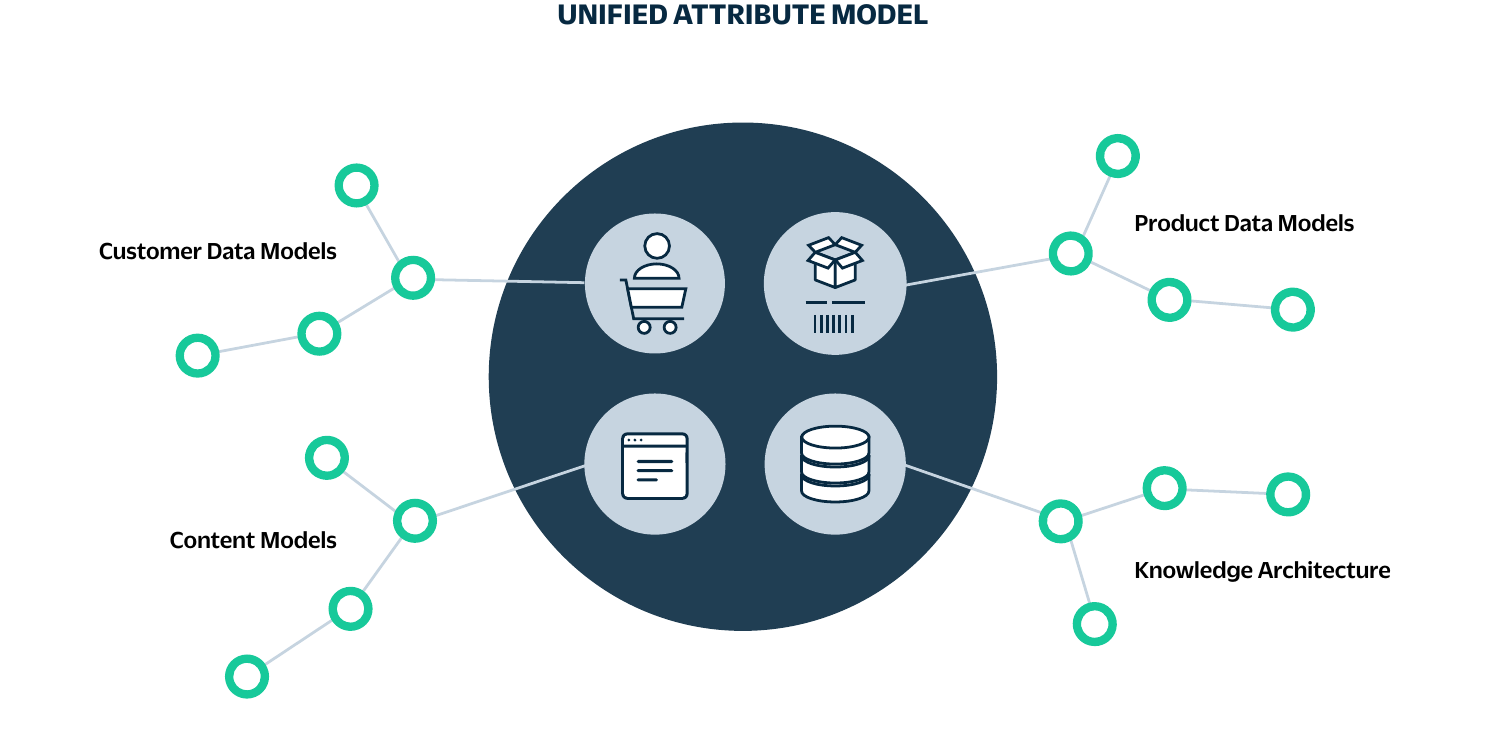
The Four Domains of the Unified Attribute Framework
Product data models: the foundation of findability
Product attributes define what a product is, what it does, and how it compares to alternatives. When product attributes are consistent and complete, products are findable on-site, in marketplaces, and across channels. When they are missing or inconsistent, products become invisible, regardless of how good they are.
Key attribute types include:
- Category-specific attributes, for example torque and power source for power tools.
- Competitive parity attributes for marketplace visibility on Amazon, Google, and B2B platforms.
- Differentiation attributes that highlight unique features and curated bundles.
Customer data models: understanding who you are serving
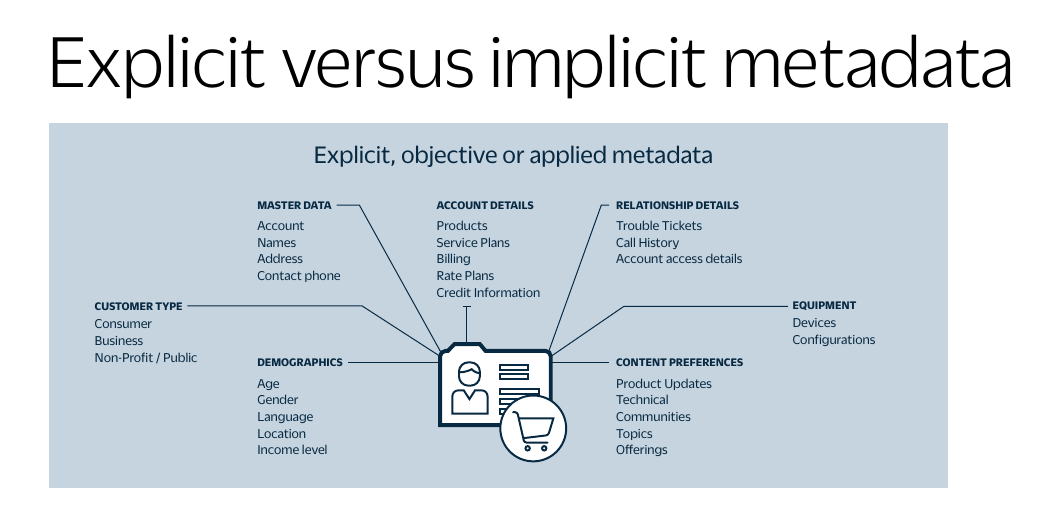
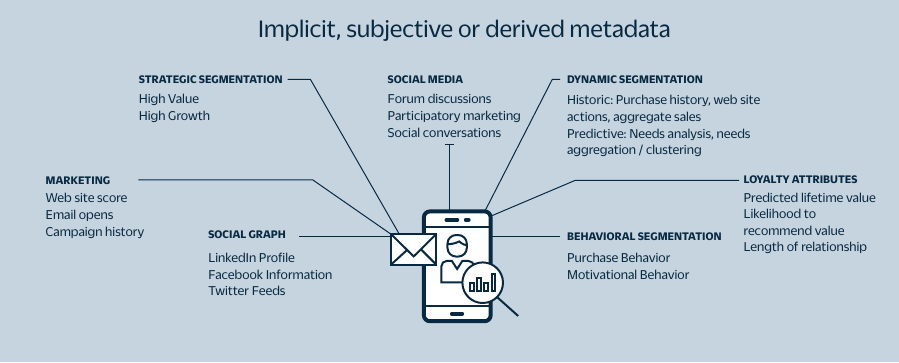
Customers can be described with two broad categories of attributes.
Explicit and objective attributes include demographics, account type, purchase history, industry, and role. These are collected directly through CRM, ERP, and order management systems.
Implicit and derived attributes include predicted lifetime value, behavioral segmentation, loyalty signals, and motivational patterns. These are calculated from behavioral and social data using analytics and machine learning.
Together these create a 360-degree view of the customer that can be used to tailor every touchpoint across the journey.
Content models: supporting the purchase at every stage
Content is not just marketing copy. It includes how-to videos, product specifications, troubleshooting guides, reviews, and support materials. When content is modeled with the same attributes used to describe products and customers, it can be surfaced in context, at the right stage of the journey, for the right customer type, in the right channel.
Content without a model becomes invisible too. The goal is a content architecture aligned to use cases, with enough detail to support the purchase without overwhelming the user.
Knowledge architecture: the hidden differentiator
Knowledge is often the most overlooked domain. It lives in the heads of sales engineers, merchandisers, and support specialists. It answers questions like which product solves this application, or what is the right configuration for this environment. When knowledge is captured, structured, and made retrievable, it becomes a competitive differentiator. This is especially true in B2B contexts with hundreds of thousands of products and applications.
Taxonomies, Metadata, and the Is-ness and About-ness Model
What metadata really does
Metadata describes two fundamental things about any piece of information: what it is, meaning its type, format, and classification, and what it is about, meaning its topic, audience, and relevance. A well-designed metadata model answers both questions consistently across all systems.
Why consistent attribute naming matters
If one system calls a field "brand" and another calls it "manufacturer," comparisons break down. If one product is dimensioned in inches and another in centimeters, filtering fails. Attribute consistency is not a technical nicety. It is the prerequisite for search, browse, comparison, and personalization to work at all.
Category-specific vs. cross-category attributes
Some attributes apply universally, including brand, price, and availability. Others are category-specific, such as thread count for bedding or torque for power tools. A third type, merchandising attributes, cuts across categories to support curated collections, themed shops, and event-based promotions. Understanding which type of attribute you are working with determines how it should be modeled and governed.
The Five-Stage Framework for Unified Commerce
Deploying a unified attribute framework is not a one-time project. It is a phased, iterative process. The five stages below describe the journey from initial research to continuous optimization.
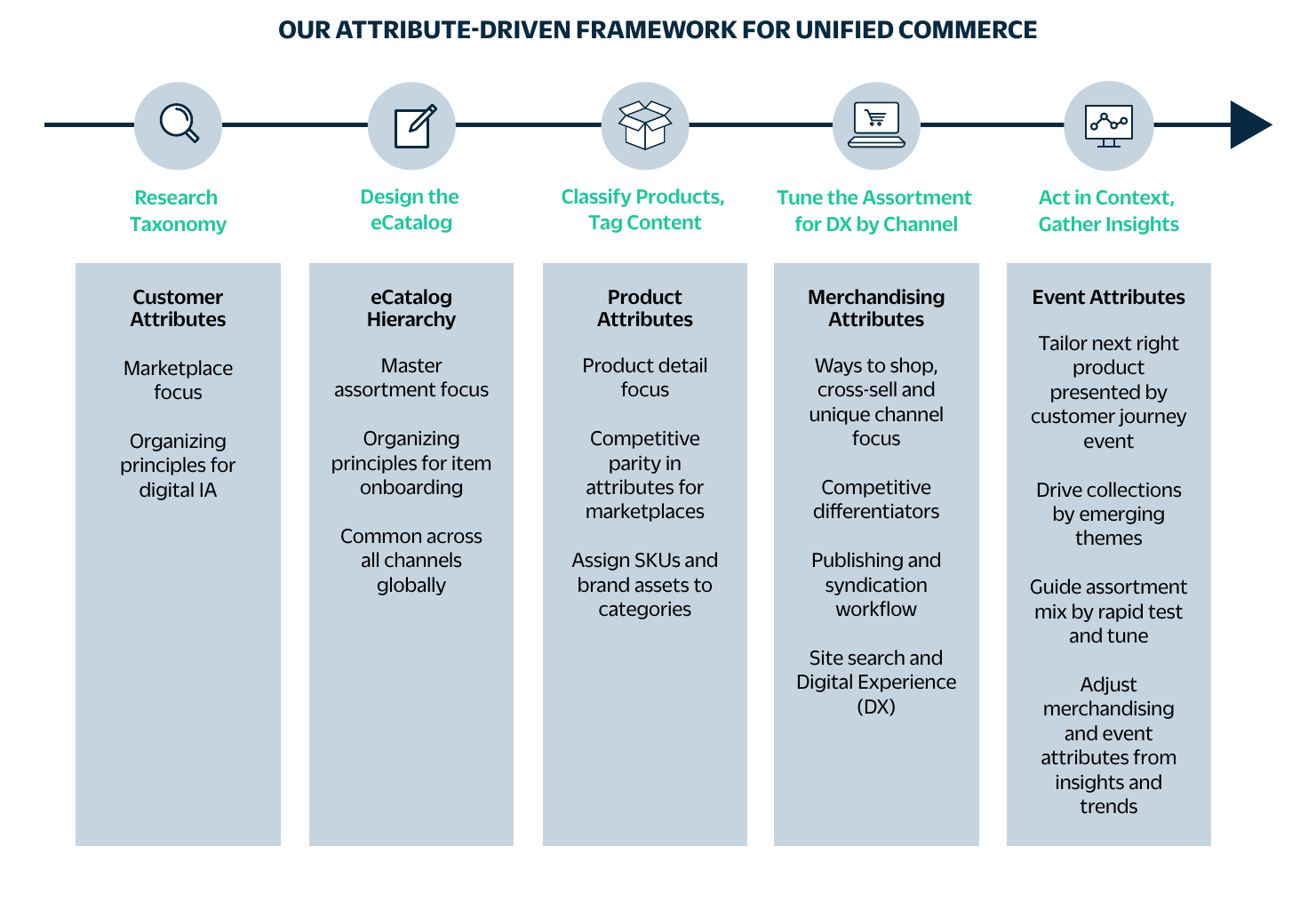
Stage 1: Research and identify customer attributes
Before designing any attribute model, organizations must understand their customers: who they are, how they buy, what they need at each stage of the journey, and what signals predict conversion. Customer personas and journey maps provide the organizing principles. Research surfaces the attributes, including industry, role, behavior, and preferences, that can be used to segment, personalize, and serve.
Stage 2: Design the eCatalog and assortment hierarchy
The eCatalog is the master assortment: every product or service the organization offers, organized into a hierarchy that reflects customer mental models and item-onboarding requirements. This hierarchy is the backbone of all downstream attribute work and must be common across all channels, digital and physical.
Stage 3: Classify products and tag content
With the catalog structure in place, products are classified into the hierarchy and tagged with product attributes. Content is tagged in parallel, using the same attribute vocabulary so that supporting materials can be associated with the right products, audiences, and journey stages. This is also when SKUs and brand assets are assigned and product IDs are linked back to the eCatalog for cross-channel findability.
Stage 4: Tune the assortment for digital experience by channel
Once the base catalog and attributes are in place, merchandising attributes layer on top to enable channel-specific presentation: ways to shop, cross-sell and up-sell relationships, curated collections, and search and navigation optimization. Different channels, including mobile app, website, in-store kiosk, and B2B portal, may require different tuning, different facets, and different assortment mixes.
Stage 5: Act in context and gather insights
Event attributes are the final layer. They connect customer journey events, such as a seasonal trigger, a loyalty milestone, or a browse pattern, to specific offers, content, and assortments. The feedback loop from customer engagement analytics then informs continuous refinement: what works, what does not, what to expand, and what to retire.
Merchandising Attributes: Powering Collections and Curated Experiences
How merchandising attributes differ from product attributes
Product attributes describe what something is. Merchandising attributes describe how it should be presented and to whom. A natural products collection might cut across pet food, bedding, grooming, and toys, united by a shared merchandising tag rather than a shared product category.
Event attributes and the next right product
Event attributes respond to customer journey signals: seasonal events, purchase triggers, behavioral patterns, and loyalty thresholds. They drive dynamic collections that can be launched and retired without touching the back-end catalog, meaning marketing teams can test and tune offers rapidly with minimal IT overhead.
Case study: natural products collection for a pet care retailer
Earley Information Science helped a national pet care retailer build a themed merchandising collection around natural products. The approach involved tagging existing PIM inventory with natural, organic, and hypoallergenic attributes; creating a new product hierarchy for the natural dog and cat category; building navigation facets specific to the collection; and aligning site search and SEO to surface the collection for relevant queries.
The result was a differentiated, shoppable experience layered on top of the existing catalog infrastructure, without disrupting core catalog processes.
Merchandising and event attributes can be applied without disturbing the back-end catalog and with minimum disruption to enterprise systems. Organizations can present unique assortments for particular customer segments, test rapidly, and refine based on real engagement data.
The Customer Journey as the Organizing Principle
Six stages, four data domains
Every stage of the customer journey, from Learn and Choose through Purchase, Use, Maintain, and Recommend, requires different combinations of product data, customer data, optimized content, and knowledge data. A unified attribute framework makes it possible to serve the right combination at the right moment.
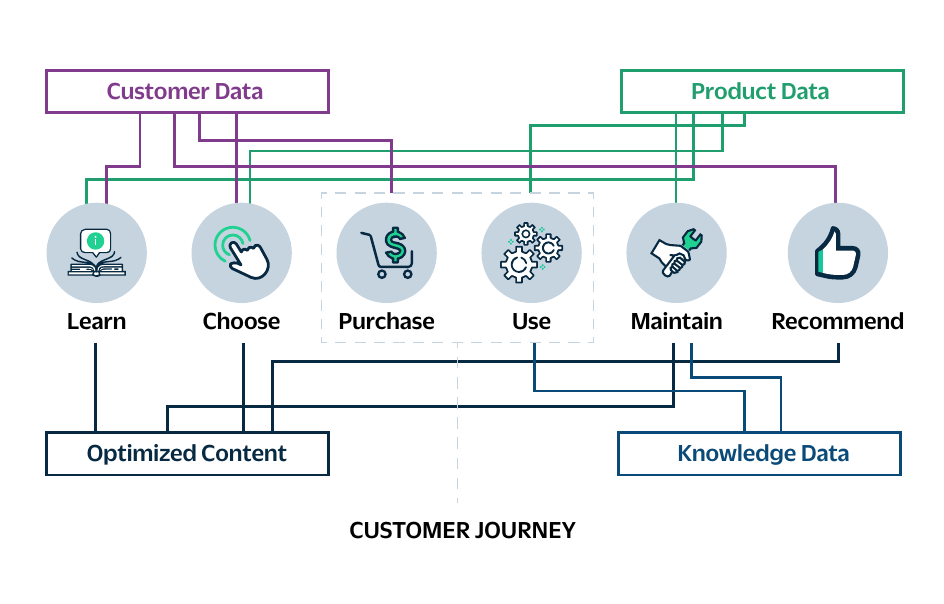
Why B2B makes this harder and more valuable
In B2B environments, the scale of complexity is dramatically higher: hundreds of thousands of products, tens of thousands of applications, multiple buyer roles, and long, multi-touch purchasing cycles. The value of a unified attribute framework scales with this complexity, making it not just a nice-to-have but an operational necessity.
Explicit versus implicit signals across the journey
Early journey stages rely heavily on implicit signals such as behavioral patterns, search terms, and referral source. Later stages rely more on explicit signals such as account type, purchase history, and declared preferences. A well-designed customer data model accommodates both, updating dynamically as the customer moves through the journey.
Governance: Keeping the Framework Alive
Why governance is part of the architecture, not an afterthought
Attribute frameworks decay without governance. Products are onboarded with missing fields. Taxonomy terms drift between departments. Customer segments go stale. Governance structures, including business owners per domain, versioning for vocabularies, and QA processes for tagging, are what keep the framework current and trustworthy.
Ownership and accountability by domain
Each data domain, including product, customer, content, and knowledge, needs a designated business owner who is accountable for accuracy, completeness, and currency. Distributed ownership prevents drift and ensures that updates in source systems propagate correctly through the attribute framework.
The upstream processes that govern change
Unified commerce is not static. Products are retired, policies change, new channels launch, and customer behaviors shift. The attribute framework must include upstream governance processes covering how changes are proposed, reviewed, approved, and published across all systems and all channels simultaneously.
Conclusion: Personalization Demands a Paved Road
Without a unified attribute framework, advanced digital experience technologies underperform. The data foundation determines what personalization is actually possible, not the sophistication of the recommendation engine on top of it.
Organizations that invest in harmonized attributes across product, customer, content, and knowledge domains will be positioned to lead. Those that do not will always be scrambling to catch up. Personalized and predictive experiences are raising the bar for every online player. Paving the way with unified attributes will unleash the power of personalization and deliver a state-of-the-industry customer experience.
Glossary: Key Terms in Unified Commerce and Attribute Design
Unified Attribute Framework
A shared set of descriptors applied consistently across customer data models, product data models, content models, and knowledge architecture, enabling personalized experiences across channels and touchpoints.
Product Attribute
A descriptor of a product's characteristics such as dimensions, material, or power source. Product attributes enable findability, comparison, and navigation in catalogs and marketplaces.
Merchandising Attribute
An attribute used to create curated collections, themed shops, and cross-category presentations. Distinct from product catalog attributes and not used for standard navigation.
Event Attribute
An attribute that connects customer journey events such as seasonal triggers, behavioral signals, or loyalty milestones to specific offers, products, or content, enabling dynamic and context-driven personalization.
Explicit Metadata
Data collected directly from customers or systems, including demographics, account type, and purchase history. Sourced from CRM, ERP, and order management platforms.
Implicit or Derived Metadata
Data calculated or inferred from behavioral signals, including predicted lifetime value, purchase frequency, and motivational segments. Created through analytics and machine learning applied to observed behavior.
eCatalog
The master assortment hierarchy that organizes all products and services an organization offers, structured to support item onboarding, cross-channel presentation, and attribute assignment.
Taxonomy
A hierarchical classification system that organizes products, content, or knowledge into categories. The organizing backbone of the eCatalog and a prerequisite for consistent attribute assignment.
Content Model
A structured definition of what content types exist, what attributes describe them, and how they relate to products, customers, and journey stages, enabling content to be served in context.
Knowledge Architecture
The structured representation of organizational expertise including answers, advice, configurations, and solutions, made retrievable and attributable so it can be surfaced at the right point in the customer journey.
Unified Commerce
An approach to commerce that aligns customer data, product data, content, and knowledge under a shared attribute framework, enabling consistent, personalized, and measurable experiences across all channels.