
Consumer-Focused Digital Agility
Four key agility levers that drive more engaging and profitable relationships with consumers
From retailers through consumer goods manufacturers of all kinds, companies are facing increasing complexity in selling while time-to-market windows are shrinking. Fashion cycles that once played out over seasons now come and go in weeks online. Consumer demand for curated collections across multiple channels, including social, further complicates the merchandising and promotional process.
Consumers are now always on, shopping at many times and places. They expect a highly adaptive, cohesive brand experience on phone, tablet, and website, and increasingly look for integrated mobile and in-store shopping. In today's competitive environment, retailers must also become highly agile to win share of wallet.
Digital Complexity and Time-to-Market Pressures Are Increasing
Online and mobile have moved well beyond a small revenue channel of convenience. They are now a key strategy to complement and boost in-store sales revenue, with digital outpacing physical retail growth by a wide margin. In the face of these pressures, retailers and consumer goods companies must adapt to new buying behaviors, new selling paradigms, and rapidly changing expectations from sophisticated consumers.
Challenges start with demands across every touchpoint
Sophisticated consumers require equally sophisticated marketing, product, and content information architecture and digital design techniques at every touchpoint. The TouchPoint Hit List below shows the top cross-channel capabilities for turning consumers into shoppers.
- Merchandise simultaneously across touchpoints
- Market product collections across touchpoints
- Promote with an emphasis on digital images
- Leverage mobile shopping in-store
- Ensure navigation, search, labeling, and filtering are complementary across touchpoints
- Attribute responses considering all touchpoints
- Drive the cart from one touchpoint to another
Customer TouchPoint Agility is the new front for competition. Battles are being won and lost on cross-channel adaptability.
Challenges are made harder by fragmented content, commerce, and provider systems
Most retailers are now dealing with a patchwork quilt of systems and providers pieced together to support digital merchandising. New technologies, platforms, and providers have emerged for new channels, mobile solutions, and digital promotion. Separate product information, content, and digital asset management systems are often pushed beyond their limits.
Together these point solutions force workflow operations into a complex process through which a new offer must be quickly coordinated and promoted. That complexity makes it hard for digital marketing teams to find the right content and assets, collaborate on cross-channel product organization, and keep up with a growing backlog of changes.
System and provider fragmentation has a very real cost:
- It can take months to prepare channels with content, new product attributes, and optimized navigation and search to launch a new product line
- Differences between systems often force changes to be manually cross-mapped, coordinated, entered, and tested, further increasing time-to-market and error rates
- Lack of consistent organizing principles across systems means that marketing teams often simply recreate content and digital assets, increasing cost
Simply put, it is too hard, takes too long, and is too costly to keep pace with more nimble startups and streamlined eTailers by relying on manual integration efforts alone.
The Four Key Digital Agility Levers
At EIS, we see agility as a journey toward competitive advantage. Each business has opportunities to push ahead in one or more of the four major levers to Consumer-Focused Digital Agility.
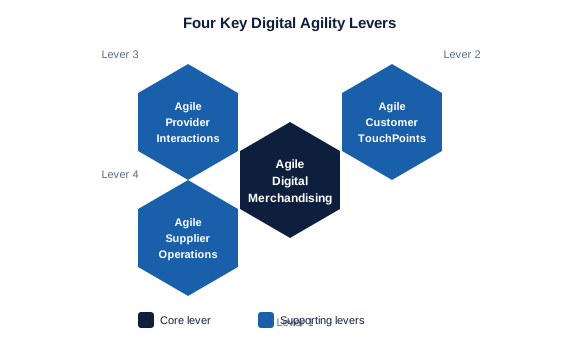
Figure 1: The four key digital agility levers
Lever 1: Agile Digital Merchandising
The rapid pace of competition demands Agile Digital Merchandising: the ability to launch new products and promotions in weeks, not months. Agile merchandisers receive product data, content, and digital assets, create branded collateral and curated collections, and publish across channels quickly and efficiently.
Lever 2: Agile Customer TouchPoints
TouchPoint agility is the ability to rapidly provide a superior, consistent, personalized experience across all customer touchpoints, adapted appropriately from website through mobile, sales associates, and contact centers. Customers want a unified shopping experience any time and everywhere.
Lever 3: Agile Provider Interactions
Working effectively with digital agencies, remote content teams, mobile commerce providers, couponing vendors, recommendations providers, social commerce platforms, and more requires Agile Provider Interactions. As a retailer or consumer goods company, you must connect with your promotional partners in a streamlined workflow, synchronizing product hierarchies and attributes and combining subsets of pre-tagged content and brand assets to drive total Customer Experience Management.
Lever 4: Agile Supplier Operations
Ensuring high-fidelity product attribute and content quality without sacrificing time-to-market requires Agile Supplier Operations. As a retailer, you must transform every product feed into branded content optimized for product findability in multiple channels. As a consumer goods company, you must quickly deploy new product lines with related content and assets to every retailer and distribution channel you supply. The best organizations can integrate a new product line or vendor in weeks, with stand-out content quality, product filtering, navigation, and search.
Making Real Progress Without Breaking the Bank
Can you get something done for the next season without taking too long to see real business impact? In almost every case, the answer is yes. It is entirely possible to move forward, become more agile, and master the complexity to compete at digital speed.
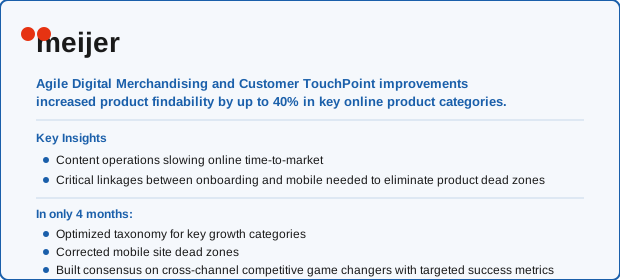
Seeing Tangible Business Benefits Before Your Next Season
Digital Information Architecture (IA) Agility solutions are a thin organizing layer of product taxonomy, content, and process management that complements and simplifies content, commerce, and provider systems while driving product findability.
If you are not sure where to start, begin with the EIS Digital Agility Roadmap. This diagnostic tool consists of a quick 4 to 6 week analysis of critical aspects of your go-to-market process. The resulting roadmap sets realistic priorities and outlines a solid, defensible, achievable business case to build internal momentum. We often identify recommendations that you can start on immediately, resulting in quick-win improvements very early in your broader Digital IA program.
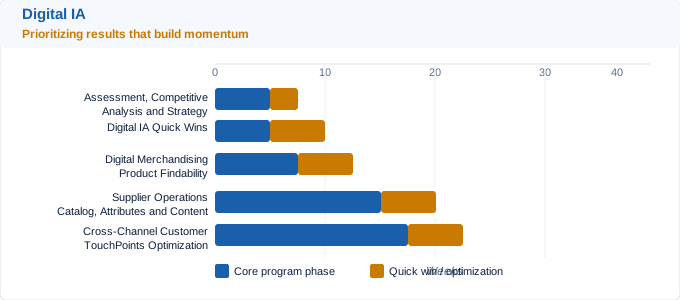
Figure 2: Digital IA roadmap -- prioritizing results that build momentum
EIS programs are coordinated in optimization stages, and changes are introduced to build on quick wins as you gain efficiencies. Stages are designed to complete within 90 to 120 days to stabilize operations and gain benefits quickly. For more advanced retailers, EIS also offers a program for mastering product attributes across all agility levers. Digital IA agility deployments typically happen in 4 to 6 months at very reasonable cost.
