
By Seth Earley, Founder & CEO, Earley Information Science
────────────────────────────────────
Published: August 2026 | Article 1 of 10 in the *Scaling GenAI* Series
Last Updated: August 2026 | Version 1.1
────────────────────────────────────
Who This Is For: C-suite executives, VP/Directors of Digital Transformation, AI/ML leaders, and Enterprise Architects responsible for scaling GenAI initiatives beyond pilot stage. Also valuable for KM leaders and Chief Data Officers tasked with enabling AI-ready content infrastructure.
Prerequisites: Basic familiarity with GenAI concepts and enterprise AI pilot projects.
────────────────────────────────────
Your AI pilot worked. The board approved expansion. And then the initiative stalled.
Across large organizations, this pattern has become consistent enough to deserve its own name: the Pilot Paradox. The very conditions that make a proof of concept succeed are the conditions that make enterprise deployment fail. The pilot didn't just succeed despite limited scope — it succeeded because of it. And therein lies the problem.
Research from Harvard Business Review Analytic Services puts a number on the blind spot. When surveyed about barriers to implementing generative AI, enterprise decision-makers ranked the inability to access and leverage data last among fourteen obstacles — cited by only 16% of respondents. Yet once those same organizations attempted to scale, 39% identified data issues as their top challenge. The barrier was invisible until they walked into it.
This article examines why the gap between pilot and production is not a linear increase in effort but an exponential increase in coordination complexity — and what that means for how organizations need to plan and invest in AI.
Why Pilots Succeed by Avoiding Enterprise Reality
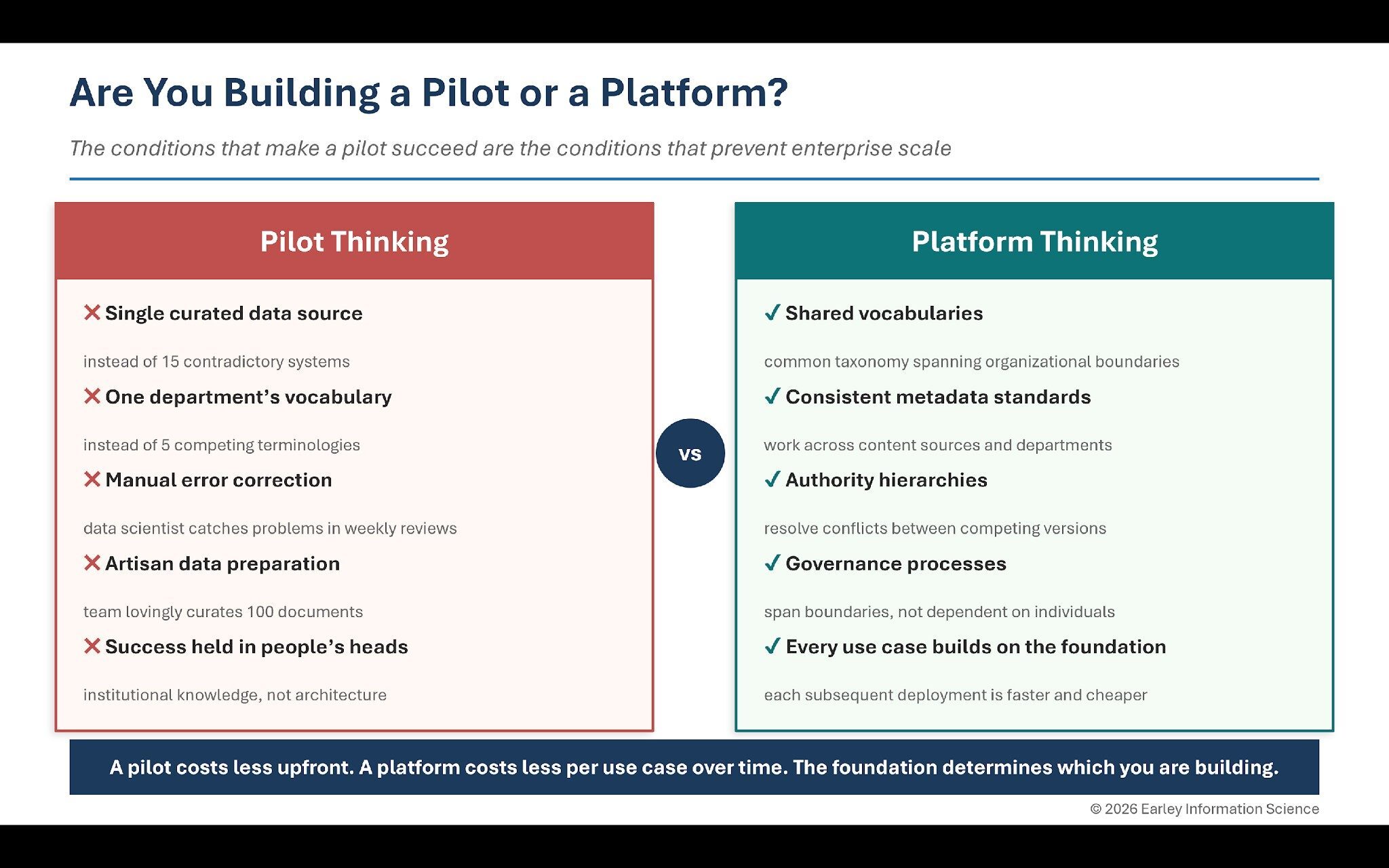
Every successful proof of concept operates under conditions that exist nowhere else in the organization. A single curated data source instead of fifteen contradictory systems. One department's shared vocabulary instead of five competing terminologies. A skilled data team quietly correcting errors that automated processes would need to handle at scale across millions of queries. Success metrics defined by one stakeholder group rather than contested across ten.
The pilot succeeds because humans are compensating for missing infrastructure — and doing so invisibly. A data scientist spends forty hours cleaning a hundred documents. A subject matter expert catches wrong answers in weekly reviews. Everyone uses the same terminology because they sit in the same room. None of this scales, and none of it shows up in the pilot's cost model.
The standard guidance for technology implementation is to start small, get a quick win, then scale up. The problem with this advice is that scaling up is not a larger version of the pilot. It is a structurally different category of problem.
The Integration Math: Why Complexity Multiplies
Most leaders assume scaling is roughly proportional: if a system works for fifty users in one department, multiplying resources should serve five thousand users across ten departments. This assumption treats each dimension of growth — more departments, more use cases, more content sources, more users — as independent. In practice, these dimensions interact multiplicatively.
A typical pilot involves one department, two use cases, two content sources, and fifty users. A typical enterprise deployment involves ten departments, twenty-five use cases, twenty content sources, and five thousand users. Each individual dimension grows by roughly an order of magnitude. If growth were additive, the enterprise deployment would require ten to a hundred times the resources. That is what most planning budgets assume. The actual complexity is not in the individual dimensions — it is in the connections between them.
Cross-department alignment — reconciling terminology, taxonomy, and governance priorities across organizational units — grows as a combinatorial function. One department requires zero alignment challenges. Five departments require ten. Ten departments require forty-five. Content source integration follows the same pattern: two sources require one schema mapping; twenty sources require up to 190 potential schema conflicts. Use case and content source combinations multiply further. Even with 40% relevance overlap, which is typical in enterprise environments, twenty-five use cases across twenty content sources produce roughly two hundred integration points. Governance touchpoints — approval workflows, ownership boundaries, escalation paths — add another hundred or more.
The arithmetic is striking. A pilot with one department, two use cases, and two content sources has roughly seven integration points to manage. An enterprise deployment with ten departments, twenty-five use cases, and twenty content sources has five hundred or more. That is a seventy-fold increase in coordination complexity before accounting for the hundred-fold increase in users.
Why This Changes the Planning Calculus
The pilot succeeded because one team could hold all seven integration points in their heads. At enterprise scale, that institutional knowledge must be embedded in architecture, governance, and process — or the system collapses under its own weight.
This is why proportional resource scaling does not work. A combinatorial coordination problem cannot be solved by hiring more people. It can only be solved by building the infrastructure that makes coordination manageable: shared vocabularies that span departmental boundaries, consistent metadata standards that work across content sources, and authority hierarchies that resolve conflicts when different systems produce different answers. This is the coordination layer that transforms a collection of departmental tools into an enterprise capability.
The Blind Spot: Why Organizations Don't See It Coming
The research finding is instructive precisely because it is so consistent. More than half of the organizations surveyed rated their data foundation readiness below the midpoint of a ten-point scale. Yet before attempting to scale, they did not view data quality as a meaningful obstacle.
The explanation is structural. During the pilot, manual curation masks data quality problems. The team compensates for missing infrastructure without recognizing that compensation as a cost. When that compensation must scale, the cost becomes visible — but by then the organization has committed budget, set stakeholder expectations, and made promises based on pilot performance that assumed conditions which no longer exist.
This is not a failure of due diligence in the conventional sense. It is a failure of the mental model that treats enterprise AI deployment as a linear extension of a successful proof of concept. The pilot and the enterprise deployment are different categories of problem, not different sizes of the same one.
What Successful Organizations Do Differently
The organizations that navigate this transition effectively share a common characteristic: they plan for integration complexity from the beginning rather than after it surfaces.
Before expanding beyond a single department, they invest in shared infrastructure — a common taxonomy that spans departmental boundaries, metadata standards that work across content sources, and authority hierarchies that resolve conflicts between competing versions of the same information. This coordination layer is what makes subsequent deployments faster and cheaper rather than progressively more expensive.
They also build feedback and error-correction processes before deployment rather than after the first crisis. Every AI system will produce errors. The question is whether those errors get detected, diagnosed, and corrected systematically, or whether they accumulate until users lose confidence in the system entirely.
Perhaps most importantly, they distinguish between the technology layer and the content infrastructure layer. Models, embeddings, and vector databases evolve rapidly and costs decline over time. Metadata, taxonomy, content models, and authority structures compound in value. Every use case built on a shared content foundation is faster and cheaper than the first. Organizations that recognize this invest in the foundation as a platform rather than treating each AI initiative as an independent project with its own data handling.
The Question That Reframes the Investment
The question most organizations ask when a pilot succeeds is: how do we scale this? The more useful question is: are we building a pilot or a platform?
A pilot solves one problem in one department with manual curation and institutional knowledge held by individuals. A platform builds the integration infrastructure that makes every subsequent use case faster, cheaper, and more reliable. The pilot costs less upfront. The platform costs less per use case over time — and is the only approach that remains viable as integration complexity grows.
At seven integration points, manual coordination works. At five hundred, only architecture works. The foundation built today determines which answer applies to the organization tomorrow.
Frequently Asked Questions
What is the Pilot Paradox in GenAI?
The Pilot Paradox is a phenomenon identified by Seth Earley where GenAI pilots succeed because humans compensate for missing infrastructure, while enterprise scale fails because humans cannot scale. It explains why approximately 95% of GenAI projects stall when attempting to move beyond pilot stage.
Why do GenAI pilots succeed but fail at scale?
GenAI pilots succeed because humans manually compensate for missing infrastructure — data scientists clean documents, domain experts review outputs, and team members handle edge cases. At enterprise scale, these human interventions cannot scale to handle 100,000+ documents and thousands of users, exposing the lack of proper content infrastructure, organizational alignment, and operational governance.
What percentage of GenAI projects fail at scale?
According to MIT's 2025 State of AI in Business report, approximately 95% of GenAI projects stall when attempting to scale beyond pilot. Gartner has predicted that 30% of generative AI projects will be abandoned after proof of concept by end of 2025.
What is invisible scaffolding in GenAI projects?
Invisible scaffolding refers to the hidden human effort that makes GenAI pilots work but doesn't exist at enterprise scale. This includes data scientists spending 40+ hours cleaning documents, manual review of AI outputs, subject matter experts handling edge cases, and team members acting as translation layers between systems.
What is the scaling multiplier problem?
The scaling multiplier means GenAI isn't 10x harder at scale, it's 10 × 10 × 10 harder. Each new department adds new vocabulary, processes, and politics. Each new use case adds new metadata requirements and quality standards. Each new system adds new integrations, data formats, and governance requirements. The complexity multiplies rather than adds.
What are the Three Pillars of Scalable GenAI?
The Three Pillars of Scalable GenAI, a framework developed by Seth Earley at Earley Information Science, identifies three foundational elements required for enterprise AI success: Content Infrastructure, structured and reusable content with metadata serving both humans and AI; Organizational Alignment, cross-functional stakeholder buy-in with clear roles and shared understanding; and Operational Governance, sustainable content ops processes with feedback loops for continuous improvement.
What is Content Infrastructure in the Three Pillars framework?
Content Infrastructure, the first pillar of scalable GenAI, includes structured, reusable content components, metadata that serves both humans and AI, and taxonomy that flexes across use cases. Without content infrastructure, AI cannot find the right answers because content is unstructured, unlabeled, and siloed.
What is Organizational Alignment in the Three Pillars framework?
Organizational Alignment, the second pillar of scalable GenAI, includes cross-functional stakeholder buy-in, clear roles and responsibilities, and shared understanding of what "good" looks like across departments. Without organizational alignment, projects get stuck in committee as different stakeholders pull in different directions.
What is Operational Governance in the Three Pillars framework?
Operational Governance, the third pillar of scalable GenAI, includes sustainable content ops processes, quality assurance workflows, and feedback loops for continuous improvement. Without operational governance, systems decay immediately after launch because there's no mechanism to maintain quality or incorporate learnings.
Can you scale technology faster than organization and process?
No. According to Seth Earley's Three Pillars framework, you cannot scale technology faster than you can scale organization and process. Technology is the easy part; the limiting factor is building the content infrastructure, organizational alignment, and operational governance that enable technology to function at enterprise scale.
How does content volume change from pilot to enterprise scale?
In pilot, you typically work with 100 clean, curated documents. At enterprise scale, you face 100,000+ messy files scattered across 12 or more systems. This is a 1,000x increase in volume with a significant decrease in quality and consistency.
How does user count change from pilot to enterprise scale?
Pilot deployments typically serve 10-50 users. Enterprise scale requires supporting 1,000-10,000 users, representing a 100-200x scaling factor with vastly different user needs and expectations.
How do use cases change from pilot to enterprise scale?
Pilot deployments focus on 1-2 carefully selected use cases. Enterprise scale must support 20-100+ different use cases across multiple departments, each with unique requirements for accuracy, speed, and content coverage.
How does content ownership change from pilot to enterprise?
In pilot, there's typically one content owner with full control and accountability. At enterprise scale, you face 15+ content owners with different priorities, standards, and availability, making coordination exponentially more difficult.
How does terminology change from pilot to enterprise scale?
In pilot, a single department uses consistent terminology. At enterprise scale, five different departments may have five different names for the same concept, creating retrieval problems and conflicting AI responses.
How do success metrics change from pilot to enterprise?
In pilot, success metrics are clear and agreed upon by a small team. At enterprise scale, success means different things to different stakeholder groups: executives want ROI, IT wants uptime, legal wants compliance, users want accuracy.
How do edge cases change from pilot to enterprise?
In pilot, edge cases are manageable and can be handled manually. At enterprise scale, edge cases become the norm; the variety of queries, content gaps, and unusual situations exceeds any team's capacity to handle manually.
What is the manual curation trap in GenAI pilots?
In pilot, data science teams often spend 40+ hours cleaning and curating 100 documents to achieve good results. At enterprise scale, nobody can curate 100,000 documents manually, resulting in "garbage in, garbage out" when the uncurated content is fed to AI systems.
What is the single source of truth illusion?
In pilot, teams often rely on a single authoritative source like "the product manual." At enterprise scale, the product manual contradicts the support knowledge base, which contradicts sales collateral, which contradicts training materials, resulting in AI giving three different answers to the same question.
What is the implicit knowledge problem in GenAI scaling?
In pilot, when AI gives a wrong answer, someone notices and manually fixes it. At enterprise scale, who catches the 1,000 wrong answers per day? There's no human capacity to review all outputs, leading to trust erosion as errors accumulate undetected.
What is the department-specific language problem?
In pilot, everyone speaks the same departmental language. At enterprise scale, Sales, Support, Engineering, and Legal all use different terms for the same concepts. AI can't connect related information when content is tagged with inconsistent terminology.
What happens without feedback loops at scale?
In pilot, weekly check-ins enable rapid iteration based on user feedback. At enterprise scale without formal feedback loops, there's no systematic way to know what's broken. The result is slow decay and frustrated users who stop using the system.
What roles does a human play in a successful GenAI pilot?
Every successful GenAI pilot has humans playing the role of content curator, quality reviewer, edge case handler, and translation layer between systems. At enterprise scale, infrastructure must replace these human roles because individuals cannot scale to handle the volume.
How do I know if my GenAI pilot has invisible scaffolding?
Ask: "What would break if [key person] went on vacation for a month?" If the answer involves data quality declining, wrong answers going undetected, or content not being updated, you have invisible scaffolding that won't survive enterprise scale.
What questions should I ask before scaling a GenAI pilot?
Before scaling, ask: Who will curate 100,000 documents? How will we detect wrong answers at scale? Who resolves conflicts between content sources? How will we handle five departments with different terminology? What's the feedback mechanism for continuous improvement?
Is my GenAI pilot success real or artificial?
Pilot success may be artificial if it depends on manual data curation, single-source content, human review of outputs, homogeneous user base, or informal feedback channels. Real success requires infrastructure that can operate without constant human intervention.
What does Gartner predict about GenAI project abandonment?
Gartner predicts that 30% of generative AI projects will be abandoned after proof of concept by end of 2025, reflecting the challenge of moving from successful pilots to enterprise deployment.
What percentage of companies abandoned AI initiatives in 2025?
According to industry reports, 42% of companies abandoned most of their AI initiatives in 2025, a significant increase from 17% in 2024, indicating growing recognition of the pilot-to-scale challenge.
What's the first step to avoid the Pilot Paradox?
The first step is acknowledging that pilot success doesn't guarantee scale success. Audit your pilot to identify every place humans are compensating for missing infrastructure, then build plans to replace those human interventions with sustainable systems.
How long does it take to build infrastructure for GenAI scale?
Building proper content infrastructure, organizational alignment, and operational governance typically requires 6-12 months before attempting enterprise scale. Organizations that skip this phase often spend longer fixing problems than they would have spent building properly.
What is the integration point explosion?
A pilot with 1 department, 2 use cases, and 2 content sources has roughly 7 integration points to manage. An enterprise deployment with 10 departments, 25 use cases, and 20 content sources has 500+ integration points, a 70x increase in coordination complexity.
How does cross-department alignment complexity grow?
Cross-department alignment grows as n(n-1)/2: 1 department equals 0 alignment challenges; 5 departments equals 10 alignment challenges; 10 departments equals 45 alignment challenges. The complexity grows geometrically, not linearly.
What did HBR research find about data issues in GenAI scaling?
Harvard Business Review Analytic Services research found that 39% of organizations cite data issues as their top challenge once they actually try to scale, yet "inability to access and leverage data" ranked dead last among barriers when surveyed before scaling, cited by only 16% of respondents.
Why don't organizations see the data obstacle before scaling?
Organizations don't see the obstacle because up until they try to scale, they have not operated without the manual curation that made their pilots work, or needed to make the enterprise data consistent across departments.
What do the 5% of successful organizations know?
The organizations that successfully scale GenAI aren't smarter about technology. They're smarter about foundations. They've built the Three Pillars: Content Infrastructure, Organizational Alignment, and Operational Governance.
How does GenAI without context behave?
GenAI without context produces confident nonsense, output that sounds good but is not tied to the content that is truly relevant. The system needs to understand not just what content says, but what kind of content it is, who it's for, when it applies, and how it relates to everything else.
What happens when an employee asks about remote work policy without proper architecture?
Without proper architecture, the AI retrieves anything mentioning "remote work," draft proposals, superseded policies, regional variations, departmental guidelines. It's basically doing a keyword search. The answer sounds authoritative but is operationally useless.
What happens with proper architecture for a remote work policy query?
With proper architecture, the system knows to prioritize approved policies over drafts, surface content relevant to the employee's role and location, and retrieve current rather than historical documents. That's not AI magic, that's metadata doing its job.
What did HBR research find about successful AI adopters?
HBR research found that organizations making progress have done the unglamorous work: publishing clear explanations of how AI is intended to be used (33% of successful adopters vs. 14% of laggards), conducting impact assessments (32% vs. 15%), and establishing cross-functional governance committees.
What is AI-era governance compared to traditional governance?
Traditional governance detects and corrects mistakes through annual reviews and single points of approval. AI-era governance catches and corrects mistakes through continuous monitoring and rapid feedback loops. The critical question is: when AI gives a wrong answer, what happens next?
What is the critical governance question for GenAI?
When AI gives a wrong answer, what happens next? If the answer is "nothing" or "eventually someone notices," your governance is broken. Effective governance assumes imperfection and creates mechanisms to detect, correct, and learn from errors at scale.
What is the metadata paradox?
Too little metadata means AI can't find the right content; too much metadata means content creators abandon the system entirely because it is too complex to maintain. The solution is progressive enhancement.
What is progressive enhancement for metadata?
Day 1: set up 5-7 core metadata fields. Week 1: AI suggests additional metadata for human review. Month 1: AI-based detection of usage patterns auto-generates new relationships. Ongoing: continuous refinement based on performance and human review.
"Why can't you just multiply resources to scale?"
The pilot succeeded because one team could hold all the integration points in their heads. At enterprise scale, that institutional knowledge must be embedded in architecture, governance, and process, or the system collapses under its own complexity.
What happened to the Fortune 500 manufacturer's GenAI pilot?
Their GenAI pilot for technical documentation achieved 91% accuracy with 500 curated documents and 25 test users. When they attempted enterprise rollout across 12 product lines and 8 languages, accuracy dropped to 54%.
What was the root cause of the manufacturer's accuracy drop?
Each product division used different terminology for the same components, and metadata standards varied wildly across legacy documentation systems.
How did the manufacturer fix the accuracy problem?
After a 6-month remediation effort focused on taxonomy alignment and metadata normalization, not AI model improvements, accuracy recovered to 87% at scale. The company estimates this foundation work saved $3.2M in avoided rework and accelerated their global rollout by 9 months.
What choice do organizations face with GenAI?
Organizations can continue treating GenAI as a technology project, deploying point solutions that deliver local value but resist enterprise integration. Or they can invest in the foundation that allows AI capabilities to scale across the enterprise.
What is the flywheel effect of building proper foundations?
Organizations that build the foundation won't just have better AI. They'll have built a flywheel: every subsequent use case becomes easier because the architecture already exists. Their competitors, still trapped in pilot mode, won't be able to catch up.
What course corrections will we see in GenAI?
We're going to see a lot of course corrections in the use of GenAI over the next year. A lot of organizations will be returning to basics, taxonomies, ontologies, knowledge graphs, content curation, because they've finally realized the technology doesn't work without them.
What is the question that matters for GenAI success?
Forget "which AI model should we use?" Ask instead: are we building a pilot or a platform? If you're honest about the answer, you'll know exactly what to do next.
What is the difference between a pilot and a platform?
Pilots are projects with end dates. Platforms are infrastructure that becomes part of how the organization operates, improves continuously, and scales with business.
Read the original version of this article on VKTR.
