
Recruitment shares fundamental characteristics with sales operations. Organizations seek ideal candidates, then persuade them about company value, role opportunities, and compensation packages. AI has already transformed e-commerce, sales, and marketing; similar approaches now apply to talent acquisition with appropriate constraints.
Current recruiting practices remain people-intensive by necessity. Attempting complete automation would be foolish. Humans best understand organizational needs, position requirements, and the judgment necessary to determine cultural fit and candidates' potential to adapt as organizational needs evolve.
However, AI can enhance and add efficiency to numerous aspects of sourcing, screening, matching, pipeline management, onboarding, and skill development processes. The question isn't whether to use AI in recruitment—it's how to apply it where it creates genuine value without undermining what makes recruitment fundamentally human.
Learning from E-Commerce Parallels
Like sales and marketing, hiring operates as a lifecycle. Making AI function in any context requires organizational clarity about objectives—the specific problems being solved. The more organizations know about prospects, the better they can target them effectively.
The employee lifecycle encompasses several distinct stages, each presenting specific opportunities for AI augmentation:
Positioning Opportunities
Getting job descriptions and openings in front of appropriate audiences parallels marketing challenges. Just as AI makes marketing more effective when messages are tailored to right targets, AI can position job openings and customize them for specific target candidates, resulting in higher-quality application pools.
AI systems can programmatically purchase advertising reaching particular demographics, industry segments, and interest profiles. They can adjust phrasing and language in postings to optimize engagement based on real-time response data. They can identify which channels produce best candidates for specific roles and allocate resources accordingly.
This goes beyond simple job board posting. Sophisticated sourcing uses predictive analytics to identify where specific candidate types are most likely to be found, what messaging resonates with them, and what timing maximizes response rates.
Filtering Applications
Even with correct sourcing, candidate screening is labor-intensive and tedious. Basic text analytics tools use pattern matching to identify required skills and education while filtering out applicants who don't meet fundamental requirements. This requires information architecture approaches—defining terminology across skills, experience, education, and related dimensions.
More advanced technologies trained on past successful hires can identify candidates by matching resumes against subtle patterns beyond explicit qualifications. This approach depends on substantial training data—large numbers of resumes representing ideal candidate qualifications along with historical performance information about people with those characteristics.
The key distinction: basic screening eliminates clearly unqualified applicants based on explicit criteria. Advanced screening identifies potentially exceptional candidates based on pattern recognition that might not match traditional qualification checklists.
Assessing Fit
Determining candidate fit for roles requires assessment across multiple dimensions. Various tools address different criteria: behavioral style, communication approaches, risk tolerance, learning capacity and style, technical skills, cognitive abilities. The value lies in understanding how candidates will interact with supervisors, managers, and coworkers, and whether their capabilities align with role nuances, position demands, and team dynamics.
AI compares candidate assessments with reference profiles for job types or with results from past or currently successful people in identical roles. You wouldn't place an introvert in outbound sales or assign a creative problem-solver who resists formalities to positions requiring strict process adherence like auditing or accounting.
Dozens of vendors offer matching tools. Some specialize by industry or specific roles—assessing programmer abilities and style, for example. Others provide more general capabilities across various positions. The sophistication varies considerably, from simple personality assessments to complex multi-dimensional evaluations.
Managing Pipeline Flow
Just as sales organizations manage prospect pipelines, recruiting organizations manage talent pipelines. Retaining interview results, assessment data, and communication history proves important because great candidates may be interested when timing isn't right.
Candidates compare opportunities partly based on how they're treated during processes. Negative experiences impact not only whether they accept positions but how they describe experiences to peers, colleagues, and broader markets. This word-of-mouth effect can significantly damage employer brand over time.
Improving candidate experience requires acknowledging application receipt and promptly communicating status updates. This includes answering routine questions and managing interview and assessment logistics. AI tools can partially automate these tasks. Chatbots can provide routine answers, though they require thorough testing and must include escalation paths to humans when complexity exceeds their capabilities.
Pipeline management systems track candidates across multiple touchpoints, identifying when follow-up is needed and suggesting appropriate communications. They can prevent candidates from falling through cracks that occur in manual tracking systems.
Supporting Development
AI can enhance job satisfaction and retention even after recruitment completes and candidates transition to hiring managers. Tools that assess and predict job skills and success can also identify knowledge and skill gaps. Customized e-learning programs address those gaps, and AI tools support on-the-job training.
Call centers use AI simulations to train new representatives in safe environments where mistakes don't affect actual customers. Helper bots provide real-time answers for new workers navigating complex systems or processes. AI-powered knowledge tools that better leverage organizational expertise increase job satisfaction and retention by making information accessible when needed.
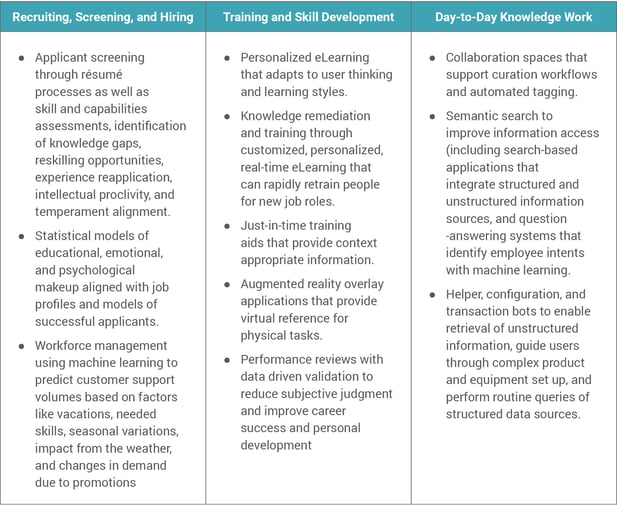
Three Application Domains
Three Broad Areas of Application for AI-Powered HR Processes
Selecting AI Tools Effectively
Some benefits are relatively straightforward to attain and can be part of packaged software from vendors with proven track records. Others require more due diligence, greater complexity, and may be less mature in the marketplace. Five considerations prove essential when evaluating AI technologies for recruitment:
Demand Business Clarity
AI isn't magic. It must be understandable from business perspective. If vendors' explanations include "that's proprietary" or "our algorithm handles that automatically" without explanation of inputs and outputs, push for more concrete answers.
Understanding how systems work doesn't require knowing implementation details. It requires knowing what data they use, what assumptions they make, what outputs they produce, and what limitations constrain their application. Vendors should be able to explain this clearly to non-technical audiences.
Start with Problems, Not Tools
Understand the specific problem you're trying to solve using AI. Don't start with tools and search for problems. Begin with business challenges and describe them as specifically as possible.
It helps to map processes and use cases that AI will support. You can't automate what you don't understand, and you can't automate dysfunction. Have vendors demonstrate your scenarios and use cases rather than their generic examples. Their demonstrations may look impressive, but the relevant question is whether their tools address your actual problems with your actual data.
Establish Success Metrics
Define what parts of processes will improve and what baseline measures currently exist. Consider what gets measured today and ensure stakeholders understand and trust those measures and any promised improvements. If people don't trust baselines, they won't trust reported improvements.
This also reveals whether you have measurement infrastructure necessary to validate AI impact. Many organizations discover they can't actually measure what they thought they were measuring, forcing them to establish proper metrics before they can evaluate AI effectiveness.
Verify Bias Mitigation
Ask AI vendors how they developed their models and validated their data. You want awareness of potential biases that could cause AI to misinterpret candidate qualifications or inadvertently screen out or bias results for particular demographics or use cases.
If data sources vendors used to build their tools don't match diversity or demographics of your targets, that can introduce unintended bias. Historical hiring patterns may reflect past discrimination that AI will learn to replicate rather than correct. This isn't hypothetical concern—multiple high-profile cases have documented AI systems perpetuating or amplifying bias.
Validate with Real Data
For advanced engagement, training, and talent management applications, good quality data is critical. Identify data sources and test vendor solutions using your data and use cases, not sanitized demonstration datasets.
Production data contains gaps, inconsistencies, and edge cases that clean demonstration data doesn't reveal. Testing with real data exposes problems before production deployment when they're less expensive to address.
Maintaining Human Centrality
Recruitment and talent acquisition is fundamentally human endeavor. The nuances of human engagement depend on interactions with people. AI supports people; it doesn't replace them.
This isn't merely philosophical position—it's practical reality. AI excels at pattern matching, consistency, and processing large volumes. Humans excel at judgment, context understanding, and adapting to novel situations. Successful recruitment requires both.
The most effective recruitment operations use AI to handle tasks where it has advantages—screening large application volumes, identifying subtle patterns in qualifications, maintaining consistent communication cadence—while preserving human involvement for tasks requiring judgment—assessing cultural fit, evaluating growth potential, making final hiring decisions.
This hybrid approach produces better outcomes than either pure automation or pure manual processes. It enables HR teams to focus time and attention where human judgment creates most value rather than spending energy on mechanical tasks that machines handle more effectively.
Implementation Considerations
Organizations implementing AI in recruitment should proceed systematically. Start with narrow applications where success can be demonstrated clearly—perhaps automating initial resume screening or managing routine candidate communications.
Build capability incrementally based on demonstrated value rather than ambitious roadmaps based on hoped-for results. Each successful implementation provides foundation for next capability while building organizational confidence in AI applications.
Invest in proper data foundations before expecting AI to deliver results. AI cannot fix fundamental data quality problems or compensate for poorly defined processes. Organizations must establish clear definitions, consistent terminology, and adequate data capture before AI can function effectively.
Monitor for unintended consequences, particularly around bias. Regular audits of AI decisions compared to human decisions reveal where systems may be introducing problematic patterns. Establish clear escalation paths for situations AI cannot handle appropriately.
The Path Forward
Embracing AI-powered HR tools brings new efficiencies to recruitment processes, improves candidate quality, and helps candidates remain satisfied and stay with organizations longer—especially when taking lifecycle approach and applying AI appropriately at each stage.
But success requires discipline. Organizations must be clear about objectives, honest about capabilities, vigilant about bias, and committed to keeping humans central to fundamentally human processes. AI enhances recruitment; it doesn't transform it into something that can operate without human judgment and human connection.
The organizations that succeed with AI in recruitment will be those that view it as tool for augmenting human capabilities rather than replacing them. They'll invest in proper foundations, proceed systematically, measure carefully, and maintain focus on what makes recruitment ultimately about people connecting with people.
This article was originally published on HR.com and has been revised for Earley.com.