
Is your content AI-ready?
AIRR-10 is EIS's 10-dimension, weighted framework for evaluating whether your content is ready for AI retrieval.
Humans can read your content. Can AI?
Last updated: August 2026
Most enterprise content was built for two audiences: humans who browse, and search engines that match keywords. AI systems are a third audience, with different rules. The AIRR-10™ evaluation tells you what AI can do with your content today, and what to fix first.
Search Is Changing. Is Your Content Keeping Up?
Search used to return a list of links. Increasingly, it returns a single AI-generated answer, from ChatGPT, Gemini, Claude, Perplexity, or Google's AI Overviews. Inside the enterprise, employees often ask an AI assistant instead of searching a knowledge base directly.
In both cases, the AI has to find your content, understand it correctly, and cite it accurately before it can help anyone. Content built for a human reader, or optimized for keyword search, is frequently invisible to these systems. Not because the AI is weak. Because the content never gave it the structure and context it needs.
The cost compounds three ways: internal AI tools underperform because they cannot find relevant content, external visibility declines as AI-generated answers replace search results, and thought leadership goes uncited while competitors who are ready for AI retrieval capture the mindshare instead.

Our AIRR-10 Scores Your Content for It's AI Retrieval Readiness
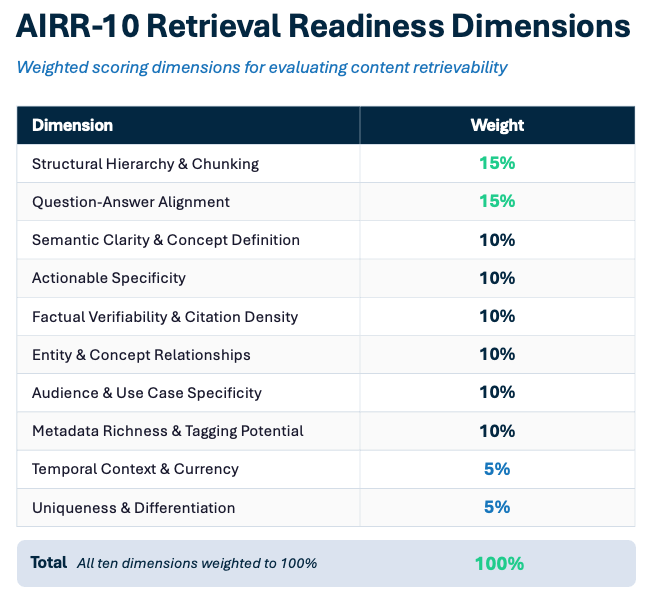
AIRR-10 is Earley Information Science's methodology for evaluating whether content can be discovered, retrieved, understood, and accurately cited by AI systems. It scores content across ten weighted dimensions, each on a 1 to 10 scale, rolled into a single composite AIRR Score, with specific evidence cited behind every score.
Content quality and content readiness are not the same thing. Well-written material can still score poorly if it lacks the structure and extractable metadata an AI system needs. AIRR-10 evaluates from the retrieval system's perspective: can an AI actually chunk, parse, and cite this content?
How it Works
Where Your Content Meets AI
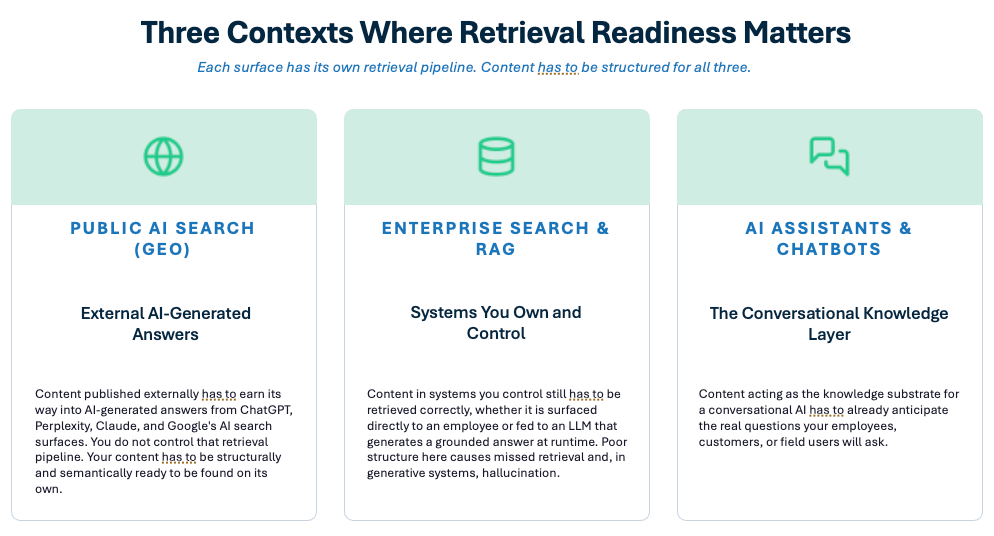
Your content meets AI in three different places. In Public AI Search, tools like ChatGPT, Perplexity, and Google's AI Overviews decide whether to cite you at all. In Enterprise Search and RAG, your own systems decide whether they can find and trust the right passage. In an AI assistant or chatbot, the system has to match a specific question to what your content actually says. AIRR-10 scores against whichever of these applies to you.
A Scored Evaluation, Not a Checklist
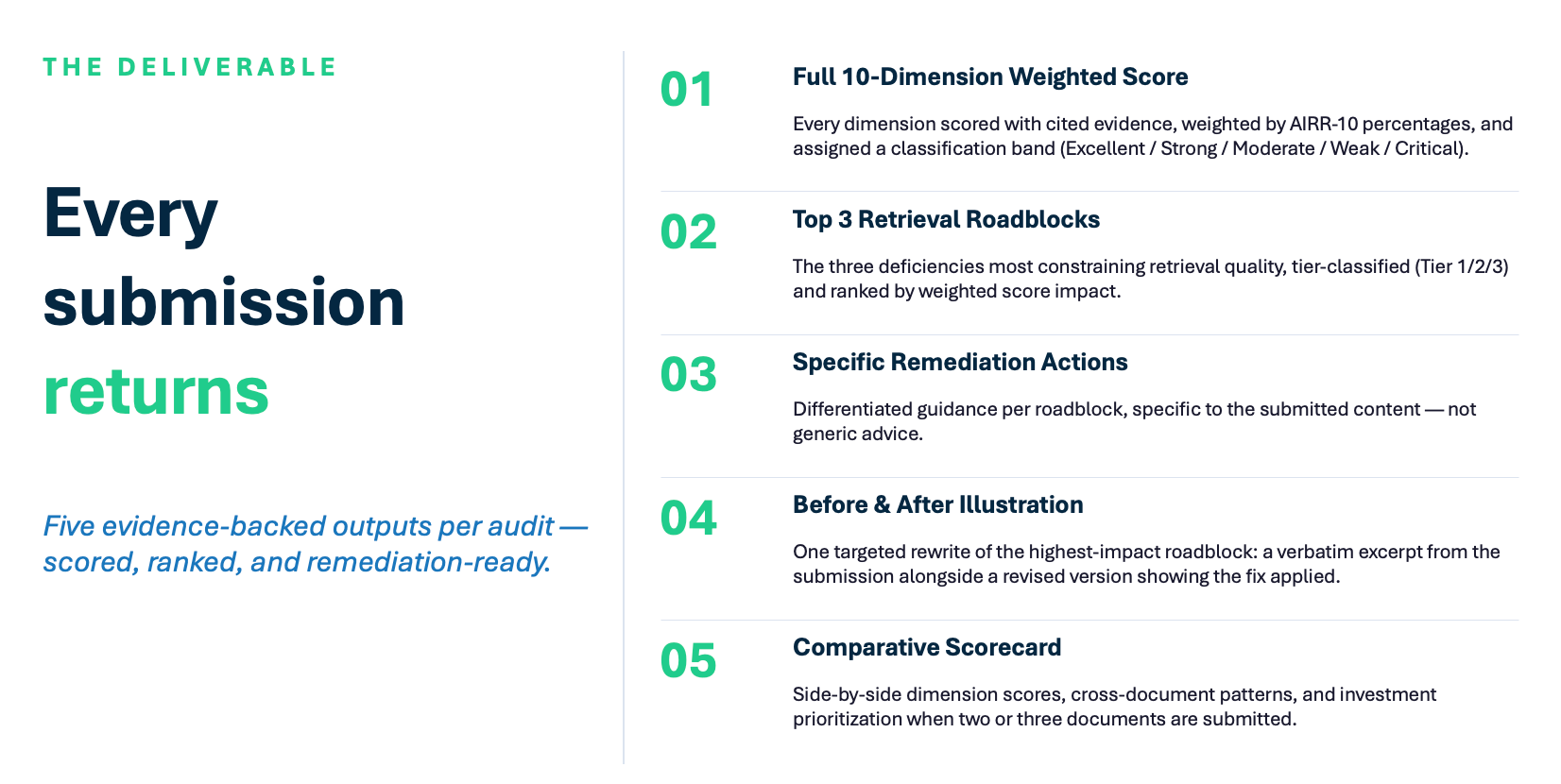
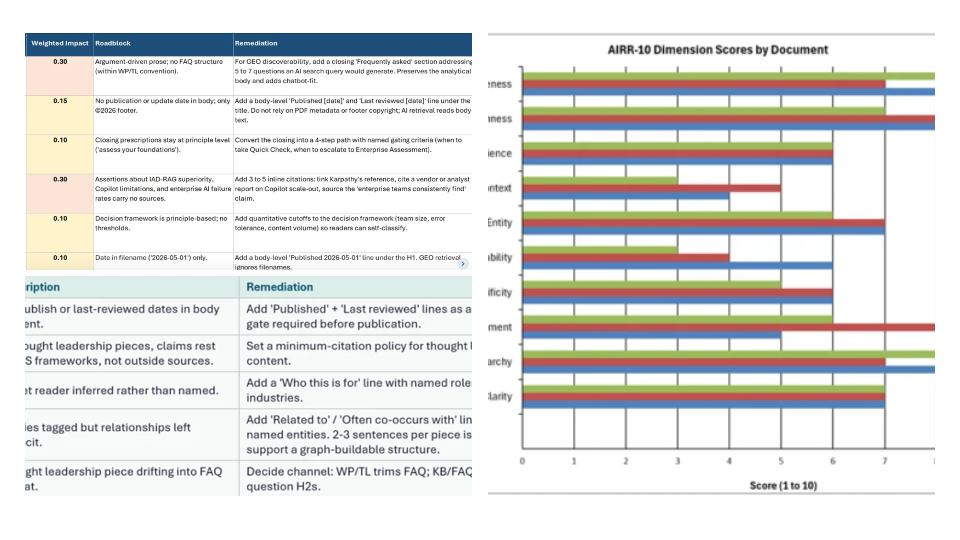
A checklist tells you whether a box is checked. AIRR-10 tells you how much a gap actually costs, weighted by how directly it affects retrieval, and hands you two coordinated deliverables: an Excel scorecard with the evidence behind every score, and a Word report with the finding and what to fix first.
A Clear Path Forward
The AIRR-10 evaluation gives you a clear picture of the state of your content as it relates to AI visibility. And then it gives you the next steps to take to remediate the content.

Choosing the Right Content to Submit
Submit content that is in front of an AI system today, or about to be.
Avoid: slide decks, scanned PDFs without selectable text, spreadsheets, and image-heavy documents. These formats do not extract cleanly and produce lower-confidence evaluations.
Confidentiality, page limits, and content types are covered in the FAQ below.
The Firm Behind "There Is No AI Without IA"
Earley Information Science has built the information architecture and knowledge engineering practices behind enterprise AI for decades. The firm's founding principle, published in IEEE in 2016, is the idea AIRR-10 is built on: There is no AI without IA. EIS's work has been featured in Harvard Business Review and cited by Gartner, Forrester, and IDC.
Frequently Asked Questions
How is AIRR-10 different from a standard content audit?
Standard content audits focus on human readers and traditional search. They typically look at readability, SEO keywords, brand voice, and link structure. These factors are important, but they do not tell you whether an AI system can break your content into useful chunks, find the right passage, and cite it accurately.
AIRR-10 is designed specifically for AI retrieval. It evaluates your content across ten dimensions that are weighted for their impact on RAG and AI-mediated discovery, using clear, published rubrics. The result is a quantified picture of your AI readiness and a prioritized remediation roadmap tailored to your AI use case.
What types of content work best?
Submit content that is in front of an AI system today or about to be: knowledge base articles; product documentation; SOPs; thought leadership; training material; marketing or sales content; or legal, compliance, or policy content.
The strongest submissions share three traits.
-
They cover a single topic or process rather than spanning many.
-
They represent the content type you most want to improve.
-
They are documents you could realistically act on if the evaluation surfaces gaps.
A few formats do not extract cleanly and will lower the confidence of the evaluation: slide decks, scanned PDFs without selectable text, spreadsheets, and documents that are primarily images or diagrams.
Not sure which to choose?
Pick the documents your team complains about most; the ones where people say "I can never find what I need" or "the AI keeps getting this wrong." Those are almost always the highest-value candidates.
How do I choose a content type?
The content type tells us what a piece of content is for, which lets us score it fairly. We grade a white paper against what a good white paper should do, and a marketing page against what good marketing should do. Without that, the framework might ding your sales page for light citations (normal for marketing) or flag your white paper for not being in FAQ format (not a real problem). Picking the type calibrates the bar.
One tip that trips people up: content type is about purpose, not where it lives or what it's called. A blog post isn't its own type; depending on its intent it might be thought leadership, a how-to, or a marketing piece. Pick the type that matches what the content is trying to accomplish.
The eight types:
- Knowledge base article or FAQ: answers to common questions.
- Technical documentation or user manual: reference material for how a product or system works.
- Standard operating procedure: step-by-step how-to.
- White paper or thought leadership: research-backed, argument-driven, cited.
- Training or enablement content: material designed to teach or onboard.
- Marketing or sales content: content meant to drive an audience toward an action.
- Legal and compliance content: contracts, regulatory, compliance material.
- Policy or governance document: what is required and why.
These eight are the built-in types that cover most enterprise content, and they're all you need for this evaluation. In a full engagement, we go further: we specialize content types for the unique purposes a given organization works with, since real content libraries often include formats and intents these defaults don't capture. For now, map your submission to the closest fit and we'll take it from there.
Not sure which fits?
Pick the closest match to the content's main job. We confirm the mapping during evaluation, so a near-miss won't sink your results.
What if my document is longer than 50 pages?
Fifty pages per sample is the sweet spot. It is long enough to reveal repeating patterns, while still keeping the review focused and manageable. If your document is longer than 50 pages, you have two options:
-
Trim your document to the 50 pages you most want us to evaluate before uploading. This gives you full control over what we score.
-
Upload the full document as-is, and we will review a representative sample that reflects its main structures and topics. Our analysts select sections based on what will give you the most useful results, not just the first, middle, and last pages.
If you would like us to evaluate the entire document, we can do that as part of a paid engagement. Simply mention this in the “Anything else we should know?” field, and we will follow up with you.
What are the AI use cases, and why do they matter?
The use case is how you plan to put this content in front of AI. It doesn't change your scores; the ten dimensions are weighted the same either way. What it changes is which gaps we highlight first in your roadblocks and fixes, so the guidance fits the system you're actually building. The same content can need different priorities depending on where it's headed.
The three use cases:
- Public AI Search / GEO: you want this content found, cited, and accurately summarized by AI systems you don't control, like ChatGPT, Perplexity, and AI-powered search. Here we lean hardest on clear concept definitions, rich extractable metadata, and a distinctive point of view, because content that reads as generic won't get cited.
- Enterprise Search / RAG: the content lives in systems you control and gets retrieved to answer internal queries, either surfaced to a person or fed to an AI that generates a grounded answer. Here structure and chunking, semantic clarity, and explicit concept relationships carry the most weight, with verifiability elevated so answers stay auditable.
- AI assistant or chatbot: people interact with the AI's answer, not your original document. Here question-answer alignment matters most, because the chatbot can only work well if your content already anticipates the questions users ask.
If you're exploring rather than committed to one path, tell us that. We can run a general retrieval-readiness read, then sharpen the guidance once a deployment is confirmed.
Is my content secure?
Yes. The content you upload is kept strictly confidential and used only to generate your AIRR-10 evaluation. Earley Information Science does not sell, license, share, or otherwise disclose your content outside our organization.
We do ask that you avoid submitting content that is subject to NDA, export control, HIPAA, or other special confidentiality requirements.
Are my documents used to train AI models?
No. We do not allow any EIS AI diagnostic accelerators to use your data to train models or to support any other product. After we deliver your results, we retain your content only for a limited time so we can respond to any follow-up questions you may have.
Will I receive a generic score or findings specific to my content?
You will receive findings specific to your content. Each dimension score is backed by cited examples from your own documents. The Top 3 Roadblocks section highlights the issues that most limit retrieval for your content and includes remediation guidance written for what you actually submitted. The Before/After illustration uses a verbatim excerpt from your content next to a revised version focused on a single dimension.
The framework is standardized so results are comparable across organizations. The insights themselves are tailored to you.
What happens after I receive my report?
You will receive two coordinated deliverables:
-
An Excel scorecard with dimension scores, cited evidence, prioritized roadblocks, and, for multi-document submissions, cross-document patterns
-
A Word memo that explains the findings and highlights the central issue
If the results raise broader questions, the next step is a 30-minute conversation with an EIS expert to discuss what the findings mean for your wider content landscape. The complimentary evaluation is a starting point, not a full project plan. The conversation helps us determine together whether a deeper engagement is the right next step.