
We help you understand what's ready, what's missing, and what to do first.
Every AI initiative depends on knowledge architecture, operational discipline, technical infrastructure, and governance. Most organizations have never measured these foundational domains. Our AI Readiness Assessment methodology identifies where the domains hold and where they create risk — before your implementation exposes them.
The Four Domains of AI Readiness
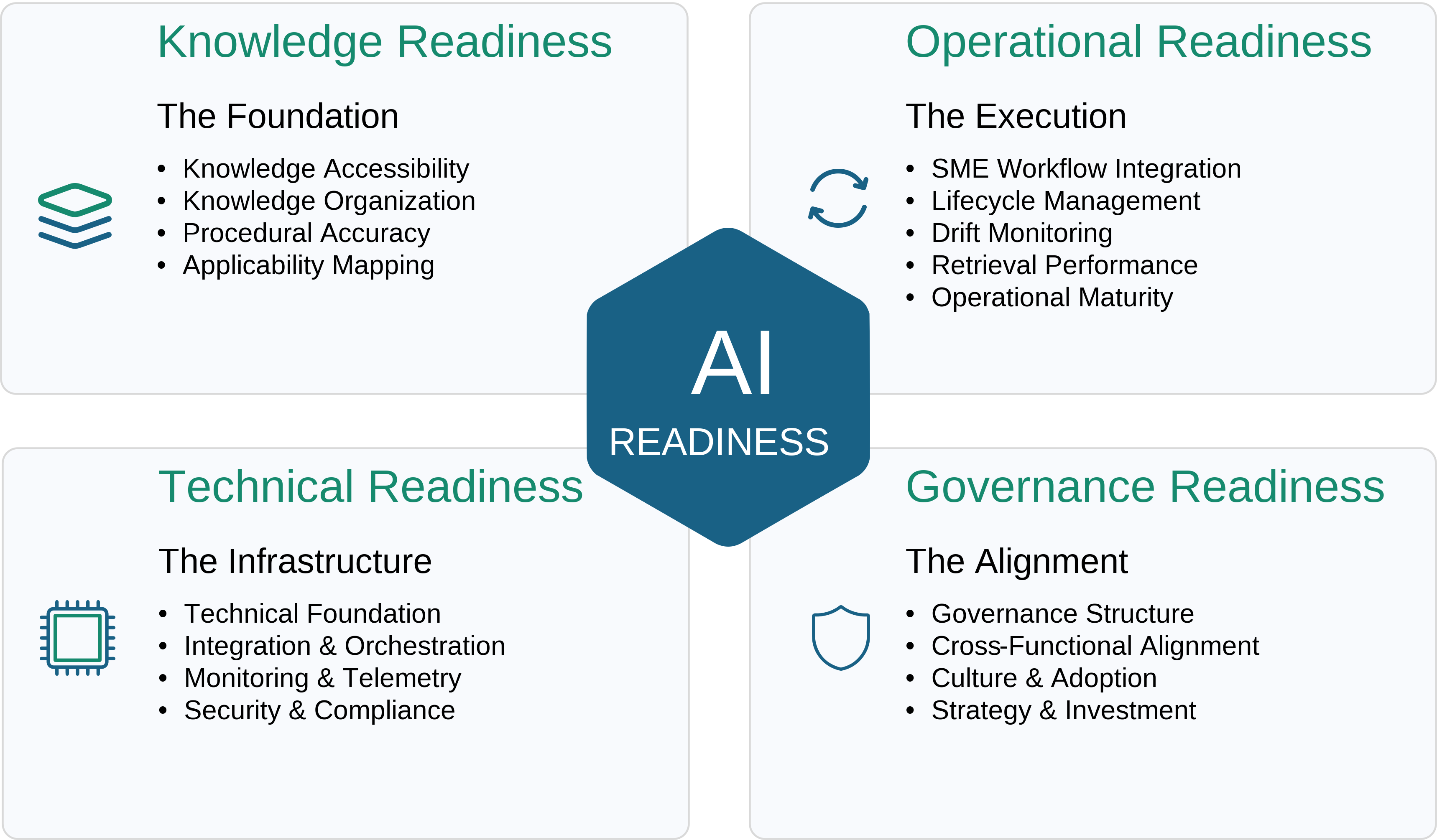
We evaluate your organization across four critical domains that determine whether AI implementations can succeed at scale. Our EIS Framework is built on 30 years of experience.
Know where you stand. Understand why. Then fix it.
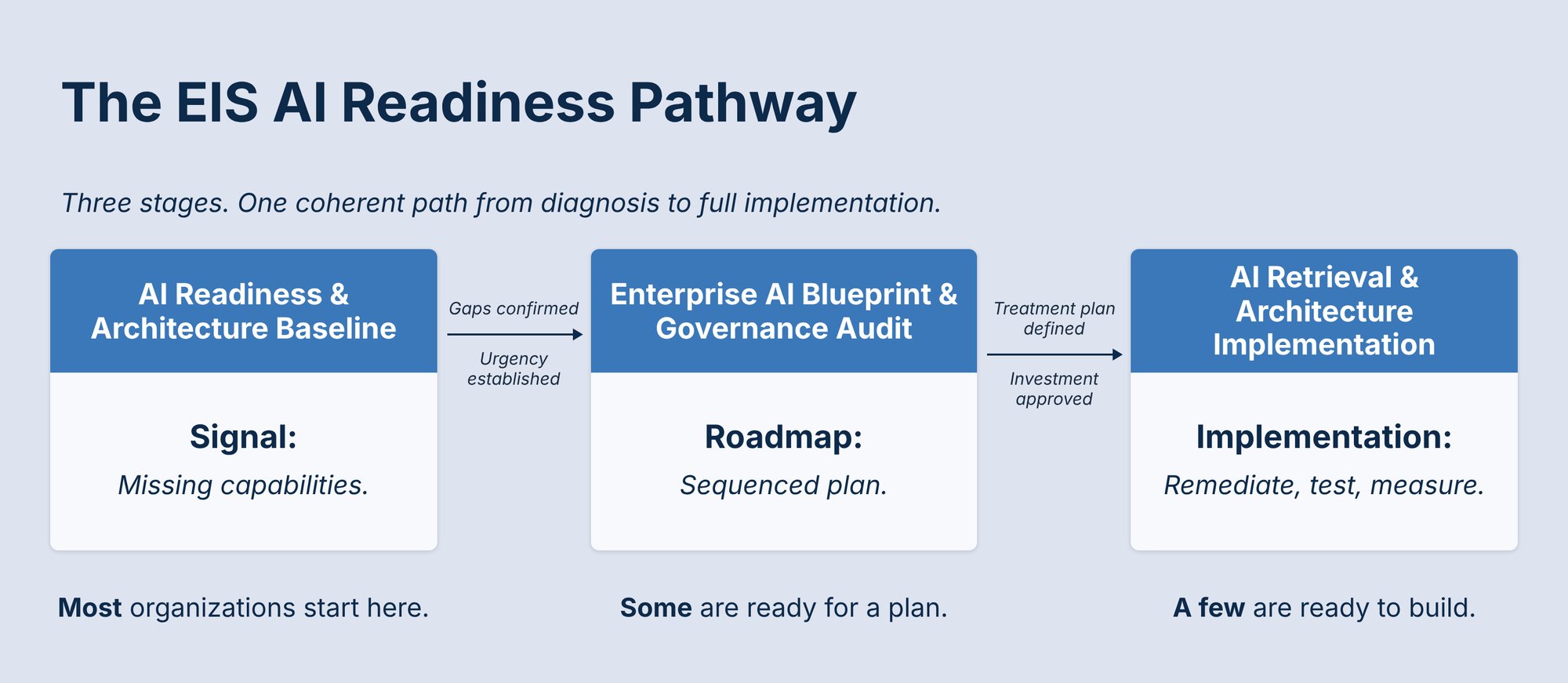
From AI Readiness to AI Powered
|
Best For
|
Mid-market & enterprise leaders needing fast clarity on blind spots before major AI spend |
|---|---|
|
Diagnostic Depth
|
12-factor diagnostic across up to 10 stakeholders + 3 to 4 executive interviews |
|
Core Deliverable
|
Quantified Gap Report, Stakeholder Divergence Analysis & 90-min Executive Readout |
|
Timeline
|
5 to 7 business days |
|
Best For
|
Organizations with complex data silos, regulatory exposure, or stalled AI pilots |
|---|---|
|
Diagnostic Depth
|
Comprehensive 74-question, 17-factor diagnostic + 15 to 25 role-based interviews |
|
Core Deliverable
|
Deep-Dive Root Cause Audit, Sequenced Remediation Roadmap & Governance Charter |
|
Timeline
|
4 to 6 weeks |
|
Best For
|
Teams ready to build production-grade RAG, taxonomy/ontology, and governance systems |
|---|---|
|
Diagnostic Depth
|
Full architectural execution across priority use cases (SearchOS / IAD-RAG) |
|
Core Deliverable
|
Production Knowledge Architecture, Metadata/Ontology Models & Retrieval Engineering |
|
Timeline
|
8 to 26 weeks |
|
Best For
|
Mid-market & enterprise leaders needing fast clarity on blind spots before major AI spend | Organizations with complex data silos, regulatory exposure, or stalled AI pilots | Teams ready to build production-grade RAG, taxonomy/ontology, and governance systems |
|---|---|---|---|
|
Diagnostic Depth
|
12-factor diagnostic across up to 10 stakeholders + 3 to 4 executive interviews | Comprehensive 74-question, 17-factor diagnostic + 15 to 25 role-based interviews | Full architectural execution across priority use cases (SearchOS / IAD-RAG) |
|
Core Deliverable
|
Quantified Gap Report, Stakeholder Divergence Analysis & 90-min Executive Readout | Deep-Dive Root Cause Audit, Sequenced Remediation Roadmap & Governance Charter | Production Knowledge Architecture, Metadata/Ontology Models & Retrieval Engineering |
|
Timeline
|
5 to 7 business days | 4 to 6 weeks | 8 to 26 weeks |
How organizations use these diagnostics
Step 1: Choose your starting point. Most organizations begin with the AI Readiness & Architecture Baseline. It is a multi-stakeholder diagnostic that delivers a quantified gap report and a 90-minute executive readout in 5 to 7 business days, and it provides the evidence base to decide whether a deeper engagement is warranted. Organizations with a defined AI initiative already underway may prefer to go directly to the Enterprise AI Blueprint.
Step 2: Include more than one perspective. The Baseline covers up to 10 stakeholders and 3 to 4 executive interviews. When a Director and a Manager in the same function score 20 points apart, that divergence is a finding: it reveals a fragmented understanding of readiness that no single respondent could identify on their own. The stakeholder divergence analysis is often the most important output.
Step 3: Get your report. Baseline reports are delivered within 5 to 7 business days. Each report includes a quantified gap analysis across 12 factors, a risk view, and stakeholder divergence findings. Enterprise AI Blueprint deliverables go deeper at the factor level, with an interview-grounded explanation of root causes and a phased remediation roadmap with ownership assignments.
Step 4: Take action. Baseline findings provide the signal and evidence to align stakeholders and prioritize investment. The 90-minute executive readout is where EIS reviews findings with your leadership team and, where appropriate, scopes the next step. Enterprise AI Blueprint deliverables define the scope and investment required for implementation. Organizations that proceed to an Enterprise AI Blueprint ($45k to $55k) or an implementation engagement ($100k+) within 60 days may apply 50% of their Baseline fee toward the next phase.
FAQ: Understanding the EIS AI Readiness Diagnostics
What is the difference between the Baseline and the Enterprise AI Blueprint?
The Baseline tells you where your gaps are and where your stakeholders disagree. The Enterprise AI Blueprint tells you why those gaps exist and what it will take to close them. The Baseline uses a 12-factor diagnostic across up to 10 stakeholders plus 3 to 4 executive interviews, and delivers in 5 to 7 business days. The Enterprise AI Blueprint uses 74 questions, structured interviews with 15 to 25 stakeholders, and 4 to 6 weeks of analysis to produce a maturity baseline, root-cause gap analysis, and a prioritized remediation roadmap with ownership assignments. They are designed to work in sequence: the Baseline creates the evidence and urgency that makes the Enterprise AI Blueprint a straightforward decision.
What does the Baseline report include?
The Baseline delivers a quantified gap report across the 12-factor diagnostic, a stakeholder divergence analysis showing where leaders and teams see readiness differently, and a 90-minute executive readout. It is not a scored survey with a bar chart. It is a consulting-grade analytical document grounded in EIS's proprietary methodology.
What is the AI Readiness Framework?
The Framework is EIS's proprietary methodology for evaluating AI readiness, developed over 30 years of enterprise information architecture and knowledge engineering practice. It defines four domains (Knowledge, Operational, Technical, and Governance), 17 factors, and five maturity levels (Not in Place, Minimal, Developing, Established, and Optimized). The analytical engine behind both diagnostics includes EIS's proprietary frameworks: AIRR-10 for document-level AI retrieval readiness scoring, IAD-RAG for information architecture-directed retrieval design, and the Retrieval Accuracy Improvement Loop for ongoing AI output quality management.
Who should start with the Baseline?
Anyone accountable for an AI initiative, evaluating AI readiness on behalf of leadership, or building the internal case for investment in knowledge, operational, or governance foundations. Senior leaders can act on the findings directly. Practitioners and program champions use the reports to build urgency and align stakeholders. The reports are designed to serve both audiences simultaneously.
Should I start with the Baseline or go straight to the Enterprise AI Blueprint?
Start with the Baseline if your organization has not yet conducted a structured readiness evaluation, if you need evidence to build internal alignment, or if you want fast clarity before committing to a larger engagement. Go directly to the Enterprise AI Blueprint if your organization has a defined AI initiative underway, executive sponsorship already secured, and a need for the detailed gap analysis and roadmap that only the full 74-question, interview-based process can produce. Many organizations do both in sequence: Baseline to create momentum, Enterprise AI Blueprint to define the work.
What are the four domains?
Knowledge Readiness evaluates whether your content is structured, discoverable, and accurate enough for AI to retrieve and use reliably. Operational Readiness evaluates whether you have the workflows to keep AI-ready content current. Technical Readiness evaluates whether your infrastructure is built for AI retrieval, not just storage. Governance Readiness evaluates whether you have clear ownership over AI outputs and the knowledge that drives them.
What the Data Shows
Across every organization we have assessed, governance scores lowest regardless of industry or organization size. Leadership commitment is not the bottleneck — visible executive sponsorship and significant AI investment are present in every case. The constraint is cross-functional coordination, ownership clarity, and the operational discipline to keep AI-ready content current after deployment.
The pattern is consistent: organizations are building on knowledge and governance foundations they have not tested. They discover the gaps after the budget is spent, not before.
Knowledge gaps produce AI that retrieves the wrong content or fails to retrieve at all. Operational gaps produce AI that degrades silently after launch. Technical gaps produce AI that cannot scale beyond a single use case. Governance gaps produce AI that nobody owns and nobody can audit.
Every one of these failure modes is diagnosable before it occurs. That is what these assessments are designed to do.
Read our new white paper:What We Learned from Assessing AI Readiness Across Fortune 1000 Organizations
The gap between where your organization thinks it stands and where it actually stands is a risk you can measure.
The Baseline delivers a quantified gap report and executive readout in 5 to 7 business days. The Enterprise AI Blueprint takes four to six weeks and delivers the roadmap your implementation needs to succeed.