
AI Readiness Enterprise Assessment

Your AI program needs a diagnosis, not a dashboard.

Generic maturity tools tell you that your governance is weak or your data quality needs work. That is a description. It does not tell you why those gaps exist, which ones constrain your current AI initiatives most directly, or what a sequenced remediation plan looks like for your organization's specific context.

The Enterprise AI Readiness Assessment is a four-week, multi-stakeholder engagement that produces the maturity baseline, root-cause gap analysis, and phased remediation roadmap your program needs to move from pilot to scale. It is grounded in 30 years of EIS information architecture and knowledge engineering methodology — the same disciplines that determine whether AI retrieves accurately, governs responsibly, and scales sustainably.

WHAT THE ASSESSMENT PRODUCES

Three deliverables. One document that defines the work.

01

Maturity Baseline

A quantified maturity score across all four domains and 17 factors, assessed against the five-level EIS Readiness Maturity Model. Each factor is scored on the basis of both survey responses and structured interviews, so scores reflect organizational reality rather than individual perception. The baseline is the benchmark against which all future progress is measured.
02

Root-Cause Gap Analysis

For every factor below target maturity, the gap analysis explains why the gap exists — not just what it is. Is the governance weakness a structural problem (no defined ownership) or a cultural one (ownership defined but not exercised)? Is the knowledge accessibility gap a technology problem (no central repository) or a content problem (repository exists but content is unstructured)? Interview-based root-cause analysis is what separates a diagnosis from a survey score.

03

Phased Remediation Roadmap

A prioritized, sequenced plan for closing the gaps identified, with actions organized by urgency and dependency, ownership assignments by role, investment estimates, and success criteria. The roadmap is scoped to your organization's specific AI use cases and implementation timeline — not a generic sequence of best practices. This is the document that justifies budget, aligns stakeholders, and defines the scope of implementation work.

HOW IT WORKS

Four weeks. Fifteen to twenty-five stakeholders. One complete picture.

Week 1
Scope & Deploy Instrument
Week 2
Interview Stakeholders
Week 3
Analyze & Synthesize
Week 4
Deliver Readout & Roadmap

Week 1: Scoping and Instrument Deployment

EIS works with your engagement sponsor to identify the right stakeholder population across business, technology, legal, compliance, and content functions. The 74-question assessment is deployed to all participants. EIS conducts an initial review of organizational context — existing AI initiatives, technology infrastructure, recent investments, and stated strategic priorities.

THE FRAMEWORK

Four domains. Seventeen factors. One methodology.

The assessment evaluates readiness across four domains that determine whether AI scales reliably or stalls. The domains are not independent — the weakest domain constrains the whole program, regardless of strength elsewhere. 

Knowledge Readiness

4 FACTORS

Evaluates whether your content is structured, discoverable, and accurate enough for AI to retrieve and use. Covers knowledge accessibility, content architecture and metadata, procedure documentation and completeness, applicability mapping, and semantic readiness. Most organizations discover in this domain that content designed for human navigation is not designed for AI retrieval.

Operational Readiness

5 FACTORS

Evaluates whether you have the workflows to keep AI-ready content current after deployment. Covers SME workflow integration, content lifecycle management, drift and error monitoring, and retrieval performance management. AI accuracy degrades silently when these capabilities are absent. Organizations that score well here have built systematic content operations, not just content repositories.

Technical Readiness

4 FACTORS

Evaluates whether your infrastructure is built for AI retrieval, not just storage. Covers AI-ready repository architecture, RAG design, system integration and orchestration, monitoring and telemetry, and security and audit controls. Technical readiness is the domain where organizations most often overestimate their position — existing IT infrastructure is rarely designed with retrieval-augmented generation in mind. 

Governance Readiness

4 FACTORS

Evaluates whether you have clear ownership over AI outputs and the knowledge that drives them. Covers ownership and accountability, governance maturity, cross-functional alignment, and strategic enablement and investment. Governance is the single weakest domain in every assessment we conduct, regardless of industry. The most common finding is not that governance is absent — it is that governance is defined on paper but not operationalized in practice.

WHO THIS IS FOR

This engagement is designed for a specific situation.

The Enterprise Assessment creates the most value when:

  • You have an active AI initiative, such as a RAG deployment, copilot rollout, agent-based workflow, or content operations update, and need to identify the gaps that could slow progress.

  • You have executive sponsorship and need credible evidence to support budget decisions. The assessment provides quantified, benchmarked, interview-validated findings.

  • You have stakeholders across IT and the business with different views of readiness and need an objective third-party assessment to align priorities.

  • You are preparing for a consulting engagement and want to define scope based on evidence, not assumptions. The assessment helps implementation partners work more effectively.

If your organization has not yet completed a structured AI readiness assessment, the Quick Check is the best place to start. It's fast and provides a detailed analytical report within two business days.

Learn about the Quick Check → 

THE METHODOLOGY BEHIND THE ASSESSMENT

Thirty years of methodology, not a maturity model built for this engagement.

Most AI maturity assessments are constructed to support a consulting sale. The questions are generic, the scoring is relative, and the recommendations lead to the firm's own service offerings regardless of what the data shows.

The EIS AI Readiness Assessment is grounded in methodology developed over 30 years of information architecture and knowledge engineering practice with hundreds of Fortune 1000 organizations in regulated, technical, and knowledge-intensive industries. The frameworks embedded in the assessment are the same frameworks EIS uses in implementation engagements.

IAD-RAG (Information Architecture-Directed RAG) is EIS's seven-layer methodology for ensuring that RAG implementations retrieve accurate, contextually appropriate content. Technical readiness factors in the assessment evaluate your infrastructure against IAD-RAG requirements — not against generic best practices.

AIRR-10 is EIS's framework for scoring document-level AI retrieval readiness across ten weighted dimensions. Knowledge readiness factors in the assessment are calibrated against AIRR-10 criteria, producing scores that connect directly to content remediation actions.

The Retrieval Accuracy Improvement Loop is EIS's systematic cycle for maintaining AI retrieval performance after deployment: monitor, diagnose, correct, optimize, validate. Operational readiness factors evaluate whether your organization has the workflows this loop requires.

The EIS Readiness Maturity Model defines five maturity levels across all four domains and 17 factors, with concrete operational criteria at each level. It is the scoring backbone of both the Quick Check and the Enterprise Assessment, ensuring that scores are consistent, comparable, and connected to a defined improvement path.

THE RELATIONSHIP TO THE QUICK CHECK

The Quick Check and the Enterprise Assessment are designed to work together.


The Quick Check identifies where your AI readiness gaps are. The Enterprise Assessment explains why those gaps exist and how to close them.

When multiple stakeholders complete the Quick Check, you start the Enterprise Assessment with something most organizations do not have: shared evidence and a common data set.

Results from a multi-respondent Quick Check directly shape the Enterprise Assessment:

  • Perception gap data informs the stakeholder interview plan.

  • Domain scores show which areas need deeper investigation.

  • Comparative analysis exposes critical dynamics, such as disagreement on current state or role-based blind spots, that interviews must address.

When the Quick Check builds alignment on the need for deeper analysis, it makes the Enterprise Assessment faster to scope and easier to fund.


WHAT HAPPENS AFTER THE ASSESSMENT

The assessment is the beginning of the engagement, not the end.

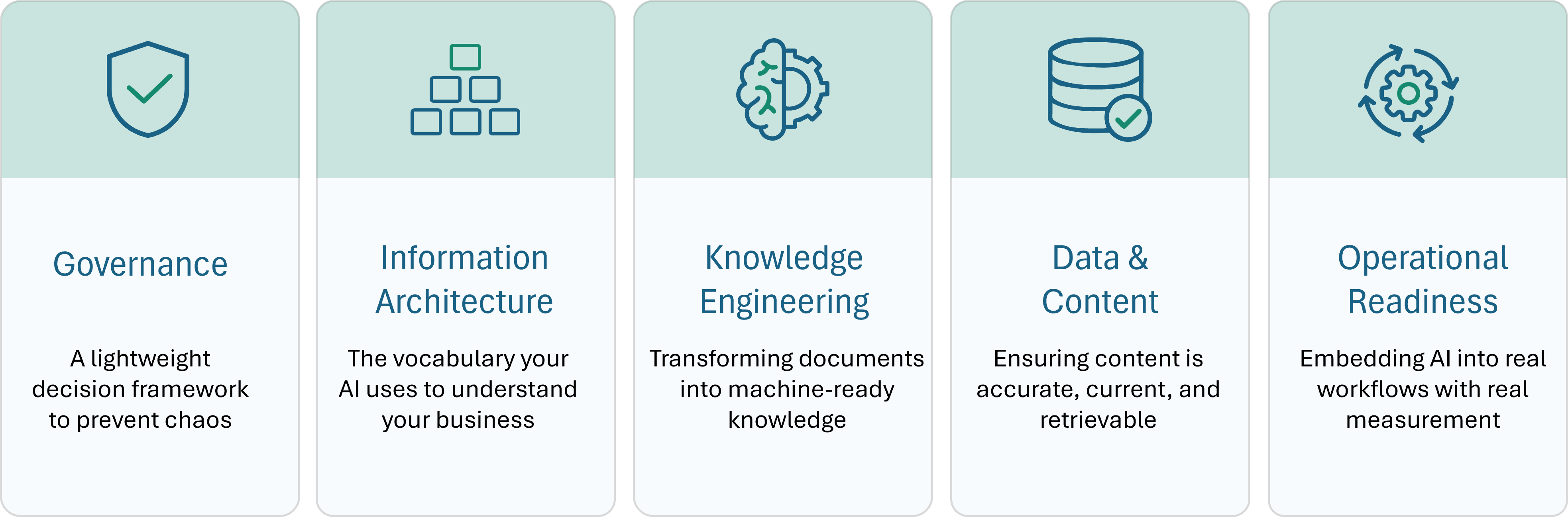
The Enterprise Assessment delivers a phased remediation roadmap. It outlines the work required across five foundational capability areas, as shown in the figure below:  

  • Information architecture and content operations – the knowledge and operational foundations that enable accurate AI retrieval

  • Governance framework design and operationalization – the ownership, accountability, and processes that allow AI to scale responsibly

  • Technical implementation – including RAG engineering, retrieval layer design, monitoring, and telemetry

Figure: The Five Foundational Capabilities for Enterprise AI

EIS-AI-Readiness-Five-Foundational-Capabilities

Earley Information Science provides consulting across all five capability areas. Typical engagements range from $100,000 to $500,000 or more, based on your scope and organizational complexity. Completing the assessment first gives your consulting engagement a clear, defined starting point instead of an open-ended discovery phase.

Organizations use the assessment to guide and evaluate third-party implementation partners—such as systems integrators, platform vendors, and AI consultancies—because the roadmap gives those firms a clear, structured foundation. You can use the same roadmap with any implementation partner or your internal teams.

Ready to scope an engagement?

Contact EIS to discuss your organization's situation, the right participant population, and what a phased engagement would look like. 

Learn more about the Quick Check first 🡢

FREQUENTLY ASKED QUESTIONS

FAQ

How is the pricing structured?

The Enterprise Assessment is priced between $45,000 and $55,000 depending on scope, number of stakeholder interviews, and organizational complexity. Contact us to discuss what the right scope looks like for your organization.

How many people need to participate?

A well-scoped Enterprise Assessment involves 15–25 stakeholders across business, technology, legal, compliance, and content functions. The exact participant population is defined during scoping based on your organization's structure and the AI initiatives under evaluation.

Can we do the Quick Check first?

Yes, and we recommend it for most organizations. The Quick Check is fast and delivers a full analytical report within two business days. Organizations that complete the Quick Check with multiple respondents arrive at the Enterprise Assessment scoping conversation with data already in hand. 

Does the assessment require us to work with EIS afterward?

No. The assessment deliverables are yours to use with any implementation partner. Many organizations use the assessment to define scope and create accountability for third-party engagements. The assessment is designed to make your implementation partners more effective, regardless of who they are.

What industries do you work in?

EIS has conducted readiness assessments and implementation engagements across financial services, pharmaceutical and life sciences, manufacturing and distribution, technology, professional services, and retail. The framework is industry-agnostic; the analysis and benchmarks are industry-specific.