
You are investing in AI. Are your foundations ready for it?
Every AI initiative depends on knowledge architecture, operational discipline, technical infrastructure, and governance. Most organizations have never measured those foundations. The AI Readiness Diagnostic identifies where they hold and where they create risk. Before your implementation exposes the gaps.
The Three stages of AI Readiness
|
Description
A short description of the product or offering. |
A consulting-grade diagnostic delivered in two business days. The Quick Check isn't just a scored survey but a 9-section analytical report grounded in EIS methodology. |
|---|---|
|
What it tells you
The strategic role this assessment plays in your AI readiness program. |
WHERE the gaps are (directional signal) |
|
Instrument
The breadth of the instrument. The Quick Check covers all four domains with 12 focused questions designed for a single respondent. The Enterprise Assessment covers all 17 factors across four domains and is designed for multi-stakeholder participation. |
12 questions, self-assessment |
|
Deliverables
The tangible outputs you receive. |
9-section analytical report per respondent; comparative analysis when 2+ respondents participate |
|
Deliverables Timeline
How long it takes to complete the assessment or consulting engagement. |
1-2 business days per report |
|
Participants
The number of people who can participate in this type of AI Readiness Assessment or consulting engagement. |
1-10+ per organization |
|
Analyst / Consultant Access
The level of EIS involvement. |
One 30-60 minute working session with an EIS consultant to review findings and define next steps. Included when 2+ respondents from the same organization participate. |
|
Entry point for
The goal of your current AI Readiness phase can help you choose the product specifically designed for this distinct purpose. |
Awareness and internal champion building |
|
Description
A short description of the product or offering. |
Multi-stakeholder diagnosis across 15–25 participants. Delivers the maturity baseline, gap analysis, and phased roadmap that defines the scope and budget for implementation. |
|---|---|
|
What it tells you
The strategic role this assessment plays in your AI readiness program. |
WHY the gaps exist and WHAT to do (diagnosis + treatment plan) |
|
Instrument
The breadth of the instrument. The Quick Check covers all four domains with 12 focused questions designed for a single respondent. The Enterprise Assessment covers all 17 factors across four domains and is designed for multi-stakeholder participation. |
74 questions, multi-stakeholder, interview-based |
|
Deliverables
The tangible outputs you receive. |
Maturity baseline, gap analysis report, phased remediation roadmap with ownership and sequencing |
|
Deliverables Timeline
How long it takes to complete the assessment or consulting engagement. |
4-6 weeks |
|
Participants
The number of people who can participate in this type of AI Readiness Assessment or consulting engagement. |
15-25 stakeholders across functions |
|
Analyst / Consultant Access
The level of EIS involvement. |
Full EIS consultant engagement |
|
Entry point for
The goal of your current AI Readiness phase can help you choose the product specifically designed for this distinct purpose. |
Organizational diagnosis and executive buy-in |
|
Description
A short description of the product or offering. |
Full-engagement implementation. EIS architects the solution, builds the governance framework, engineers the retrieval stack, and operationalizes the content infrastructure your AI requires. |
|---|---|
|
What it tells you
The strategic role this assessment plays in your AI readiness program. |
HOW to remediate (implementation) |
|
Instrument
The breadth of the instrument. The Quick Check covers all four domains with 12 focused questions designed for a single respondent. The Enterprise Assessment covers all 17 factors across four domains and is designed for multi-stakeholder participation. |
Survey, interview, system walkthrough, architecture, proof of value/pilot |
|
Deliverables
The tangible outputs you receive. |
Phased delivery milestones with defined acceptance criteria, architecture, governance framework, content operations, RAG engineering |
|
Deliverables Timeline
How long it takes to complete the assessment or consulting engagement. |
8-26 weeks, depending on scope |
|
Participants
The number of people who can participate in this type of AI Readiness Assessment or consulting engagement. |
Full organizational engagement across all affected functions |
|
Analyst / Consultant Access
The level of EIS involvement. |
Dedicated EIS team with defined project management, milestone tracking, and executive reporting |
|
Entry point for
The goal of your current AI Readiness phase can help you choose the product specifically designed for this distinct purpose. |
Transformation execution |
|
Description
A short description of the product or offering. |
A consulting-grade diagnostic delivered in two business days. The Quick Check isn't just a scored survey but a 9-section analytical report grounded in EIS methodology. | Multi-stakeholder diagnosis across 15–25 participants. Delivers the maturity baseline, gap analysis, and phased roadmap that defines the scope and budget for implementation. | Full-engagement implementation. EIS architects the solution, builds the governance framework, engineers the retrieval stack, and operationalizes the content infrastructure your AI requires. |
|---|---|---|---|
|
What it tells you
The strategic role this assessment plays in your AI readiness program. |
WHERE the gaps are (directional signal) | WHY the gaps exist and WHAT to do (diagnosis + treatment plan) | HOW to remediate (implementation) |
|
Instrument
The breadth of the instrument. The Quick Check covers all four domains with 12 focused questions designed for a single respondent. The Enterprise Assessment covers all 17 factors across four domains and is designed for multi-stakeholder participation. |
12 questions, self-assessment | 74 questions, multi-stakeholder, interview-based | Survey, interview, system walkthrough, architecture, proof of value/pilot |
|
Deliverables
The tangible outputs you receive. |
9-section analytical report per respondent; comparative analysis when 2+ respondents participate | Maturity baseline, gap analysis report, phased remediation roadmap with ownership and sequencing | Phased delivery milestones with defined acceptance criteria, architecture, governance framework, content operations, RAG engineering |
|
Deliverables Timeline
How long it takes to complete the assessment or consulting engagement. |
1-2 business days per report | 4-6 weeks | 8-26 weeks, depending on scope |
|
Participants
The number of people who can participate in this type of AI Readiness Assessment or consulting engagement. |
1-10+ per organization | 15-25 stakeholders across functions | Full organizational engagement across all affected functions |
|
Analyst / Consultant Access
The level of EIS involvement. |
One 30-60 minute working session with an EIS consultant to review findings and define next steps. Included when 2+ respondents from the same organization participate. | Full EIS consultant engagement | Dedicated EIS team with defined project management, milestone tracking, and executive reporting |
|
Entry point for
The goal of your current AI Readiness phase can help you choose the product specifically designed for this distinct purpose. |
Awareness and internal champion building | Organizational diagnosis and executive buy-in | Transformation execution |
How organizations use these diagnostics
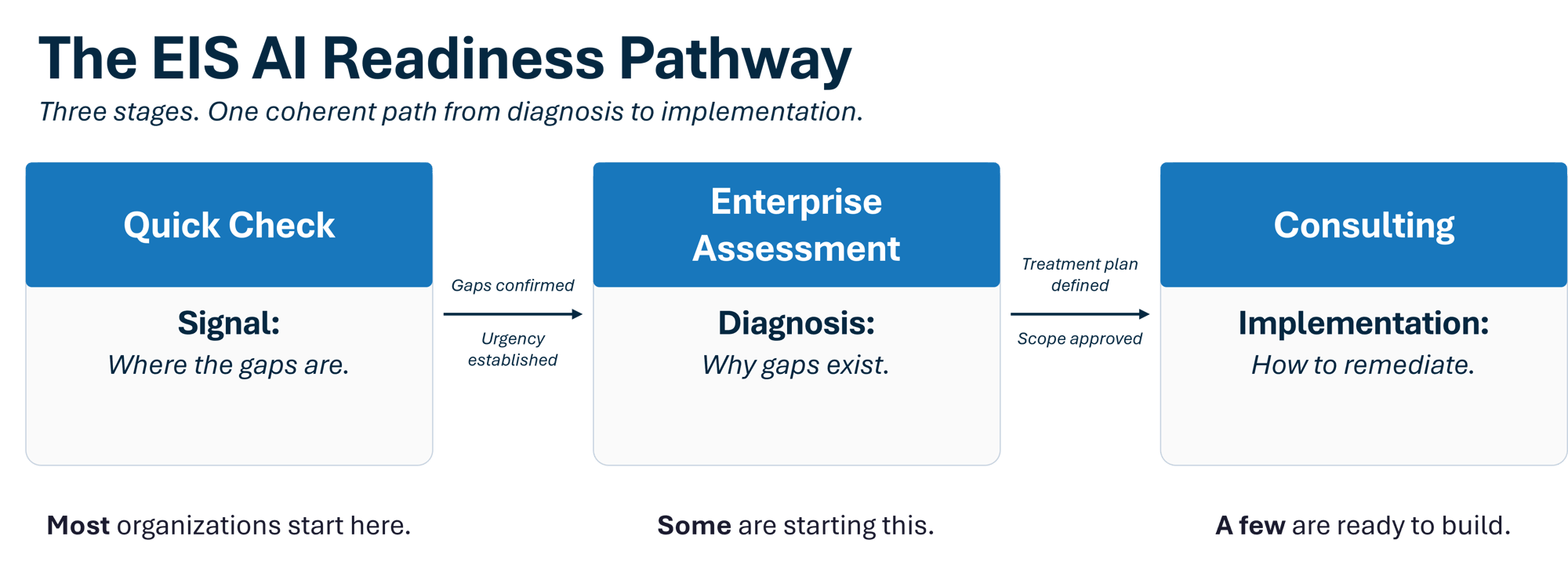
Step 1: Choose your starting point. Most organizations begin with the Quick Check. It's a short survey that delivers a full analytical report within two business days and provides the evidence base to decide whether a deeper engagement is warranted. Organizations with a defined AI initiative already underway may prefer to go directly to the Enterprise Assessment.
Step 2: Include more than one perspective. The Quick Check is most valuable when completed independently by multiple people across your organization. When a Director and a Manager in the same function score 20 points apart, that divergence is a finding — it reveals a fragmented understanding of readiness that no single respondent could identify on their own. The comparative analysis that accompanies multi-respondent engagements is often the most important output.
Step 3: Get your report. Quick Check reports are delivered within two business days. Each report includes domain-level maturity scores, factor-specific gap analysis, industry research benchmarks, remediation guidance, and diagnostic questions for deeper investigation. Enterprise Assessment deliverables include all of the above at the factor level, plus an interview-grounded explanation of root causes and a phased remediation roadmap with ownership assignments.
Step 4: Take action. Quick Check findings provide the signal and evidence to align stakeholders and prioritize investment. The included working session (for multi-respondent Quick Check engagements) is where EIS reviews findings with your team and, where appropriate, scopes the next step. Enterprise Assessment deliverables define the scope and investment required for implementation.
Know where you stand. Understand why. Then fix it.
FAQ: Understanding the EIS AI Readiness Diagnostics
What is the difference between the Quick Check and the Enterprise Diagnostic?
The Quick Check tells you where your gaps are. The Enterprise Diagnostic tells you why those gaps exist and what it will take to close them. The Quick Check uses 12 questions and a self-assessment format to produce a directional signal across four domains. The Enterprise Diagnostic uses 74 questions, structured interviews with 15–25 stakeholders, and four weeks of analysis to produce a maturity baseline, root-cause gap analysis, and a prioritized remediation roadmap with ownership assignments. They are designed to work in sequence: the Quick Check creates the evidence and urgency that makes the Enterprise Diagnostic a straightforward decision.
What does the Quick Check report include?
The 9-section report covers: executive summary, industry research and context benchmarking, domain-level scorecard, factor-level gap analysis, risk assessment, factor-specific remediation guidance, diagnostic questions for deeper investigation, mapped EIS service recommendations, and suggested next steps. The report is not a scored survey with a bar chart. It is a consulting-grade analytical document grounded in EIS's proprietary methodology.
What is the AI Readiness Framework?
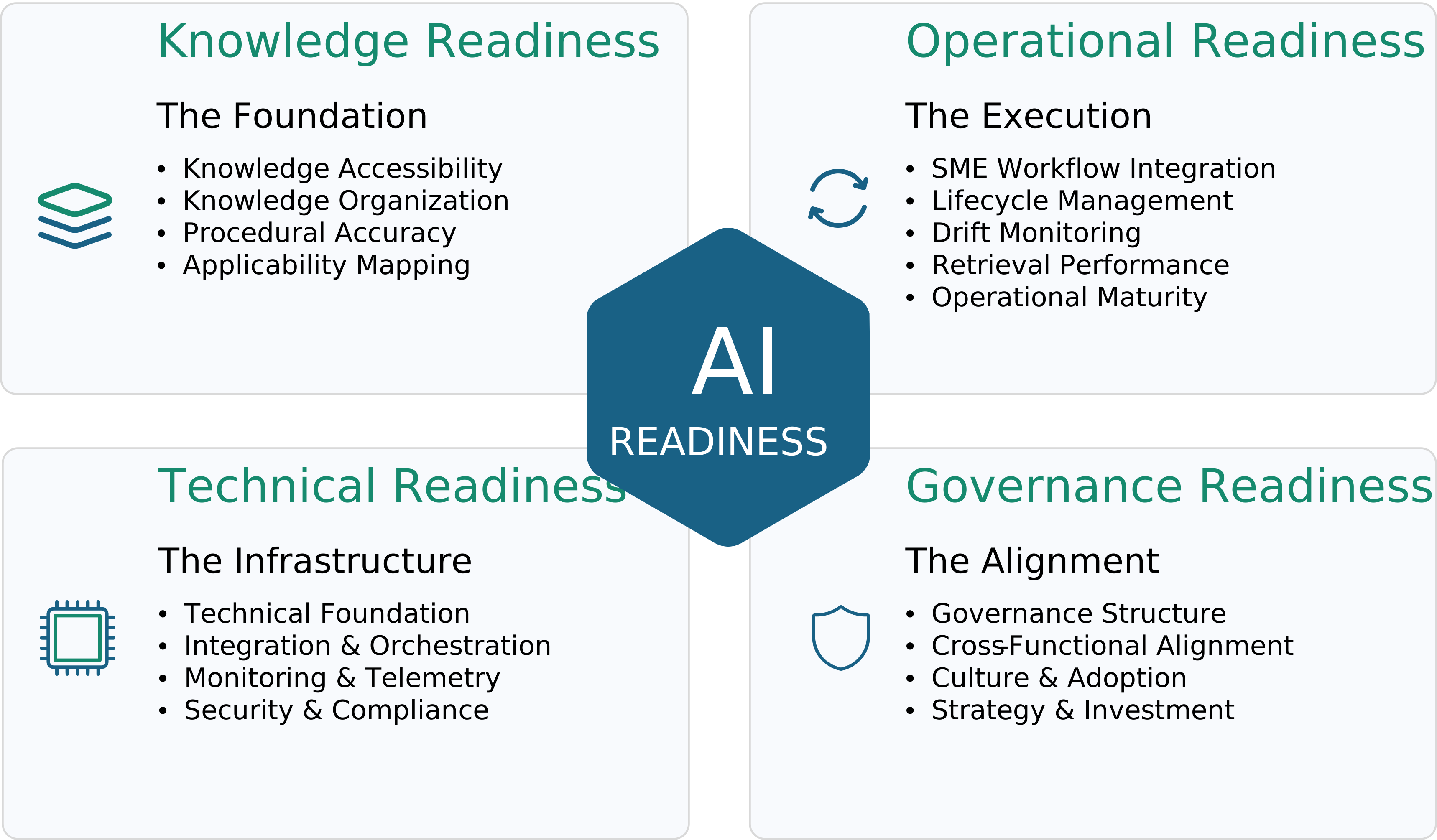
The Framework is EIS's proprietary methodology for evaluating AI readiness, developed over 30 years of enterprise information architecture and knowledge engineering practice. It defines four domains (Knowledge, Operational, Technical, and Governance), 17 factors, and five maturity levels (Not in Place, Minimal, Developing, Established, and Optimized). The analytical engine behind both diagnostics includes EIS's proprietary frameworks: AIRR-10 for document-level AI retrieval readiness scoring, IAD-RAG for information architecture-directed retrieval design, and the Retrieval Accuracy Improvement Loop for ongoing AI output quality management.
Who should take the Quick Check?
Anyone accountable for an AI initiative, evaluating AI readiness on behalf of leadership, or building the internal case for investment in knowledge, operational, or governance foundations. Senior leaders can act on the findings directly. Practitioners and program champions use the reports to build urgency and align stakeholders. The reports are designed to serve both audiences simultaneously.
Should I start with the Quick Check or go straight to the Enterprise Assessment?
Start with the Quick Check if your organization has not yet conducted a structured readiness evaluation, if you need evidence to build internal alignment, or if you want a fast baseline before scoping a larger engagement. Go directly to the Enterprise Diagnostic if your organization has a defined AI initiative underway, executive sponsorship already secured, and a need for the detailed gap analysis and roadmap that only the full 74-question, interview-based process can produce. Many organizations do both in sequence: Quick Check to create momentum, Enterprise Diagnostic to define the work.
What are the four domains?
Knowledge Readiness evaluates whether your content is structured, discoverable, and accurate enough for AI to retrieve and use reliably. Operational Readiness evaluates whether you have the workflows to keep AI-ready content current. Technical Readiness evaluates whether your infrastructure is built for AI retrieval, not just storage. Governance Readiness evaluates whether you have clear ownership over AI outputs and the knowledge that drives them.
Comprehensive Enterprise AI Readiness Diagnostic
Talk to a member of our team to scope and price a comprehensive Enterprise AI Readiness Diagnostic.
The Four Domains of AI Readiness
Our Framework evaluates your organization across four critical domains that determine whether AI implementations succeed at scale.
What the Data Shows
Across every organization we have assessed, governance scores lowest regardless of industry or organization size. Leadership commitment is not the bottleneck — visible executive sponsorship and significant AI investment are present in every case. The constraint is cross-functional coordination, ownership clarity, and the operational discipline to keep AI-ready content current after deployment.
The pattern is consistent: organizations are building on knowledge and governance foundations they have not tested. They discover the gaps after the budget is spent, not before.
Knowledge gaps produce AI that retrieves the wrong content or fails to retrieve at all. Operational gaps produce AI that degrades silently after launch. Technical gaps produce AI that cannot scale beyond a single use case. Governance gaps produce AI that nobody owns and nobody can audit.
Every one of these failure modes is diagnosable before it occurs. That is what these assessments are designed to do.
Read our new white paper: What We Learned from Assessing AI Readiness Across Fortune 1000 Organizations
The gap between where your organization thinks it stands and where it actually stands is a risk you can measure.
The Quick Check takes as little as 10 minutes and delivers a full analytical report in two business days. The Enterprise Diagnostic takes two to four weeks and delivers the roadmap your implementation needs to succeed.