An Autonomous Agent Layer That Continuously Improves Search
SearchOS™
What Is SearchOS
SearchOS
SearchOS™️ operationalizes your information architecture, so search, product discovery, and AI assistants continuously improve rather than continuously degrade.
Complete the SearchOS survey to get an assessment of where you search stands right now.
Want to know more about how SearchOS can improve your ROI? Request a personalized demo with Seth and Sanjay.
How Enterprise Search Fails
Enterprise search and conversational AI fail not because of the models, but because of the information architecture underneath them.
Search inside AI assistants and enterprise chatbots fails differently than traditional search. There is no zero-results page. There is no error state. There is no alert. A user asks a question, receives a vague or wrong answer, and moves on. The organization registers nothing. That invisible failure accumulates. All of it affects outcomes.
Common Failure Modes For Enterprise Search
-
Relevance driftOver time, catalog changes, outdated synonyms, and index updates quietly weaken your search rankings. There are no alerts, no obvious signals—until users simply stop finding what they need.
-
Zero-result accumulationFailed queries often end up in logs that no one reviews, even though each one represents a customer interaction that ended without a helpful answer. -
Unused behavioral signalsYour click, add-to-cart, and conversion data lives in your analytics, but it is not yet guiding how you tune search. The signals are there—you just have not closed the loop.
-
Invisible content gapsPoor metadata, missing attributes, and inconsistent naming quietly reduce findability. Often, you do not see the issue until it is already affecting revenue.
-
Reactive, slow tuningEvery change requires developer time, so experiment cycles stretch into weeks. By the time a fix goes live, the conditions that caused the issue have often already changed.
SearchOS is built to solve every one of these failures. Not as a one-time audit, but as a continuously running operational system.
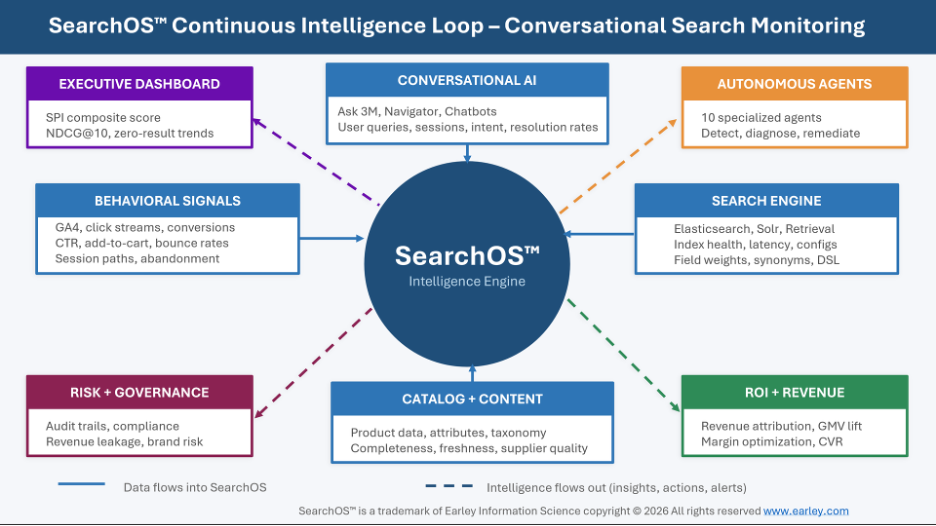
Search Monitoring On a Continuous Intelligence Loop
SearchOS creates a closed feedback loop between conversational AI, search infrastructure, catalog content, and business outcomes. Every interaction generates signals that feed optimization; every optimization improves the next interaction.

Shifting From Reactive to Predictive Search Monitoring
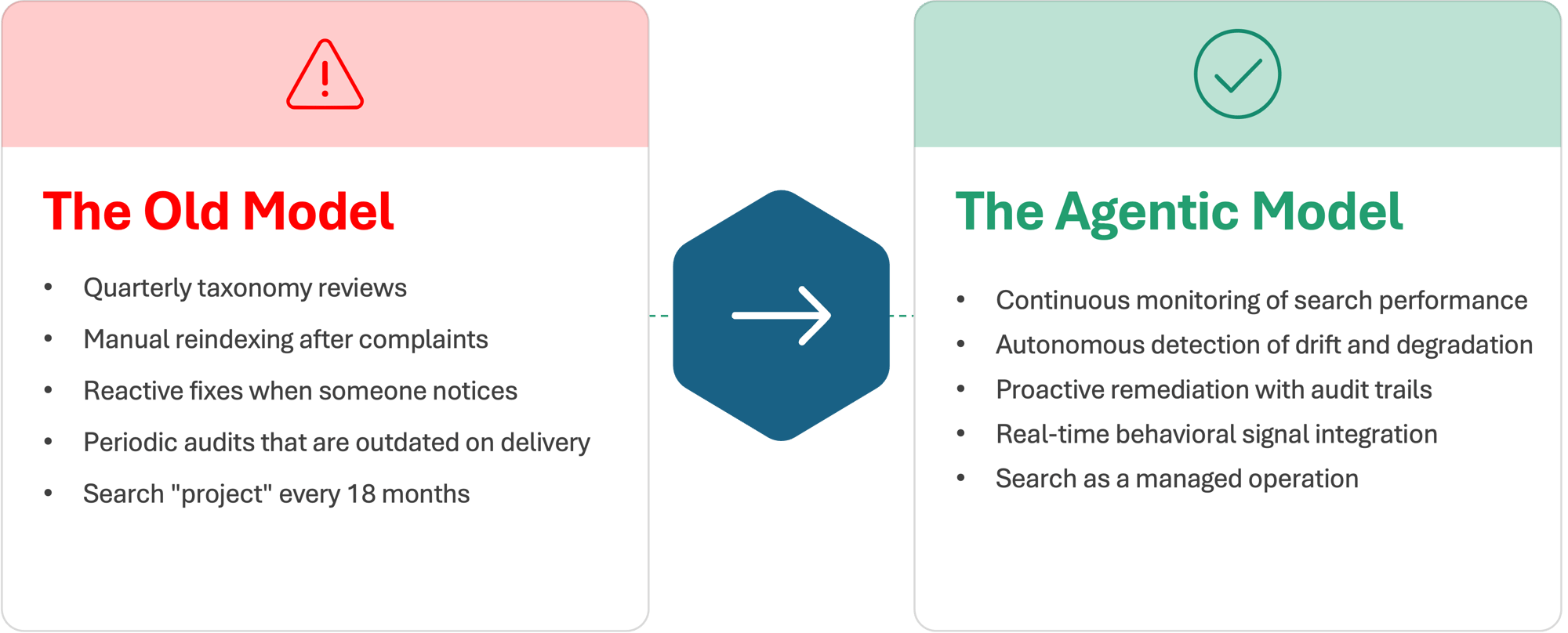
The old search monitoring model treats search as a project. You do a taxonomy redesign, reindex, tune for a quarter, then move on. Eighteen months later you do it again.
The agentic model treats search as an operation. Continuous monitoring, autonomous detection of problems, proactive remediation. The same shift that happened in DevOps is now happening in search

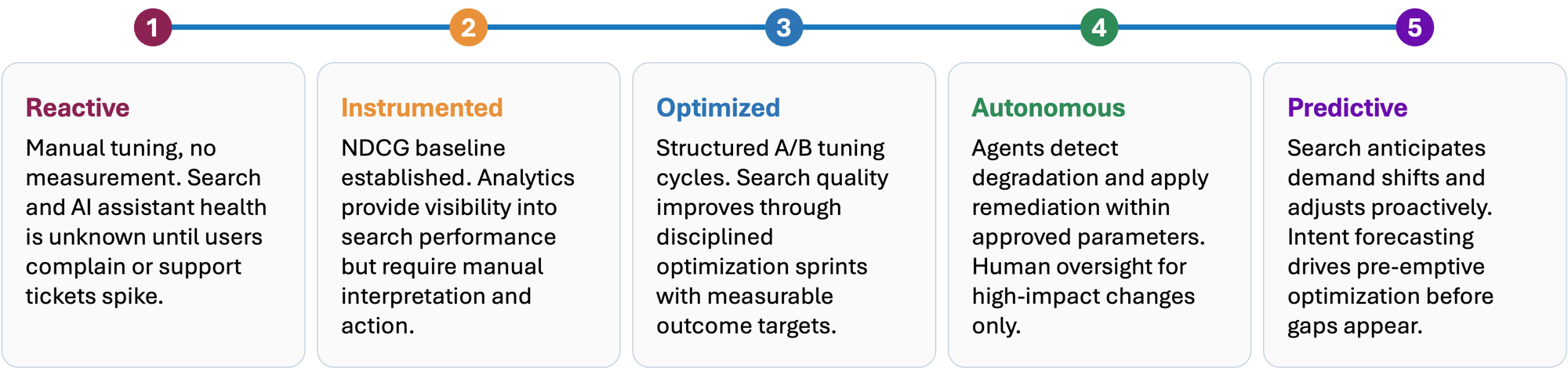
The Search Maturity Spectrum
SearchOS defines a five-level maturity progression that provides a clear picture of current state and a roadmap for improvement. Most organizations operate at Level 1 or 2. SearchOS provides a structured path to Level 4 and beyond.

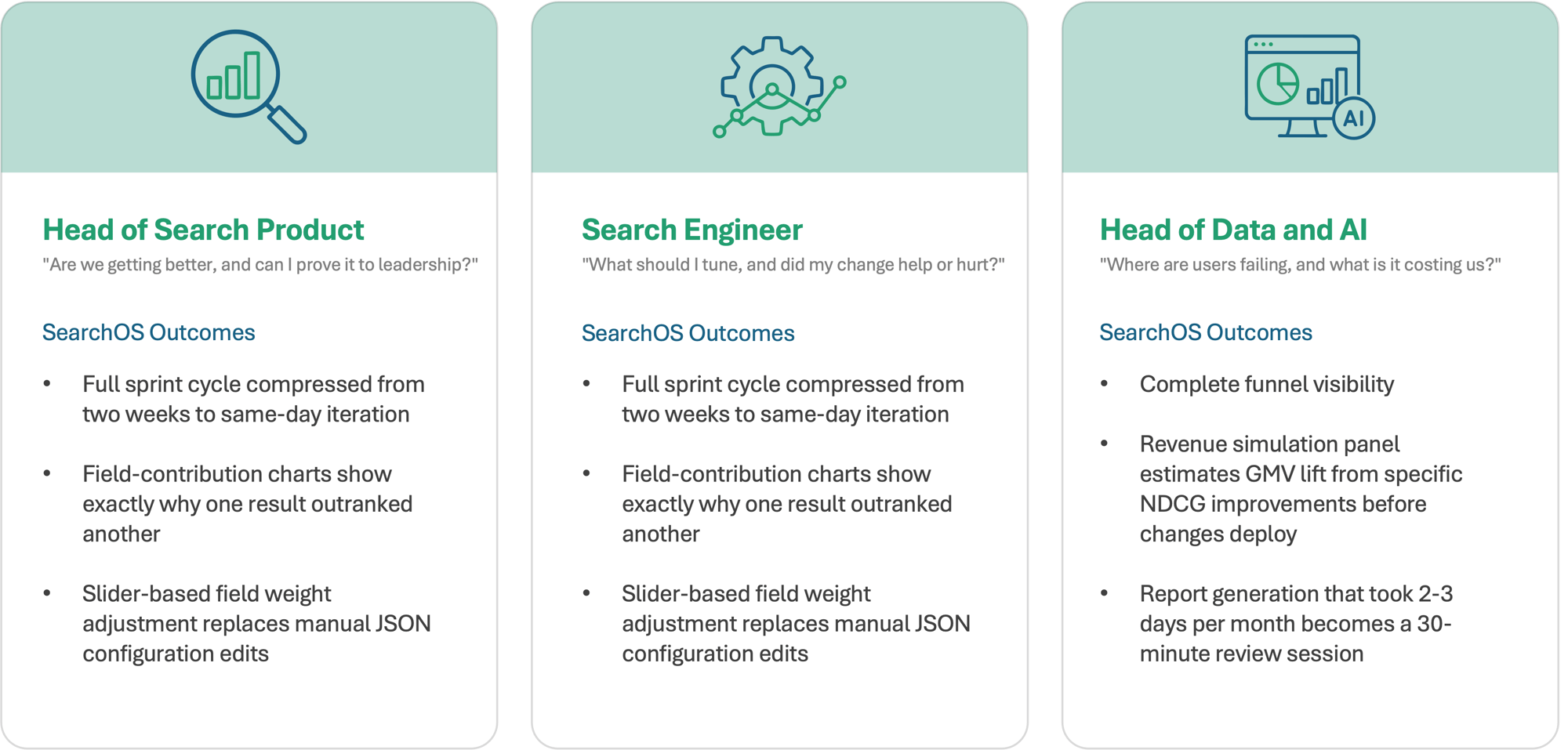
Built for Search Leaders, Search Engineers, and Data & AI Teams
SearchOS serves three roles that approach search from different angles. Whether you're proving search performance to leadership, deciding what to tune next, or tracking where revenue is leaking from a broken query, you're solving the same problem from a different seat: search performance that's invisible until it's already costing you.
SearchOS replaces the manual reporting, guesswork, and disconnected tools each role relies on today with one continuous system of measurement and optimization. The result is less time spent assembling answers and more time acting on them, with search quality and ROI improving every cycle instead of every quarter.

Why the Information Architecture Foundation Matters
SearchOS is built on 30 years of the EIS information architecture and governance methodology. This is not a marketing distinction. It is the structural reason SearchOS produces improvements that persist.
Field weighting, synonym coverage, and behavioral tuning all operate against an information model. When that model is inconsistent, incomplete, or misaligned with how users actually express intent, search fails regardless of how sophisticated the retrieval engine is. You can tune a search system built on poor information architecture, but the gains are limited and they erode quickly.
EIS knowledge architects ensure that the information architecture is an active, governed, continuously maintained asset. SearchOS makes that asset operationally visible and continuously optimized. Together, they provide what neither does alone: a search environment that improves systematically rather than degrading gradually.
This is the core distinction from pure-play search vendors: they optimize the search you already have. EIS diagnoses why it's producing the results it's producing, then builds the infrastructure to keep it improving over time.
How SearchOS Bridges the Gap Between Infrastructure and Methodology
Most organizations end up choosing between a search platform and a consulting engagement to fix their search issues, and neither one solves the whole problem.
Platforms give you infrastructure but no methodology for using it well. Consultants give you a diagnosis but leave once the report is delivered. SearchOS is built on a different premise: search and conversational AI quality depends on the information architecture underneath them, and that architecture degrades without ongoing attention. SearchOS provides that ongoing attention, continuously monitoring and maintaining it as your catalog and content evolve.
Comparing Search Solution Approaches
|
What they deliver
|
Retrieval infrastructure and tuning tools |
|---|---|
|
Where it stops
|
No IA methodology, catalog governance, or behavioral optimization built in |
|
The Result
|
Powerful tools, no discipline for applying them |
|
What they deliver
|
Assessments and recommendations |
|---|---|
|
Where it stops
|
No operational tooling left behind after the report |
|
The Result
|
Clear answers, no infrastructure to act on them |
|
What they deliver
|
Continuous measurement, optimization, and autonomous agents |
|---|---|
|
Where it stops
|
The platform keeps running after the engagement ends |
|
The Result
|
Both the discipline and the infrastructure, built in and left behind |
|
Pure Search Platforms (Coveo, Algolia, Elastic)
|
Consulting Firms
|
SearchOS
|
|
|---|---|---|---|
|
What they deliver
|
Retrieval infrastructure and tuning tools | Assessments and recommendations | Continuous measurement, optimization, and autonomous agents |
|
Where it stops
|
No IA methodology, catalog governance, or behavioral optimization built in | No operational tooling left behind after the report | The platform keeps running after the engagement ends |
|
The Result
|
Powerful tools, no discipline for applying them | Clear answers, no infrastructure to act on them | Both the discipline and the infrastructure, built in and left behind |
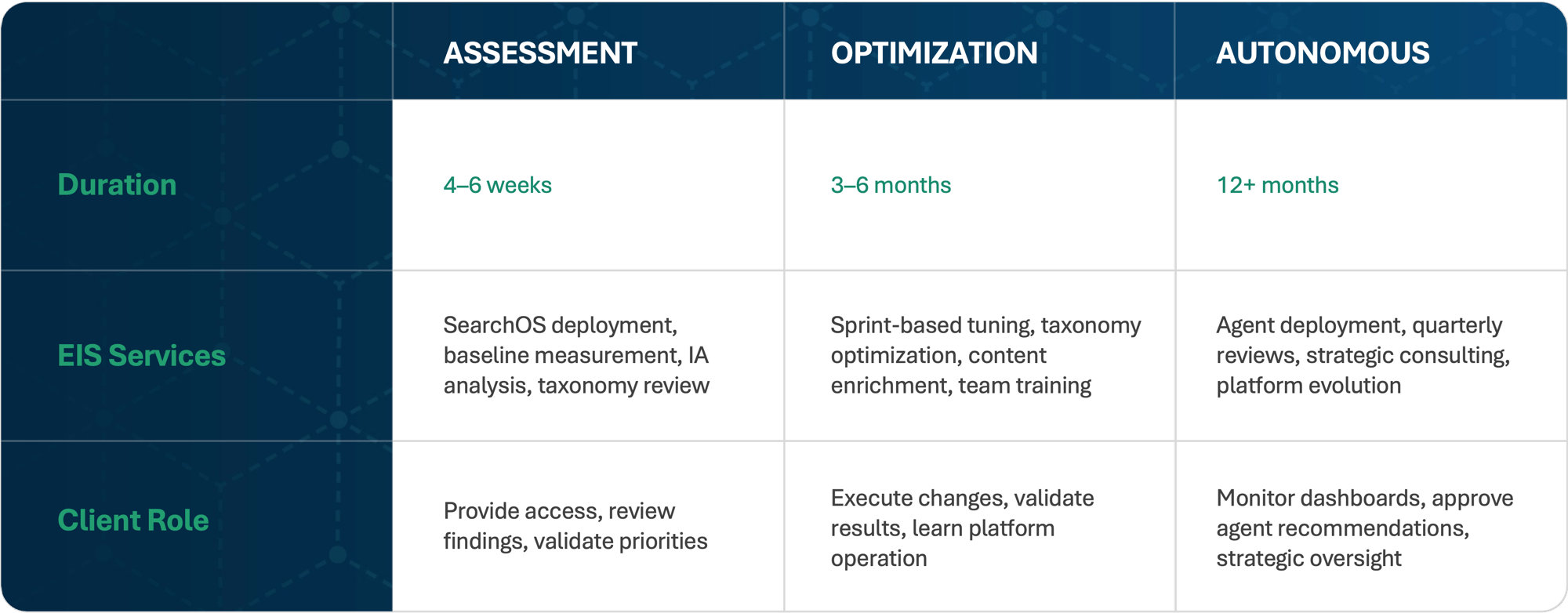
The Three Phases of a SearchOs Engagement Model
SearchOS is delivered through a model that blends professional services with SaaS operational capability. Every engagement begins with a structured assessment. Platform operations follow from what that assessment reveals.

Complete the SearchOS survey to get an assessment of where you search stands right now.
Want to know more about how SearchOS can improve your ROI? Request a personalized demo with Seth and Sanjay.
Client Testimonials
What Our Clients Say
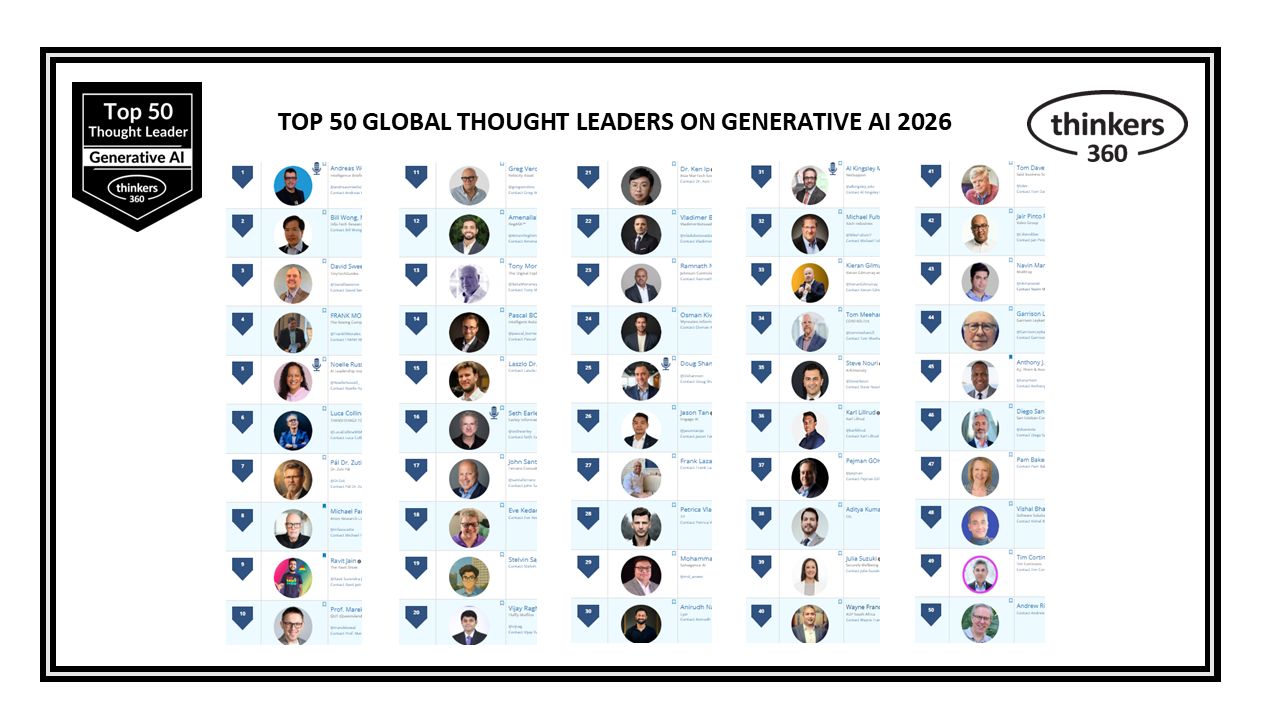
Early Information Science Thought Leadership Awards
Our expertise and knowledge in the information architecture space has been long known and respected. Here are a few of our most recent accolades.