
Enterprise transformation initiatives and customer data platforms both suffer from terminology ambiguity that complicates decision-making for prospective adopters. Digital transformation lacks clear boundaries, with definitions varying substantially across organizations. Similarly, despite the undeniable value of comprehensive customer visibility, the industry maintains no consensus regarding customer data platform specifications.
These concepts prove highly interdependent. Comprehensive customer understanding clearly represents a critical transformation component. Simultaneously, only within well-conceived transformation contexts can customer intelligence platforms deliver full potential value. This discussion clarifies definitions and functions to illuminate how transformation programs and customer data platforms should integrate effectively.
Addressing Terminology Dilution in Enterprise Change
Enterprise transformation terminology encompasses everything from tools and technologies to business processes, customer experiences, and artificial intelligence applications. Analyst and vendor definitions span IT modernization, online service deployment, new business model development, digital-first approaches, and novel process and experience creation.
Transformation challenges stem from requiring broad scope to achieve focused objectives. Common program goals include streamlining customer experiences or expanding digital revenue channels. When scope encompasses improving end-to-end customer experiences, initiatives may touch every customer-facing touchpoint and supporting technology plus underlying processes and backend systems. Goals appear straightforward and focused superficially. However, numerous interdependent elements—departments, functions, technologies, information sources, workflows—create extremely broad scope.
This necessary breadth creates sustained momentum and long-term support challenges. One organization we engaged with saw sponsors repeatedly requesting business justification midstream in multi-year programs, despite having approved funding based on comprehensive business cases two years earlier. Foundational work lacking direct ROI linkage prompted re-justification demands that stalled initiatives and eliminated critical momentum. Programs touching multiple organizational processes and divisions require careful decomposition into sub-projects, each containing multiple workstreams. Identifying intermediate achievements and returns significantly maintains sponsor and stakeholder engagement, warranting inclusion in planning processes. Customer intelligence platforms provide value across multiple contexts during large-scale transformations.
Establishing Platform Requirements Based on Organizational Needs
Customer data platform terminology proves equally ambiguous. While platform categories can be defined by particular functional clusters, broad descriptions provide limited utility for business leaders. The essential question becomes: what specific outcomes do you require from customer intelligence capabilities? This determines appropriate feature and functionality combinations.
Platform technology and functionality overlap numerous software solutions previously addressing customer record management and engagement challenges, including Master Data Management, Customer Relationship Management, and Marketing Automation technologies.
Customer Master Data Management programs pursued golden customer records but didn't necessarily consolidate cross-system interactions except when modifying primary customer records. MDM tools and programs target technical audiences, typically lacking functionality supporting marketer efforts across personas and segments.
CRM systems focus on account-level and individual contact interactions. However, most CRMs aren't purpose-built for integrating real-time or near-real-time behavioral data like clickstreams or feeding that intelligence to other applications requiring customer behavioral and preference information. As CRMs advance and marketing automation systems with personalization capabilities absorb greater functionality from other tools, convergence emerges. HubSpot, originally an inbound marketing automation technology bringing visitors through SEO and content marketing, now incorporates CRM, social media integration, and numerous functions enabling more personalized interactions based on customer digital body language. They still lack several CDP functionalities.
Customer data platforms capture both anonymous data from cookies and tracking pixels alongside authenticated data. CRM and marketing automation tools typically focus on identified users. Platforms collect entire customer journey data, whereas CRMs emphasize sales and pipeline activities. Platforms are architected for integrating and collecting substantial data volumes.
Core platform functionality builds unified customer databases while addressing multiple downstream challenges depending on technology lens and organizational problem conception. This gets influenced by how organizations believe their functions or departments can resolve issues. Platforms can manage customer engagement, provide analytics and attribution plus segmentation, and enable personalization, message selection, and campaign management.
Since platforms arrive in various configurations, organizational requirements get determined by challenge framing and supporting process maturity levels. For example, organizations wanting personalized web experiences leveraging platform functionality need certain precursors including appropriate content management systems, high-quality data, and detailed understanding of what personalization means to target customers. What constitutes authentic personalized messaging? Which customer details will differentiate messages and offers? This scenario requires journey orchestration capabilities not available in every platform.
The following diagram illustrates platform functional modes:
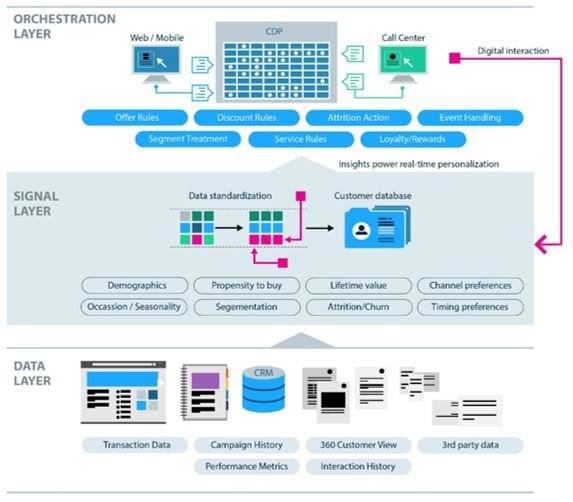
Each layer represents necessary functionality potentially included in platforms or enabled through other systems.
Bottom layer information consolidation reflects how most people conceptualize platform functionality—data integration and normalization. The next signal layer interprets information from various systems as customer digital body language, making it comprehensible for orchestration layers generating user experiences. Note that orchestration layers—where systems respond with offers, content, product recommendations, or other interactions—feed these interactions back to platform signal layers. Platforms can provide mechanisms and intelligence behind customized and personalized experiences, serving as sources for dynamically assembled content and data, or they can drive customer experience platforms where digital assets get assembled and presented.
Functionality boundaries demonstrate considerable overlap, making boundary definition critical when selecting, configuring, and deploying platforms.
Platform Contributions to Transformation Programs
Any customer-involving transformation—most qualify—requires harvesting customer interaction data and operating on that intelligence somehow. Consider customer relationships as dialogues. Any interaction can initiate dialogue. Website searches participate in dialogue, as do call center conversations. Responding to advertisements or email messages continues dialogue. Since conversations and interactions occur across numerous departments and touchpoints, conceptualize platforms as consolidating those fragmented conversations.
Platforms capture signals representing customer digital body language and integrate those signals enabling other systems and processes to respond. Responses range from website offers to personalized emails to how customer service representatives address problems. Extending this concept from chatbots to social media marketing to customer support diagnostic scripts reveals platforms potentially playing extraordinarily wide roles in customer experiences.
Because platforms can function at any customer journey point and interact with any marketing, sales, or customer experience technology, initial transformation program steps involving platforms must define application boundaries and understand process, system, and data scope included in projects. This guidance applies to any major enterprise application re-evaluation but proves particularly important when systems impact so many other applications.
Intelligence, Strategy, and Execution
David Raab's analysis of different platform types breaks down major functionality as building unified customer views through data integration and consolidation, strategic decisions using metrics, analytics, and human judgment plus creativity determining what to communicate or offer in various customer situations, and actual content delivery through various channels and devices. Whether these operations use rules or leverage machine learning and AI, human knowledge and insight remain central.
Technology assists with insight and evidence regarding decisions. However, experienced brand managers, marketers, or customer specialists determine meaningful engagement approaches. Delivery encompasses automation, message assembly, distribution, and content syndication including feedback loops forming customer engagement engines. Automation degree and customer response adaptation depend on full digital and offline marketing ecosystem maturity, integration, and architecture.
This highlights organizational needs for rigorous customer journey examination, customer lifecycle analysis, supporting tool evaluation, data source assessment, and process maturity review within market differentiation and go-to-market strategy contexts. Excellent starting points involve full marketing stack evaluations. The approach begins with customer journey mapping, exhaustive technology inventories, sanity checks about each tool's journey stage importance, and finally deployment health assessments.
Using this approach to gain holistic customer engagement technology stack understanding—plus supporting processes—helps organizations understand where platforms provide specific value and guides focused intervention opportunities. Results will be comprehensive organizational platform requirements definitions and clear program execution plans.
This article by Seth Earley was originally published on CustomerThink.