
This is Part 2 of a three-part series on scaling enterprise AI. Read Part 1: The Pilot Paradox: Why Enterprise AI Doesn't Scale the Way You Think.
Every enterprise generative AI conversation eventually arrives at retrieval-augmented generation. The concept is straightforward: connect a large language model to proprietary organizational data so it answers questions about the business rather than drawing on the internet's general knowledge. The appeal is immediate. So is the gap between the concept and enterprise reality.
RAG does not fix bad content. It amplifies it. A poorly organized, inconsistently structured content environment, fed into a retrieval system, produces authoritative-sounding disorder. The AI has no awareness that it is wrong. It serves up operationally useless results with full confidence. Understanding why this happens, and what prevents it, requires a clear look at how retrieval actually works and what information architecture makes possible at each stage.
The Retrieval Problem That Determines Everything Else
RAG operates in three stages: the system interprets the user's query, retrieves relevant content from enterprise data, and uses that content to generate a response. Most organizations concentrate their investment on the third stage while systematically underinvesting in the second.
The math is unforgiving. If retrieval accuracy is 70%, meaning three queries in ten pull the wrong documents, the system's accuracy ceiling is 70% regardless of how capable the underlying language model is. Sophisticated generation cannot compensate for retrieving wrong source material. The model is working with incorrect inputs and producing incorrect outputs with equal fluency.
Research from HBR Analytic Services confirms that 39% of organizations identify data issues as their primary challenge when scaling generative AI, and more than half rate their data foundation readiness below the midpoint of a ten-point scale. These are not technology problems. They are information architecture problems that surface as AI failures once organizations attempt to move beyond controlled pilots.
What Context Actually Means in Enterprise Retrieval
Context is the most frequently invoked and least operationalized concept in enterprise AI. Vendors use it to describe semantic understanding and vector embeddings. For enterprise retrieval, context is something more specific, and more dependent on foundational work that precedes any AI technology decision.
Three questions a field service technician might ask an AI assistant illustrate the point concretely. "How do I set up my modem?" requires knowing which modem, which model number within a product family, and whether this is a residential or commercial installation. "Where is the installation guide?" requires knowing which product, which version, and whether the user needs a quick-start card or a comprehensive manual. "What does error code 50 mean?" requires knowing which product, since the same code may mean entirely different things across two models in the same product line, and at what stage of installation or operation the error occurred.
Each question sounds simple. Each is impossible to answer reliably without context that must be built into the content architecture before the AI encounters it. The system does not develop these distinctions on its own. Information architecture provides them.
The Prompt as Metadata Container
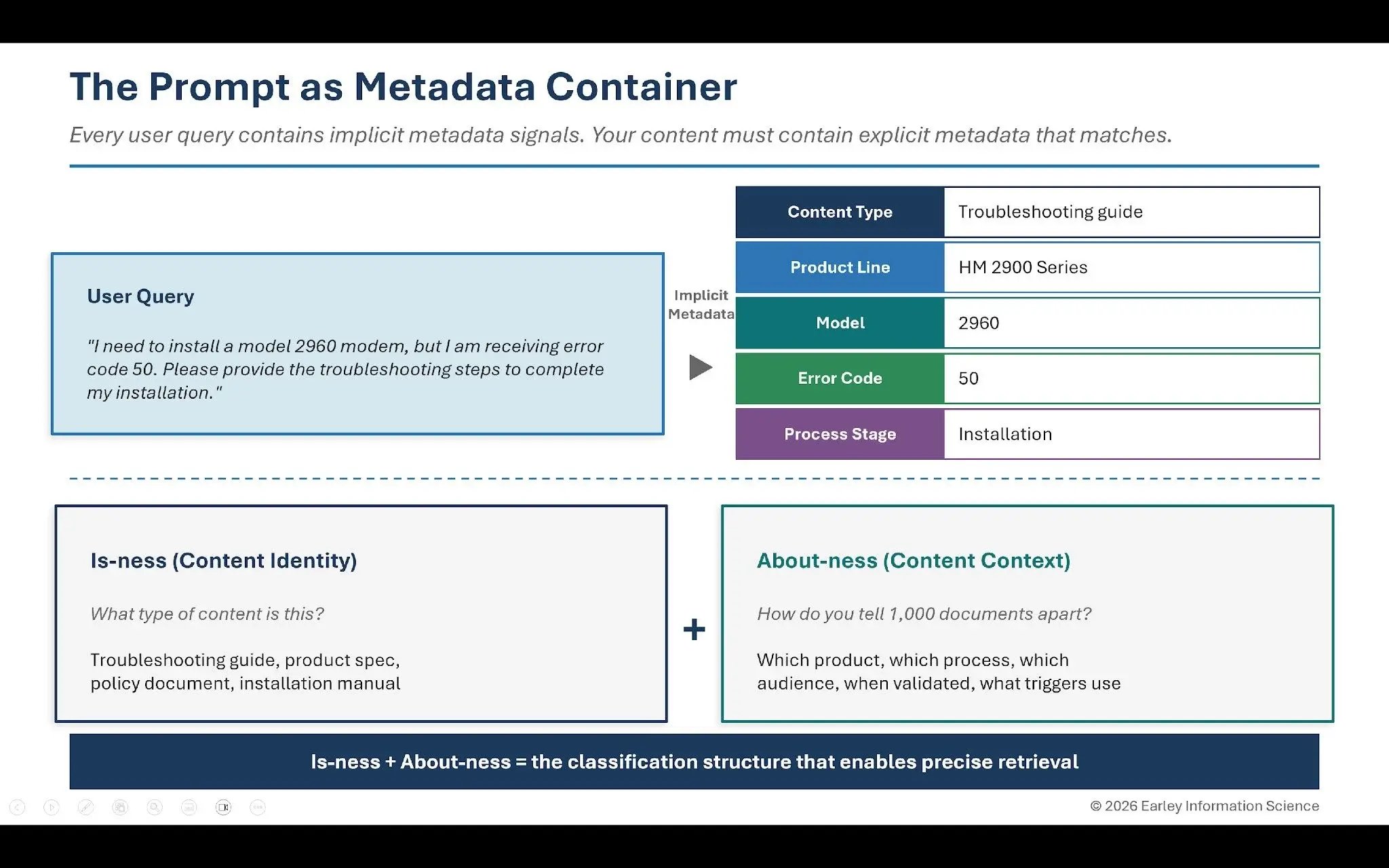
A concept that fundamentally reframes how to think about generative AI retrieval: every user prompt is a metadata container.
When a field service technician types "I need to install a model 2960 modem and I am receiving error code 50 during installation, please provide troubleshooting steps," that query embeds several explicit metadata signals: the content type needed (troubleshooting guide, installation instructions), the product line (HM 2900 Series), the specific model (2960), the error code (50), and the process stage (installation). The AI uses these signals to retrieve relevant content, but it can only retrieve content that has been tagged with matching metadata. If troubleshooting guides are not tagged by product, model, and error code, the system cannot match the query to the correct answer.
This is the core of why organizations with capable models still get poor results. The model understands what the user is asking. The content is not structured to provide the answer. The user's question contains implicit metadata. The content must contain explicit metadata that corresponds to it. Information architecture builds that bridge.
[Figure: The Prompt as Metadata Container diagram]
Is-ness and About-ness: A Classification Framework
EIS has applied a two-part classification framework across more than two decades of information architecture work, originally developed in the context of product data management and applicable directly to the enterprise AI challenge. The framework organizes content along two axes.
Is-ness answers: what type of content is this? If you handed it to someone without any context, what would they call it? A service procedure. A product specification. A troubleshooting guide. A policy document. An installation manual. Is-ness defines the content type.
About-ness answers: given a thousand documents of the same type, how do you tell them apart? Which product does this cover? Which process does it support? Which audience is it intended for? When was it last validated? What conditions trigger its use? About-ness defines the metadata schema for each content type.
Is-ness gives you categories. About-ness gives you the attributes within each category that make precise retrieval possible. Most organizations have is-ness reasonably well established. They can identify a troubleshooting guide when they see one. Few have about-ness systematically defined across their content environment. That gap is why their AI retrieves five troubleshooting guides when it should retrieve one.
How Use Cases Define Architecture Requirements
Information architecture connects to business strategy at the level of specific use cases. A simple formula makes that connection explicit: as a specific role, I need to perform a specific action so I can achieve a specific outcome.
For a field service organization, that might look like: as a field service technician, I need to locate troubleshooting guides so I can service equipment quickly with minimal customer downtime. Or: as a field service technician, I need to know which spare parts are available and how to procure them before arriving at a service call.
Each use case defines precisely what metadata the content requires. The first tells you that troubleshooting guides must be findable by equipment type, symptom, and error code. The second tells you that parts information must be linked to specific equipment models with availability status and procurement pathways. Multiplied across the full set of priority use cases, this process produces a complete information architecture requirements specification derived from actual work the AI needs to support, not from theoretical taxonomy exercises.
Use cases also generate the test cases for measuring RAG performance. Each one becomes a question the system should be able to answer accurately. When it cannot, the failure points directly to the specific content or metadata gap that needs to be addressed.
Building the Foundation: A Practical Sequence
Enterprise-scale information architecture can sound overwhelming. The approach that works in practice is progressive enhancement: building metadata and structure incrementally rather than attempting comprehensive coverage at the outset.
The starting point is identifying the five to seven metadata fields that matter most for the priority use cases. Content type, product or domain, intended audience, authority level (draft, approved, retired), and effective date will cover most high-value retrieval needs. A competent content contributor can apply these fields in under two minutes per document, which makes the initial enrichment effort tractable even for large content environments.
Once a core metadata foundation exists, AI can accelerate enrichment substantially. Topic extraction, audience inference, entity recognition, and relationship identification can all be performed by AI systems operating against an established baseline. Human reviewers validate suggestions, creating a feedback cycle that is orders of magnitude faster than manual tagging alone. Usage patterns then provide a continuous signal for refinement: queries that succeed and fail, co-access patterns that suggest relationships the metadata has not yet captured, and user feedback that surfaces gaps between what content owners think they have and what users actually need.
This sequence respects organizational reality. Content owners have finite capacity. Governance processes take time to mature. Starting simple and iterating consistently outperforms starting comprehensive and stalling.
The Competitive Implication
Organizations that invest in strong information architecture will not simply have better generative AI results. They will have built foundational infrastructure that supports every subsequent AI capability: more precise search, more relevant personalization, richer analytics, and eventually agent-based systems that can act reliably across domains. The metadata foundation normalizes meaning across the enterprise, enabling integration between systems that were never designed to work together and creating a shared semantic layer that makes each new AI application faster and cheaper to deploy than the last.
AI models will continue to improve and new capabilities will emerge at pace. The requirement for structured, well-governed content will remain constant regardless of what changes at the model layer. The organizations investing in this foundation now are building a compounding asset that organizations which defer the work will find increasingly difficult to replicate.
There is no AI without IA. The organizations that act on this will lead.
This is Part 2 of a three-part series on scaling enterprise AI. Part 1, "The Pilot Paradox," examined why integration complexity grows exponentially. Part 3, "Governance That Enables Iteration," addresses the feedback loops and operating model that sustain AI quality at scale.
Read the original version of this article on VKTR.