
Digital transformation projects often focus more on tools and technologies than on content and context. For most organizations today, operating as a digital business is not a strategic option. It is a matter of survival. Competitors in every marketplace are investing in advanced digital capabilities to attract and retain customers. Without the right information foundation, even the most sophisticated technologies will underperform.
The Digital Transformation Imperative
There was a time when digital transformation was considered a strategic vision for how organizations evolve from a traditional model of customer engagement to the new digitally enabled and data-driven go-to-market paradigm. That time has passed. The choice is simple: embrace the digital age now and stay competitive, or risk becoming irrelevant.
According to Altimeter Group, 88% of companies are undergoing digital transformation efforts. However, the same survey indicates that only 25% of respondents can map their customer journey in terms of digital touchpoints, an indication that these initiatives often lack the necessary know-how to succeed.
This points to a central issue that threatens the success of any digital transformation project: focusing on tools and technologies without a comprehensive information architecture that delivers the contextual data and content required to make them effective. Without the right information strategy to provide a solid foundation, investing in state-of-the-art technologies is like having a Ferrari in the garage but having rutted dirt roads to drive on. An effective information infrastructure must deliver the right content to the right user or customer at the right moment, or performance will suffer.
The cost of getting it wrong
For B2C organizations, merchandising needs to react to data in near real time. Marketing needs to measure campaign effectiveness and rapidly adjust. Customer service needs access to all customer data and must be able to supply answers immediately. Commerce teams need to get products on the website quickly and efficiently and associate them with the right content.
B2B organizations face the same challenges. Even if a company does not sell through its website, business customers still learn about offerings and solutions online. Prospective buyers are armed with knowledge and information, and if yours is out of date, they will go to a competitor.
What is typically missing
Companies are amassing enormous volumes of data and content from multiple sources, stored across multiple systems and applications, consumed by users with diverse needs, and updated simultaneously by many processes. And frequently without:
- An overarching knowledge framework to guide usage
- A harmonized, consistent structure
- Information quality processes and governance
- Mechanisms for onboarding new content and data sources
- Scorecards to monitor business impact
Under these circumstances, digital transformation efforts will be at best hindered and at worst will fail.
Context-Aware Information Infrastructure
For any digital technology to be effective, it must deliver content in context. Customers only care about what they care about. Employees only care about information that is relevant to the business problem they are solving. Contextualization is actually a very complex information architecture challenge. It requires sophisticated content modeling and relationship mapping between information types and categories, with supporting governance and change management processes.
Context enhances everything: the relevance of content marketing, the impact of product recommendations, the accuracy of search, and the precision of business analytics. Without context, content loses value and its impact on digital business performance will be diminished.
The contextual information value chain
Contextualization of information can be viewed as a value chain. Data and content provide the greatest value to the enterprise when viewed holistically across information silos, where they can be organized, structured, harmonized, and tagged to deliver more meaningful analytics and attributes that represent contextual relationships.
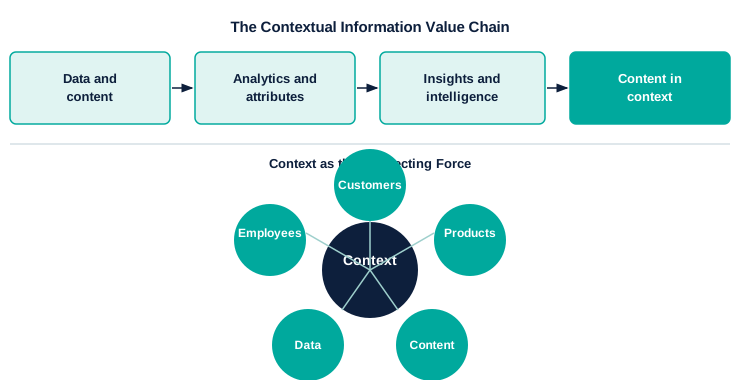
Figure 1: The contextual information value chain
The reference architecture
Realizing the benefits of the information value chain requires a context-aware information infrastructure: a framework for building an external digital commerce engine or an internal digital workplace. The following reference architecture illustrates this framework.
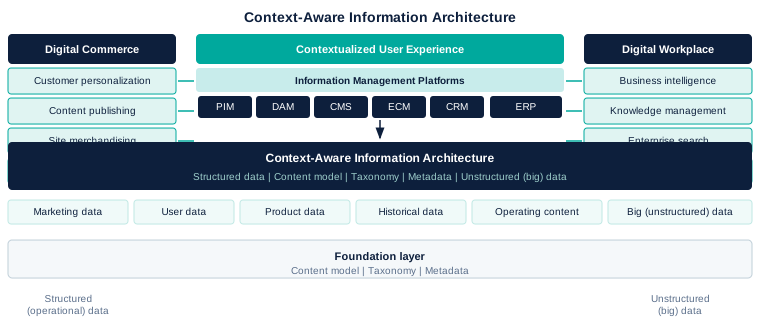
Figure 2: Context-aware information architecture reference model
This architecture illustrates the importance of building a solid foundation of content structures (models), consistent terminology (taxonomies), and data standards (metadata) for transforming digital technologies into business solutions. Beginning at the business strategy, developing consistent business language, and then translating into the various technical elements across the enterprise information ecosystem leads to a significantly improved outcome over traditional approaches that typically begin with a focus on technology.
The accuracy and completeness of this architecture will make or break the performance of the tools and technologies that power a digital business. Before making investments in systems or replacing technologies, be sure to have a comprehensive information architecture design and a roadmap in place for operationalizing it.
"When we fixed the taxonomy, the technology finally worked like it should!" - CIO of S&P manufacturer
Enhancing the Customer Experience
An obsession with the customer's contextualized experience will drive higher revenues, customer loyalty, and retention. Research consistently shows that buyers expect and prefer a personalized online shopping experience, as long as the personalization is accurate. It saves customers time and helps them make the best purchasing decision for their needs.
For a customer profile to be accurate, it must be based on a number of data points that typically reside in multiple systems. These include purchasing history and buying behavior, market segment data, customer service information, and real-time site behavior, the "digital body language" of the customer.
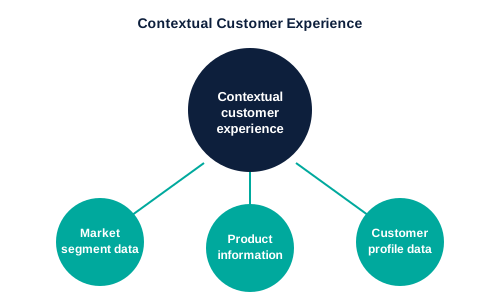
Figure 3: Contextual customer experience
Customer profile data sources
- Purchase history
- Clickstream data
- Social media data
- Customer journey data
- Channel preferences
- Market segment data
- Demographics
- Psychographics
Effective personalization outcomes
- Better product recommendations
- Contextual search results
- Relevant content marketing
- Context-driven promotions
- Improved engagement
- Greater brand loyalty
- Increased wallet share
Real-world results from past EIS projects
- 20%+ increase in SEO page entries
- Up to 40% increase in product search click-through rate
- Up to 40% increase in product detail page conversions
- Double the pace of item onboarding
- Reduction or elimination of onboarding backlog
- 20%+ increase in website usability customer satisfaction
"We spent millions upgrading technology... looking back, I'd get the taxonomy right from the beginning!" - Chief Marketing Officer, $8B Scientific Equipment Maker
Streamlining the Digital Workplace
The same level of contextual modeling required for customer experience is also required for streamlining the digital workplace and implementing knowledge management solutions. Instead of buyer profiles and market data, the contextual model for knowledge management is based on business processes and role-based access to information by employees.
Planning for an audit is a very different process than releasing a clinical trial. Planning a marketing campaign is a very different process than troubleshooting a support issue. A user in human resources requires a different view of data than an engineer or a salesperson.
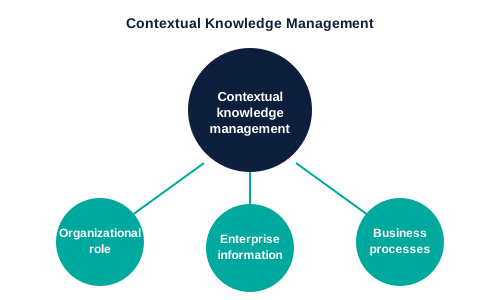
Figure 4: Contextual knowledge management
Benefits of a streamlined digital workplace
- Fast and actionable business intelligence
- Integrated real-time and historical analytics
- Easy access to structured and unstructured data
- Improved process and operational efficiency
- Instant market intelligence and business agility
- Deeper insights and innovation abilities
- Faster product development and improved time to market
- Actionable customer knowledge and market insights
- Alignment of customer experience with operational metrics
- Improved market agility and competitive responsiveness
Digital agility requires efficient upstream processes. Improving the user experience requires removal of sources of friction caused by poor search functionality, manual manipulation of data, and the re-creation of content rather than reuse of existing assets.
Design, Delivery and Deployment
A common approach for undertaking the design, delivery, and deployment of an information architecture is to choose the right champion, form a team, and follow a controlled methodology with defined phases and a phase review process.
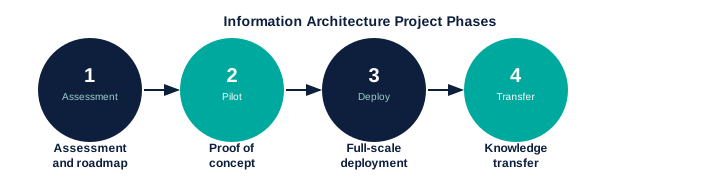
Figure 5: Information architecture project phases
| Phase | Description | Key outputs |
|---|---|---|
| 1. Assessment and roadmap | Assessment of business goals, functional requirements, resource planning, and a high-level project schedule. High-value content and data supporting high-priority processes are identified. Baseline metrics are linked to the desired business outcome. Business ownership and financial stakeholder buy-in are critical. | Roadmap, business case, ROI model or cost-of-doing-business framework |
| 2. Proof of concept | Elements of the design are tested on a small and manageable scale to ensure feasibility and identify any hurdles or gaps in functionality, performance, usability, or scalability. A detailed scope of work is developed in preparation for deployment. | Validated design, detailed scope of work, go/no-go recommendation |
| 3. Deployment and adoption | Wider deployment across the organization including targeted high-priority information management platforms. Includes complete information architecture design, detailed taxonomy and metadata, classifying and tagging content, integrating information across systems, data cleansing, governance, and compliance processes. Rigorous testing before go-live. | Deployed information architecture, integrated systems, governance processes, tested solution |
| 4. Knowledge transfer and user training | Knowledge transfer throughout the project and at project close-out. All relevant personnel are trained. Business stakeholders are educated about their role in applying the new information infrastructure, ongoing content curation, and information hygiene. | Trained teams, documented processes, sustained change management |
Typical business solutions
EIS supports a wide range of solutions across B2C and B2B digital commerce as well as the digital workplace, including product curation and catalog management, site merchandising taxonomy and attribute design, product search and findability, product information management, enterprise content and records management, and enterprise knowledge management.
Choosing Your Champion
Given the complexity associated with an initiative of this scale and impact, you will want to carefully consider who acts as your champion for the information architecture initiative. The champion must have a deep understanding of information management practices while at the same time having strong expertise on the business side. Most business people do not understand information science, and most IT practitioners do not understand business challenges and strategies to overcome them.
Information Architects for the Digital Age
Earley Information Science is a consulting firm that focuses on information architecture for the digital age. We bridge the gap between your digital agency, your platform vendors, your internal IT staff, and your business stakeholders. We have been information architects for more than 20 years and have helped the world's leading brands leverage their information into a strategic asset.
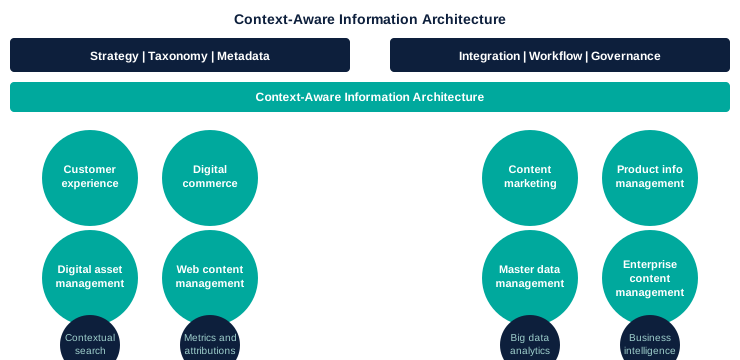
Figure 6: Context-aware information architecture services
What our clients say
- "Our IT stack was state-of-the-art but our taxonomy and product data had not been properly managed."
- "The value that Earley brought was visible from the beginning."
- "Helping us to arrive at a consensus and path forward was invaluable."
- "Great assessment of business. Helped build a compelling business case."
- "You have earned the right to ask for more business and you have achieved trusted business advisor status."
Diverse Industry Experience
EIS has diverse experience in industries ranging from retail and consumer products to financial services and insurance, from manufacturing to energy and utilities, from life sciences to non-profit and public sector organizations. We have helped some of the most recognized names in these industries realize their vision for digital transformation.
