
1. Introduction: Why Governance Is the Core of Enterprise AI Readiness
Enterprise AI does not fail because of models. It fails because of lack of structure, lack of boundaries, undefined authority, and absence of oversight. In knowledge-intensive enterprises, AI interacts with regulated processes, expert workflows, safety-critical decisions, complex product ecosystems, multi-jurisdictional rules, and large volumes of versioned content. Without governance, AI introduces risk instead of reducing it.
AI governance is the set of policies, frameworks, decision rights, safeguards, controls, and oversight mechanisms that ensure AI systems behave predictably and responsibly. Governance defines how AI must operate within the enterprise: what it may do, what it must not do, and what it must escalate.
The uncomfortable truth is that most enterprise AI failures are not technology problems. They are governance and information architecture problems. Organizations rush to implement the latest LLMs while overlooking the foundational work that determines whether AI delivers lasting value or becomes another expensive experiment. The pilot works in a controlled environment with curated data and a motivated team. But when it comes time to scale from a chatbot that works in one department to an assistant that spans the enterprise, organizations hit a wall. That wall is governance.
This is not an anecdotal pattern. Gartner's July 2024 research predicted that 30 percent of generative AI projects would be abandoned after proof of concept by the end of 2025, citing poor data quality, inadequate risk controls, and unclear business value as the leading causes (Gartner, "Gartner Predicts 30% of Generative AI Projects Will Be Abandoned After Proof of Concept By End of 2025," July 29, 2024). MIT's Project NANDA reached a similar conclusion from a different angle in its 2025 "State of AI in Business" research: 95 percent of enterprise generative AI pilots failed to deliver measurable ROI, with the report attributing the gap not to model quality but to organizations lacking the operational discipline (including governance and integration) to move from pilot to production. Both findings point to the same wall this section names.
Enterprise AI governance ensures that:
- AI retrieval remains within approved boundaries
- Models adhere to version-controlled, validated content
- Regulatory constraints are respected automatically
- Safety warnings are never detached from the steps they govern
- Escalation is triggered when uncertainty is high
- Sensitive or regulated information is protected
- Models cannot generate outputs that circumvent policies
- SMEs maintain authority over domain logic
- Decisions are documented, traceable, and reviewable
- Governance rigor is proportional to risk, accelerating low-risk innovation while ensuring appropriate controls for high-risk deployments
Without governance, even the best AI system becomes a liability. With governance, AI becomes a controlled, auditable, enterprise-grade capability that strengthens operational consistency, reduces risk, and supports scalable transformation.
This pillar explains the full structure of enterprise AI governance, including risk frameworks, policy design, oversight structures, safety controls, compliance alignment, lifecycle management, monitoring, and enforcement mechanisms. It incorporates proven operational patterns from enterprise governance deployments that have remained effective for more than a decade, adapted for the specific challenges of AI in knowledge-intensive organizations.
2. What AI Governance Means in Knowledge-Intensive Enterprises
AI governance is not a single document or committee. It is a multilayered system of controls, authority structures, processes, and decision rights that collectively ensure AI systems behave in ways that are safe, compliant, and aligned with organizational goals.
In knowledge-intensive enterprises, governance must do more than prevent misuse. It must actively encode the domain logic, safety requirements, regulatory expectations, and operational boundaries that shape how AI interacts with the organization.
AI governance includes:
- Policies that define what AI may and may not do
- Standards that drive consistency in everything AI touches
- Procedures that specify how AI is developed, reviewed, and validated
- Controls that prevent unauthorized or unsafe behavior
- Oversight mechanisms that provide authority and accountability
- Risk frameworks that classify and mitigate AI risk proportional to business impact
- Safety practices that prevent harm
- Monitoring systems that maintain long-term stability
- Auditing processes that ensure compliance
- Success metrics that measure governance effectiveness, not governance activity
Governance transforms AI from an unpredictable tool into a structured, dependable component of the enterprise operating model. The critical distinction: governance must enable velocity, not impede it. When governance is perceived as a bottleneck, users route around it. The framework must demonstrably accelerate AI delivery for low-risk use cases while ensuring appropriate rigor for high-risk deployments.
3. Pillars of an Enterprise AI Governance Framework
A mature governance system consists of interconnected pillars. Each pillar supports a specific dimension of safety, control, or alignment. Together, these pillars form a comprehensive framework for managing AI behavior across the enterprise.
3.1 Policies: Defining the Boundaries of AI Behavior
Policies establish foundational rules governing AI operations. They articulate where AI can be deployed, where it cannot, which decisions require human oversight, what content AI may access, prohibited data categories, risk thresholds, compliance obligations, and transparency requirements.
Policies protect organizations from unconstrained AI use across domains including:
- AI usage and acceptable use
- Model access and content access
- Data privacy and retention
- Security and identity controls
- Model lifecycle and update policy
- Third-party model and vendor governance
- Transparency and disclosure policy
- Incident response and escalation
- AI model and tooling governance, including evaluation, pricing, and approval processes for AI models and tooling at enterprise level
Policies define the legal and operational perimeter within which AI must operate. Without a defined process for evaluating and approving AI models and tooling, vendors sell capabilities directly to business units, creating unauthorized acquisition risk, architectural fragmentation, and cost duplication.
3.2 Standards: Ensuring Consistency, Clarity, and Structural Integrity
Standards translate policies into actionable operational requirements. They define metadata requirements, taxonomy usage, ontology alignment, knowledge-unit structure, terminology rules, input conditions, output formats, risk categorization, and version markers.
Standards ensure that every piece of content AI consumes or produces aligns with consistent, repeatable patterns. Without standards, variability in content structure creates variability in AI behavior, which is a direct risk.
3.3 Procedures: Operationalizing Governance in Day-to-Day Processes
Procedures define how governance is executed. They describe who performs each step, when actions are taken, how reviews and approvals occur, how exceptions are handled, how auditing is performed, how incidents are managed, and how escalation is triggered. Procedures convert policy requirements into daily operational practices, ensuring consistency across teams, traceability, reviewability, compliance with internal and external expectations, and clear handoffs between SMEs, governance teams, and AI teams.
Procedures protect the organization from inconsistency and ambiguity. In enterprise deployments, the most common procedural failure is a one-size-fits-all review process. When every AI request goes through the same review regardless of risk level, the result is predictable: everything slows to the pace of the highest-risk use case, low-risk experiments are bottlenecked, and high-risk deployments receive insufficient rigor. Procedures must be tiered to match risk classification.
3.4 Controls: Preventing Unsafe, Unapproved, or Noncompliant Behavior
Controls are the safeguards that ensure AI systems cannot behave outside approved parameters. Controls may be technical, procedural, or structural. They include access controls, role-based permissions, version restrictions, applicability filters, content boundaries, output constraints, mandatory escalation triggers, review gates, rate limits, and audit logs. Controls operationalize governance by enforcing boundaries and preventing unintended use.
3.5 Oversight: Committees, Authority Structures, and Decision Rights
Oversight gives governance its power. Without defined authority, governance is symbolic rather than operational. The most common failure pattern in enterprise AI governance is a single committee that meets infrequently, handles both strategic and tactical decisions, and becomes either a bottleneck or a rubber stamp. Effective governance requires separation of concerns across multiple bodies with distinct charters, cadences, and decision authority.
Oversight moves governance from policy to operational discipline. Section 6 of this document provides a detailed three-tier governance operating model that addresses these requirements.
3.6 Risk Frameworks: Classifying and Managing AI Risk
A risk framework defines how the organization identifies AI risk, classifies risk levels, evaluates risk impact, applies mitigating controls, determines required review processes, escalates high-risk cases, and protects the enterprise from exposure. Risk frameworks ensure that AI activity aligns with the organization's appetite for risk. Section 5 provides a detailed risk tiering framework with specific approval paths and timelines.
The Purple Book Community's "State of AI Risk Management 2026" research (published March 2026) found a widening confidence gap between organizations that report having an AI risk framework on paper and those whose practitioners say that framework actually governs day-to-day AI use. The tiered model in Section 5 is built specifically to close that gap: a framework nobody applies to real requests is not a risk framework, it is a document.
3.7 Monitoring and Auditing: Ensuring AI Remains Safe Over Time
Monitoring protects the enterprise from drift, misuse, degradation, or unexpected changes in AI behavior. Auditing ensures governance itself remains effective.
Monitoring includes drift detection, output quality evaluations, hallucination detection, applicability boundary checks, retrieval accuracy assessments, safety violation alerts, and transparency and explainability reviews.
Auditing includes periodic policy reviews, compliance audits, model performance audits, content and metadata audits, and risk and safety audits. Monitoring and auditing keep AI aligned with enterprise expectations long-term.
4. AI Risks in Knowledge-Intensive Enterprises
Knowledge-intensive enterprises face unique AI risks because their operations depend on highly technical documentation, regulated procedures, expert decision flows, and domain logic that must be applied precisely. When AI retrieves or generates information in these environments, the consequences of error are amplified. Incorrect outputs can lead to regulatory violations, operational failures, product defects, safety incidents, customer harm, legal exposure, and large-scale financial impact. Unlike consumer AI use cases, enterprise AI systems must operate within strict boundaries, reflect authoritative knowledge, and maintain alignment with SME-validated meaning at all times. Risk mitigation is not an optional layer but a core requirement for responsible AI deployment.
Gallagher's 2026 AI Adoption and Risk Benchmarking survey of risk and insurance professionals found that while 82 percent of organizations report positive impacts from AI adoption, data protection and AI errors or hallucinations remain the top-cited unresolved challenges, well ahead of cost or performance concerns. Adoption is outrunning governance at almost every organization surveyed, which is precisely the imbalance this section addresses.
AI risk in these organizations arises from several interconnected factors: content complexity, version variability, jurisdictional distinctions, domain-specific exceptions, incomplete or ambiguous documents, SME-dependent logic, regulatory requirements, and high-risk workflows. When AI interacts with unstructured, inconsistent, or outdated content, retrieval becomes unpredictable. Without governance, AI may combine steps across variants, apply rules outside their intended context, hallucinate missing logic, or offer guidance that circumvents mandatory escalation.
4.1 Retrieval of Incorrect, Unsafe, or Inapplicable Recommendations
In knowledge-intensive environments, the most common and most dangerous AI failure is retrieval of content that is technically correct but contextually wrong. AI may retrieve procedures intended for a different product variant, rules applicable only in specific jurisdictions, steps designed for older firmware versions, or guidance meant for expert-level technicians rather than frontline personnel. Because embeddings match content based on statistical similarity rather than semantic intent, retrieval errors occur whenever meaning is implied rather than explicitly encoded. Governance structures, risk filters, applicability boundaries, and explicit metadata are required to prevent these errors.
4.2 Overgeneralization, Concept Blending, and Misapplied Rules
LLMs tend to generalize, blending similar concepts when boundaries are not explicitly stated. This is dangerous in domains where distinctions matter, such as risk classifications, policy rules, equipment configurations, or product variants. AI may merge definitions, collapse regulatory categories, or treat exceptional conditions as standard cases. Clear definitions, disambiguated terminology, structured taxonomies, and explicit exceptions help preserve distinctions that are essential to correct reasoning.
4.3 Ambiguity, Vague Language, and Missing Boundaries
Many enterprise documents rely on SME intuition or contextual understanding to interpret meaning. Phrases like "use appropriate judgment," "follow best practices," "as needed," or "based on experience" are common in human-oriented documentation but problematic for AI. When boundaries are not explicitly stated, AI fills in the gaps, often incorrectly. Ambiguity is one of the leading causes of hallucination-driven responses, because AI must infer intent from incomplete context. Governance requires content to be engineered with clarity, precision, and full contextual boundaries, ensuring AI never has to guess what a human would implicitly understand.
4.4 Hallucinations Used as Factual or Operational Guidance
Hallucinations occur when AI generates plausible but incorrect information. This risk is amplified in enterprise environments, where models often respond confidently to questions outside their knowledge scope. Without governance, AI may fabricate procedural steps, regulatory conditions, diagnostic pathways, definitions, product specs, risk classifications, and compliance requirements. These hallucinations are especially dangerous because they resemble expert guidance. Governance requires mandatory escalation for low-confidence queries, strict retrieval boundaries, output verification procedures, and human review for high-risk interactions.
4.5 Exposure of Sensitive, Regulated, or Confidential Information
Enterprise AI systems interact with knowledge that may be subject to strict confidentiality, privacy, regulatory, or contractual constraints. Without governance, AI systems may inadvertently retrieve or generate internal procedures, product specifications, customer records, proprietary processes, regulated documents, draft content not approved for external use, or information restricted to specific roles. Governance must define role-based access, content boundaries, masking and redaction rules, user authorization levels, and controls that prevent models from retrieving content outside their allowed scope.
4.6 Failure to Comply With Regulatory or Industry Standards
In industries such as life sciences, insurance, finance, public utilities, and manufacturing, regulatory compliance is a non-negotiable requirement. AI cannot infer these requirements on its own. Without governance, models may generate outputs that violate regulations, omit mandatory steps, or propose actions that are not compliant with applicable standards. Governance enforces alignment with regulatory frameworks, ensuring outputs are safe, auditable, and grounded in approved content.
4.7 Lack of Traceability, Explainability, and Accountability
Enterprise AI systems must be explainable. When AI generates recommendations in high-risk contexts, stakeholders must be able to trace where the answer came from, which content was used, which rules were applied, which SME validated the logic, which version of the content was referenced, and what approval workflow governs the action. Without explainability and traceability, enterprises cannot meet regulatory requirements or internal compliance mandates.
4.8 Escalation Failures and Over-Automation
AI should never answer questions that exceed its authority. Without governance, AI may attempt to diagnose complex failures, provide legal or regulatory interpretations, make risk classifications, offer engineering recommendations, bypass SME approval, or propose actions requiring licensed expertise. AI that answers when it should escalate is a systemic risk. Governance defines mandatory escalation conditions, confidence thresholds, and decision boundaries that determine when human oversight is required.
4.9 Drift in Model Behavior Over Time
AI models change as content updates, operational context evolves, user behavior shifts, embeddings drift, and fine-tuning modifies model tendencies. Without monitoring and governance, drift leads to unpredictable or degraded performance. Drift can cause models to ignore applicability boundaries, misinterpret rules, or retrieve outdated content. Governance establishes monitoring, review cycles, and drift detection mechanisms that preserve long-term safety and consistency.
4.10 Shadow AI and Uncontrolled Tool Proliferation
When governance offers no viable path to approved AI tools, users route around governance. Shadow AI instances create uncontrolled data exposure, regulatory risk, and architectural fragmentation. In regulated industries such as financial services, shadow AI data exfiltration creates both regulatory and reputational risk. The root cause is typically not malicious intent but governance failure: when users are told "no" without being offered a sanctioned alternative, they find their own solutions outside the governance perimeter. Effective governance must provide a path to "yes" through structured evaluation and approval processes, not simply a path to "no" that users circumvent.
5. The Enterprise AI Risk Tiering Framework
Why do organizations with good governance policies still struggle with AI execution velocity? In most cases, the answer is a one-size-fits-all review process. A sandboxed prototype with no customer data goes through the same review as a credit decisioning model. The result is predictable: everything slows to the pace of the highest-risk use case.
The risk tiering framework solves this by making governance rigor proportional to risk. This is the single most important mechanism for addressing the velocity problem in enterprise AI governance. The framework achieves two goals simultaneously: it accelerates low-risk innovation while ensuring appropriate controls for high-risk deployments. Every AI initiative should be classified into a tier at intake, with the operational governance body responsible for tier assignment during its weekly triage.
5.1 Four-Tier Risk Classification
| Tier | Description | Examples | Approval Path | Timeline |
|---|---|---|---|---|
| Tier 1: Critical | Customer-facing financial decisions; restricted data; autonomous actions with financial impact | Credit decisioning AI, autonomous collections agents, fair lending models, pricing engines | Steering Committee + CDO + Legal | 4 to 6 weeks |
| Tier 2: High | Customer-facing non-financial; confidential PII; significant operational impact | Virtual agents, case management AI, customer-facing chatbots, predictive routing | Working Group | 2 to 4 weeks |
| Tier 3: Moderate | Internal facing; internal data; augments human decisions | BI query AI, AI-assisted ETL, code generation, speech analytics QA, document summarization | Domain Lead + AI Product Owner | 1 to 2 weeks |
| Tier 4: Low | POCs, sandboxes, internal productivity tools; no customer or financial data | Prototypes, internal knowledge base chatbots, test generation, coding assistants in sandbox | Self-service (register only) | Under 1 week |
5.2 Risk Categories and Classifications
AI risks fall into clearly defined categories that reflect the nature of enterprise operations. These categories help stakeholders understand where risks arise and what types of controls are required:
- Operational risk: impact on business processes, workflows, and service delivery
- Compliance risk: violation of regulatory requirements or industry standards
- Safety risk: potential for physical harm or unsafe guidance
- Regulatory risk: exposure to enforcement actions or audit findings
- Data privacy risk: unauthorized access to or exposure of protected information
- Reputational risk: damage to organizational trust or brand
- Model risk: degradation, drift, or unpredictable behavior in AI models
- Retrieval and applicability risk: misapplied content leading to incorrect guidance
- Financial risk: cost duplication, wasted licenses, or unattributed AI spend
Each category carries different implications for governance, monitoring, and validation. Retrieval risk, unique to AI systems that rely on RAG architectures, is one of the most critical in knowledge-intensive environments, because misapplied content can lead to severe errors that are difficult for non-experts to detect.
5.3 Evaluating AI Use Cases Through the Risk Framework
Each AI use case must be evaluated through the risk framework before deployment. Evaluation considers the domain in which the AI will operate, the consequences of incorrect output, whether regulatory or legal implications apply, whether outputs require human review, the sensitivity of the knowledge involved, the potential for safety incidents, the role of SMEs in validating the logic, the frequency and criticality of decisions, the complexity of the content, and the presence of ambiguous or incomplete documents.
This evaluation determines whether the use case is appropriate for AI intervention, what governance structures are required, what tier classification applies, and whether certain tasks must remain human-only.
5.4 Mitigation Controls by Tier
Mitigation controls scale with risk tier:
- Tier 1 (Critical): Mandatory SME review, formal legal review, bias testing framework, continuous monitoring, documented incident response procedures, quarterly re-validation, full traceability and audit trail.
- Tier 2 (High): Working Group review with architecture evaluation, security assessment, retrieval boundaries and applicability filters, version control enforcement, defined escalation procedures, monthly performance monitoring.
- Tier 3 (Moderate): Domain lead approval, standard security review, output validation workflows, confidence thresholds that trigger escalation, quarterly performance review.
- Tier 4 (Low): Self-service registration with metadata capture, sandbox environment restrictions, no customer or financial data access, standard acceptable use policy compliance.
5.5 Risk Ownership, Accountability, and Decision Rights
Clear ownership ensures that AI risks are managed effectively. Governance defines who approves AI use cases, who owns risk assessments, who validates engineering logic, who ensures compliance, who monitors ongoing performance, who escalates incidents, who maintains version control, and who approves changes to content or models. Decision rights prevent ambiguity. Without clearly defined roles, AI systems drift into unmanaged territory, creating exposure.
5.6 Continuous Risk Monitoring and Review Cycles
Risks evolve as products change, regulations update, content expands, or models drift. Continuous monitoring ensures the AI system remains aligned with enterprise requirements. High-risk use cases require more frequent review cycles to maintain long-term safety and performance. Organizations should establish monitoring that includes regular model evaluations, retrieval accuracy audits, hallucination detection, applicability violation tracking, SME reviews of high-risk content, and review of governance compliance.
6. Governance Structures and Operating Models
To implement governance effectively, organizations must define how governance is structured, how responsibilities are distributed, and how decision rights are exercised. Governance is only effective when authority, accountability, and processes are clearly defined.
The most common failure pattern in enterprise AI governance is a single advisory committee that meets infrequently, handles both strategic direction and tactical decisions, and becomes either a bottleneck that slows everything or a rubber stamp that governs nothing. In stakeholder interviews, these committees are often characterized as "book clubs" rather than decision-making bodies. The root cause is structural: strategic oversight and operational decision-making require different cadences, different participants, and different decision authority.
The three-tier governance model described below addresses this directly. The Committee sets direction, the Working Group makes binding operational decisions weekly, and Task Forces execute time-boxed investigations. This separation of concerns is essential: the Committee focuses on "what" and "why" while the Working Group decides "how."
6.1 AI Steering Committee (Strategic Oversight)
Charter
The AI Steering Committee provides strategic direction, executive oversight, and cross-functional alignment for the AI program. It ensures AI investments align with business strategy, resolves escalated cross-functional conflicts, socializes AI wins and lessons across business units, approves all Tier 1 (Critical) AI deployments, and allocates budget for AI initiatives.
Composition
The Committee includes the Chief Data Officer (Chair), CIO (Executive Sponsor), CISO, Head of Enterprise Architecture, Chief Risk Officer, AI Product Owner, EPMO representative, and rotating business unit representatives. Executive participation is essential; without it, governance remains symbolic and difficult to enforce across business units.
Cadence
Every six weeks, 90 minutes. The standard agenda allocates time across six areas: Working Group status report (15 min), AI portfolio review and ROI tracking (15 min), Tier 1 deployment approvals (15 min), business unit showcase (10 min), escalated issues resolution (10 min), and strategic direction discussion with action items (15 min).
Decision Authority
The Committee has final authority on Tier 1 (Critical) AI deployments, AI budget allocation, strategic direction, and escalated issues from the Working Group. It does not make architecture standards or tool-level decisions; those belong to the Working Group.
6.2 AI Governance Working Group (Operational Decision-Making)
Charter
The Working Group is the primary decision-making body for AI governance operations. It functions as the AI Architecture Review Board, establishing and enforcing architecture standards, evaluating tools and vendors against a consistent framework, making binding standards decisions, managing the AI agent registry, tracking cost attribution and ROI, and owning the AI model and tooling governance process.
This is where the governance structure creates velocity: weekly cadence with delegated authority eliminates the bottleneck that results from routing every decision through a six-week committee cycle.
Composition
The Working Group includes the CDO (Co-Chair for governance alignment), Head of Enterprise Architecture (Co-Chair for platform strategy), AI Product Owner (intake triage), AI Architecture lead, Enterprise Architecture representative, CISO (security and compliance), Data Governance lead, and advisory members as needed.
Cadence
Weekly, 60 minutes. The standard agenda covers action item review (10 min), new AI request triage and tier assignment (10 min), standards and policy deep-dive on a rotating topic (15 min), Task Force status reports (10 min), architecture decisions (10 min), and risk/compliance updates (5 min).
Decision Authority
The Working Group has binding authority on architecture standards, tool approvals (Tier 2 and 3), policy development, and vendor recommendations. Business input occurs at the Committee level while technical architecture decisions are made here. All decisions are logged with rationale for audit trail and organizational learning.
6.3 AI Execution Task Forces (Time-Boxed Investigation)
Charter
Task Forces are temporary, cross-functional teams chartered to investigate specific governance gaps, conduct technical assessments, execute proofs of concept, and deliver findings and recommendations to the Working Group. Membership is fluid based on the initiative, and each Task Force operates under a time-boxed charter with defined deliverables and success criteria.
Typical enterprise Task Forces include:
- Platform Evaluation Task Force (6 to 8 weeks): Capability comparison, TCO model, consolidation recommendation for overlapping platforms.
- Agent Registry Build Task Force (4 weeks): Metadata schema, initial registry population, maintenance process.
- Shadow IT Remediation Task Force (6 to 8 weeks): Request/redirect/approve process, digital adoption platform configuration, deployment.
- Licensed AI Activation Task Force (4 weeks): Dormant capability inventory, business cases, fast-track governance review.
- AI Incident Response Task Force (6 weeks): Draft procedures, severity levels, tabletop exercise.
6.4 Standing Working Groups (Ongoing Operational Functions)
In addition to time-boxed Task Forces, certain governance functions require ongoing operational teams. These Standing Working Groups operate on a permanent basis with regular cadences:
AI Cost Management Team
Bi-weekly, 45 minutes. Responsible for cost attribution model development, token consumption dashboards, BU chargeback frameworks, ROI measurement per use case, and quarterly budget forecasting. The standard agenda covers AI spend review (actual vs. forecast by BU and use case), token consumption and licensing utilization tracking, ROI scorecard updates, vendor cost variance and contract compliance review, and escalations to the Working Group.
AI Champions Group
Monthly, 60 minutes. A community of AI practitioners across business units sharing best practices, surfacing use case ideas, providing adoption feedback, assessing training needs, and facilitating cross-organizational knowledge transfer. The Champions Group provides critical bottom-up intelligence to the Working Group: tool effectiveness, training gaps, workflow barriers, and workarounds that indicate governance friction. The agenda covers governance updates from the Working Group, BU spotlights, adoption feedback, use case ideation, training calendar review, and items to escalate.
6.5 Governance Body Accountability Matrix
| Governance Entity | Tool Governance | Data Governance | Cost Governance | Architecture | Regulatory | Process |
|---|---|---|---|---|---|---|
| AI Steering Committee | I | I | A | I | A | A |
| AI Governance Working Group | A | A | A | A | C | A |
| Task Forces | R | R | R | R | C | R |
| Cost Management Team | I | I | R | C | I | C |
| AI Champions Group | C | I | I | I | I | C |
R = Responsible, A = Accountable, C = Consulted, I = Informed
6.6 Integration With Enterprise Governance
AI governance must align with existing enterprise governance structures including data governance, metadata governance, information architecture, risk management, compliance programs, quality management systems, and product lifecycle management. AI governance cannot be isolated or treated as a technical function; it must be embedded across the organization. The three-tier structure integrates with enterprise processes at each level: the Committee aligns with executive management, the Working Group coordinates with enterprise architecture and EPMO processes, and Task Forces draw on cross-functional expertise.
7. Governance Gap Analysis: Common Patterns and Remediation
Enterprise AI governance assessments consistently reveal a set of recurring gaps that prevent governance structures from enabling execution at scale. These patterns appear across industries and organization sizes. Understanding them allows organizations to prioritize remediation efforts and sequence governance build-out correctly.
7.1 Common Governance Gaps
The following governance gaps appear with high frequency in enterprise assessments. Each represents a structural barrier that must be addressed before AI can scale reliably:
Gap 1: No Tiered Governance Review Process
All AI requests treated identically regardless of risk. Low-risk experiments are bottlenecked while high-risk deployments receive insufficient rigor. This is the single most common governance failure and the primary driver of the "governance as bottleneck" perception. Remediation: implement the risk tiering framework (Section 5) with distinct approval paths and timelines for each tier.
Gap 2: No Operational Working Group
The committee meets infrequently for socialization, but no body exists for weekly, action-oriented decision-making on architecture standards, tool evaluations, or policy development. Remediation: establish the Working Group (Section 6.2) with weekly cadence and delegated binding authority.
Gap 3: Shadow AI Uncontrolled
Significant unauthorized AI tool instances detected, but no process exists for handling access requests or redirecting users to sanctioned alternatives. Users route around governance because governance offers no viable path forward. Remediation: commission a Shadow IT Remediation Task Force with a 60 to 90 day charter to evaluate alternatives, define a request/redirect/approve workflow, and deploy to production.
Gap 4: No AI Model and Tooling Governance
No defined process exists for evaluating, pricing, and approving AI models and tooling at enterprise level. Vendors sell AI capabilities directly to business units, creating unauthorized acquisition risk and architectural fragmentation. This gap is the root cause of platform duplication and the shadow AI problem: without a path to "yes," governance becomes a path to "no" and users route around it. Remediation: establish evaluation criteria, create a vendor assessment template, and formalize the Working Group's authority over tool approval decisions.
Gap 5: No Agent Registry or Inventory
Organizations operate AI agents across multiple platforms with no unified view. You cannot govern what you cannot see. Without a centralized registry, risk assessment is impossible, incident response is blind, and cost attribution cannot be tracked. Remediation: begin with a spreadsheet-based v1 that captures known AI agents across all platforms. Perfection is the enemy of visibility.
This is measured, not hypothetical. The Purple Book Community's 2026 research found that shadow AI use is now common enough at surveyed enterprises that most risk teams describe visibility, not policy, as their primary gap: organizations frequently do not know how many unsanctioned AI tools are already touching their data, which is exactly the condition Gap 5 (Section 7.1) and the agent registry remediation exist to close.
Gap 6: No Cost Attribution
AI consumption costs are absorbed centrally with no per-business-unit or per-use-case visibility. This makes ROI measurement impossible and budget advocacy unfounded. Remediation: establish consumption-based attribution with per-BU token budgeting and thresholds through the AI Cost Management Standing Group.
Gap 7: Platform Duplication
Without structured evaluation, overlapping platform capabilities accrue cost without resolution. Remediation: commission a platform evaluation Task Force with a defined comparison framework, TCO model, and consolidation recommendation.
Gap 8: Licensed AI Capabilities Unused
Purchased AI tokens, features, and capabilities sit idle while teams lack access to sanctioned tools. Every month of delay has a direct, measurable cost. This is typically the most immediate ROI opportunity in any governance assessment. Remediation: conduct a dormant capability inventory and fast-track governance review for already-purchased capabilities.
Gap 9: No Decision Logging
Ad hoc meeting notes with no structured tracking, no rationale capture, and no accountability trail. This creates organizational amnesia that forces repeat discussions. Remediation: establish a structured decision log in a shared repository from day one.
Gap 10: No AI Incident Response Playbook
Organizations operating in regulated environments have no documented procedures for AI-related incidents. Remediation: commission an Incident Response Task Force to draft procedures, define severity levels, and conduct tabletop exercises.
7.2 Prioritizing Gap Remediation
| Priority Level | Timeline | Focus Areas |
|---|---|---|
| Priority 1 | Weeks 1 to 4 | Governance structure, risk tiering, shadow AI workflow, AI model and tooling governance process |
| Priority 2 | Weeks 2 to 8 | Agent registry, platform evaluation, licensed AI activation, decision logging |
| Priority 3 | Weeks 4 to 12 | Data classification for AI, cost attribution and chargeback, incident response playbook, bias testing framework |
| Priority 4 | Ongoing | Vendor evaluation framework formalization, AI skills and training, key person risk mitigation, EPMO portfolio intelligence |
8. Governance Maturity Roadmap
Governance maturity is not built in a single initiative. It requires sequenced capability development across multiple dimensions, with each phase establishing the foundation for the next. The roadmap below organizes governance build-out into phases that reflect natural dependencies and build organizational muscle progressively.
The phased approach is essential because governance capabilities are interdependent. You cannot implement cost attribution without an agent registry. You cannot enforce data classification standards without a Working Group to approve them. You cannot conduct bias testing without the incident response framework to act on findings. Sequencing governance maturity correctly prevents false starts and rework.
8.1 Phased Governance Maturity Model
| Phase | Governance Category | Key Actions | Timeline | Success Indicator |
|---|---|---|---|---|
| A | Operating Model and Oversight | Establish three-tier structure; ratify charters; define intake process; set exit criteria | Months 1 to 2 | 40% faster low-risk approvals |
| B | Financial Engineering | Consumption-based attribution; central registry for models, tools, agents; AI tooling governance process | Month 2 | 100% AI spend attributed to BUs |
| C | Platform Rationalization | Platform evaluation task force; consolidation decision; activate purchased capabilities | Month 2 | Duplicate spend resolved |
| D | Data Classification and Lineage | Classify structured and unstructured data; define vectorization framework; establish RAG pipeline | Months 2 to 3 | 70%+ data classified |
| E | Legal, Compliance, and Cost Attribution | Encryption; audit logs; compliance process; cost attribution to BUs; metadata management | Month 3 | Full audit trail operational |
| F | Vendor Management and Incident Response | Tool evaluation process; AI incident response playbook; tabletop exercises | Months 3 to 4 | 100% incidents follow documented procedures |
| G | DevSecOps and Deployment Patterns | Canary and blue-green deployment; rollback procedures; shadow mode deployment | Months 4 to 5 | Zero unplanned production incidents from deployment |
| H | Monitoring and Audit | Accuracy metrics; drift detection; ops monitoring; token cost monitoring; pipeline monitoring | Months 5 to 6 | Zero unknown AI agents; complete token visibility |
| I | Model Validation | Functional testing; adversarial robustness testing; fairness and bias assessment | Month 7 | All Tier 1 models validated |
| J | Configuration Management | Version control; Infrastructure as Code; dependency and library pinning | Month 7 | All AI systems under version control |
| K | Documentation and Access Control | Model cards; agent cards; RBAC; ABAC; detailed documentation with version control | Months 8 to 9 | 100% production agents documented |
8.2 Critical Path
The critical path runs through Phase A (operating model), Phase C (platform rationalization), and Phase D (data classification). Every initiative in Phases G through K depends on these foundations being in place. Organizations that attempt to implement monitoring, model validation, or access controls before establishing the governance structure and data foundation will encounter rework and false starts.
8.3 Implementation Velocity
The governance operationalization timeline for Phases A through F (approximately 12 weeks) stands up the decision-making structures that the broader 12-month AI roadmap depends on. This is not a planning exercise; it is an execution sprint. The following actions should happen in Week 1:
- Ratify the three-tier structure. Circulate the charter to Committee members for endorsement. This requires no budget, no procurement, and no technology decisions.
- Hold the first Working Group meeting. Convert existing office hours or standing meetings to a structured working session with the agenda defined above. The group already meets; it needs a mandate, not a new meeting.
- Start the agent registry. A spreadsheet-based v1 with known AI agents across all platforms takes one person one day. Perfection is the enemy of visibility.
- Draft the AI tooling evaluation template. A one-page scoring framework covering capability fit, TCO, integration complexity, security posture, and architectural alignment gives the Working Group the tool it needs for structured vendor decisions from day one.
- Activate already-licensed capabilities. Initiate professional services engagement for purchased-but-dormant AI capabilities. Every month of delay is wasted investment.
9. Controls, Safeguards, and Enforcement Mechanisms
Controls are the operational backbone of AI governance. They ensure that AI systems cannot act outside prescribed boundaries, retrieve inappropriate content, generate unsafe outputs, or bypass required reviews. In enterprise environments, controls must be explicit, enforced through a combination of technical and procedural mechanisms, and aligned with risk classifications. Controls protect the organization from inconsistent model behavior, prevent accidental exposure of regulated information, and maintain traceability in high-risk workflows.
AI controls fall into three categories: preventive controls that stop unwanted behavior before it occurs, detective controls that identify issues when they arise, and corrective controls that ensure the system is restored to safe operation after an incident. Together, these safeguards maintain the reliability and safety of AI systems across their lifecycle. Controls are only effective when they are documented, enforced, monitored, and reviewed. Weak or unenforced controls undermine the entire governance framework.
9.1 Access Controls and Role-Based Permissions
Access controls determine who can interact with AI systems, what content each user can access, and what actions different roles are permitted to take. Role-based permissions ensure that sensitive, regulated, or high-risk content is only available to authorized users, and that only qualified personnel can approve changes or validate outputs. These controls include user authentication, identity verification, least-privilege access, role-specific permissions, controlled environments for high-risk tasks, and access audits and logs.
9.2 Content and Knowledge Boundaries
AI models must only retrieve approved content that has been validated, version-controlled, and engineered for safe interpretation. Content boundaries ensure that models cannot access draft or unapproved documents, outdated versions of procedures or policies, content intended for different jurisdictions, regulated material with restricted disclosure, internal notes or unvalidated SME comments, non-final working files, or personal or confidential information.
9.3 Applicability Filters and Retrieval Constraints
Applicability filters prevent AI systems from retrieving or applying content outside of the context for which it was intended. These filters incorporate metadata and information architecture elements that reflect product models, firmware versions, configurations, jurisdictions, customer segments, regulatory categories, operating environments, and risk levels. AI must only retrieve content that matches the user's scenario and must reject content that falls outside these boundaries.
9.4 Output Constraints and Guardrails
Output constraints ensure that AI-generated content does not violate safety, compliance, or operational expectations. These constraints include forbidden actions or responses, restricted recommendations, prohibited interpretations, required disclaimers, boundaries on procedural steps, limitations on regulatory advice, and mandatory references to authoritative sources.
9.5 Confidence Thresholds and Mandatory Escalation
AI systems must not provide authoritative responses when uncertain. Confidence thresholds determine when the model must escalate to a human reviewer, defer to official documentation, require SME validation, or request additional context from the user. Mandatory escalation is crucial in high-risk workflows where incorrect answers could cause harm. Escalation rules ensure that AI only operates autonomously within defined risk boundaries.
9.6 Version and Change Control Enforcement
AI models must not retrieve or generate content based on outdated or superseded information. Version control ensures only approved versions are accessible, deprecated versions are archived or hidden, changes require formal review, SME approval is recorded, version history is auditable, and updates are communicated across teams.
9.7 Auditing and Traceability Controls
Every AI interaction (inputs, outputs, retrieval sources, and decision pathways) should be traceable. Traceability ensures regulatory compliance, accountability, root cause analysis, explainability, repeatability, and long-term model reliability. Auditing captures deviations from expected behavior and identifies weaknesses in content, logic, or governance.
10. Monitoring, Validation, and Model Lifecycle Management
AI systems are not static. They change over time as models update, usage evolves, content grows, and business requirements shift. Monitoring ensures that AI remains safe, aligned, and predictable. Validation ensures that AI systems behave as intended. Lifecycle management ensures that AI continues to meet enterprise standards throughout its operational life.
10.1 Drift Detection and Behavior Monitoring
AI systems exhibit drift when their responses change due to model updates, shifting user patterns, cumulative noise, embedding drift, content changes, or operational context changes. Drift detection ensures that deviations do not compromise accuracy or safety. Monitoring includes behavioral audits, retrieval accuracy reviews, output comparison against baseline responses, statistical analysis of output variance, and anomaly detection tools.
10.2 Retrieval Accuracy Testing
Retrieval accuracy is one of the most important metrics in enterprise AI. Testing ensures that AI retrieves correct content, complete content, contextually appropriate content, applicable content, and content linked to authoritative sources. Testing includes both automated retrieval checks and SME reviews. Retrieval accuracy must be evaluated regularly to prevent degradation in quality or safety.
10.3 Hallucination and Error Detection
Hallucinations may appear as fabricated rules, invented procedures, non-existent product features, incorrect regulatory interpretations, or invalid combinations of steps. Hallucination detection systems identify patterns that indicate unsafe output generation. Alerts may trigger mandatory escalation, model review, or SME evaluation.
10.4 Ongoing SME Review and Validation
SMEs must remain actively involved in validating AI outputs, especially in high-risk domains. SME review ensures domain accuracy, regulatory alignment, consistency with expert logic, identification of edge cases, detection of anomalies, and updates to content, patterns, or exceptions. SMEs preserve the fidelity of domain meaning across the model's lifecycle.
10.5 Scheduled Governance Reviews and Re-Approvals
Governance frameworks must evolve as regulations change, products evolve, enterprise priorities shift, new models are introduced, new risks emerge, and content grows. Review cycles ensure that governance remains aligned with organizational needs. High-risk AI systems may require quarterly or even monthly reviews.
10.6 Incident Response and Root Cause Analysis
When an AI system produces unsafe or incorrect outputs, governance requires immediate containment, user notification, SME evaluation, root cause analysis, model or content corrective action, documentation and reporting, and updates to controls. Incident response prevents repeated failures and strengthens governance over time. In regulated industries, examination guidelines require documented AI governance procedures. Tabletop exercises with Legal, PR, and Technology teams should be conducted at least annually.
11. Success Metrics
The governance framework must be measured by outcomes, not activity. If the framework cannot demonstrate measurable improvement in these areas within 90 days, it needs to be adjusted. Governance for its own sake is overhead; governance that enables is infrastructure.
| Category | Metric | Target | Frequency |
|---|---|---|---|
| Velocity | Average time from AI request to deployment, by tier | Tier 4: under 1 week; Tier 1: under 6 weeks | Monthly |
| Control | Shadow AI instance count | Reduction to under 50 within 6 months | Monthly |
| Control | Agent registry completeness | 100% of production AI within 90 days | Monthly |
| Cost | Licensed AI utilization rate | Over 80% | Monthly |
| Cost | AI spend attribution coverage | Over 90% attributed to BU/use case within 6 months | Quarterly |
| Compliance | Data classification coverage for AI sources | Over 80% within 12 months | Quarterly |
| Compliance | AI-related regulatory findings | Zero | Ongoing |
| Adoption | Governance transaction SLA compliance by tier | Over 90% processed within defined timelines | Monthly |
12. Compliance, Ethics, and Responsible AI Practices
AI systems must operate within legal, regulatory, and ethical boundaries. Responsible AI practices ensure that models treat users fairly, protect sensitive information, maintain transparency, and support organizational values. In knowledge-intensive enterprises, responsibility is inseparable from safety and compliance.
12.1 Regulatory Compliance and Industry Standards
AI systems must comply with industry regulations, data protection laws, quality management requirements, safety standards, jurisdiction-specific rules, and sector-specific obligations. In regulated industries such as financial services, examination guidelines from bodies such as CFPB, FDIC, and FFIEC require documented AI governance procedures. Compliance ensures that AI outputs align with legal and regulatory expectations. Governance structures must map AI use cases to applicable regulations and ensure controls are sufficient to meet regulatory standards.
12.2 Privacy and Confidentiality Safeguards
AI systems must not reveal sensitive information. Governance protects personal data, customer records, confidential business information, protected health information, proprietary workflows, and intellectual property. Privacy controls include masking, redaction, access restrictions, and monitoring for information leakage.
12.3 Transparency, Explainability, and Disclosure
AI users must understand how the system works, where information comes from, why decisions were made, what boundaries apply, and what the limitations are. Explainability is crucial for regulatory alignment, user trust, and risk mitigation. Disclosure ensures users understand when AI is used and how to interpret its recommendations.
12.4 Fairness, Bias Mitigation, and Equity
Bias in AI systems can lead to unfair or discriminatory outcomes. Governance must ensure diverse training sets, fair decision-making criteria, bias mitigation techniques, regular bias audits, and SME review for risk-prone outputs. In regulated industries such as insurance or finance, fairness is both an ethical obligation and a legal requirement. Fair lending models, credit decisioning systems, and collections automation all require documented bias testing frameworks.
12.5 Human-in-the-Loop (HITL) as a Safety Requirement
AI must not replace human judgment in high-risk contexts. Human review ensures that ambiguous or unclear outputs are validated, edge cases are addressed, regulatory compliance is met, SME expertise remains authoritative, and escalation conditions are respected. HITL preserves safety where automation alone would be unsafe.
13. Organizational Readiness, Culture, and Change Management
AI governance requires more than policies and controls. It requires organizational maturity and cultural readiness. Employees must understand how AI works, what its limitations are, and how governance protects them. Leaders must communicate clear expectations, support training, and reinforce the importance of compliance and safe use.
13.1 Training and Education for All Users
Employees must understand when AI should be used, when it should not be used, how to interpret AI outputs, how to escalate concerns, what risks are associated with misuse, and how governance protects them and the organization. Training ensures safe, confident use of AI across business units. The AI Champions Group (Section 6.4) provides a critical channel for identifying training gaps and ensuring enablement reaches frontline practitioners.
13.2 Executive Alignment and Leadership Support
Executives must champion AI governance as a strategic priority. Their support ensures adequate resources, cross-functional collaboration, adherence to controls, alignment across business units, and integration with enterprise strategy. Governance is only effective when leadership supports it visibly and consistently. The Steering Committee (Section 6.1) provides the structural mechanism for maintaining executive alignment.
13.3 Change Management and Adoption Support
Adoption requires clear communication, user support, training, documentation, stakeholder engagement, and feedback loops. Change management ensures that governance becomes part of daily operations rather than an afterthought. The most effective change management approach positions governance as an enabler: demonstrating that governed AI processes move faster and deliver better results than ungoverned ad hoc approaches.
14. Implications and Next Steps
Enterprise AI cannot be safe without governance. As organizations deploy AI into increasingly complex, regulated, and mission-critical environments, governance becomes the foundation that ensures consistent performance, regulatory compliance, operational safety, and organizational trust.
The framework presented here draws on proven patterns from enterprise governance deployments that have endured for more than a decade precisely because they focus on decision structures rather than specific technologies. As AI landscapes evolve (from current platform implementations through future agentic AI architectures), this governance structure provides the stable foundation for allocating resources, solving problems, and ensuring a return on AI investments.
The governance maturity roadmap (Section 8) provides the sequencing discipline. The gap analysis patterns (Section 7) provide the diagnostic lens. The three-tier operating model (Section 6) provides the decision-making structure. The risk tiering framework (Section 5) provides the velocity mechanism. Together, these components ensure governance enables rather than impedes AI delivery.
Five actions should happen this week in any organization beginning governance operationalization:
- Ratify the three-tier structure. Circulate the charter to executive stakeholders for endorsement. This requires no budget, no procurement, and no technology decisions.
- Hold the first Working Group meeting. Convert existing meetings to a structured working session with the defined agenda. The group already meets; it needs a mandate, not a new meeting.
- Start the agent registry. A spreadsheet-based v1 with known AI agents across all platforms takes one person one day. Perfection is the enemy of visibility.
- Draft the AI tooling evaluation template. A one-page scoring framework gives the Working Group the tool it needs for structured vendor decisions from day one.
- Activate already-licensed capabilities. Initiate professional services engagement for purchased-but-dormant AI capabilities. Every month of delay is wasted investment.
Every week of governance delay has a measurable cost: expiring AI licenses, continued shadow AI data exposure, unresolved platform duplication, and missed opportunities for AI-driven efficiency. The question is not whether to operationalize governance. The question is whether you can afford not to.
The Three-Tier Governance Operating Model
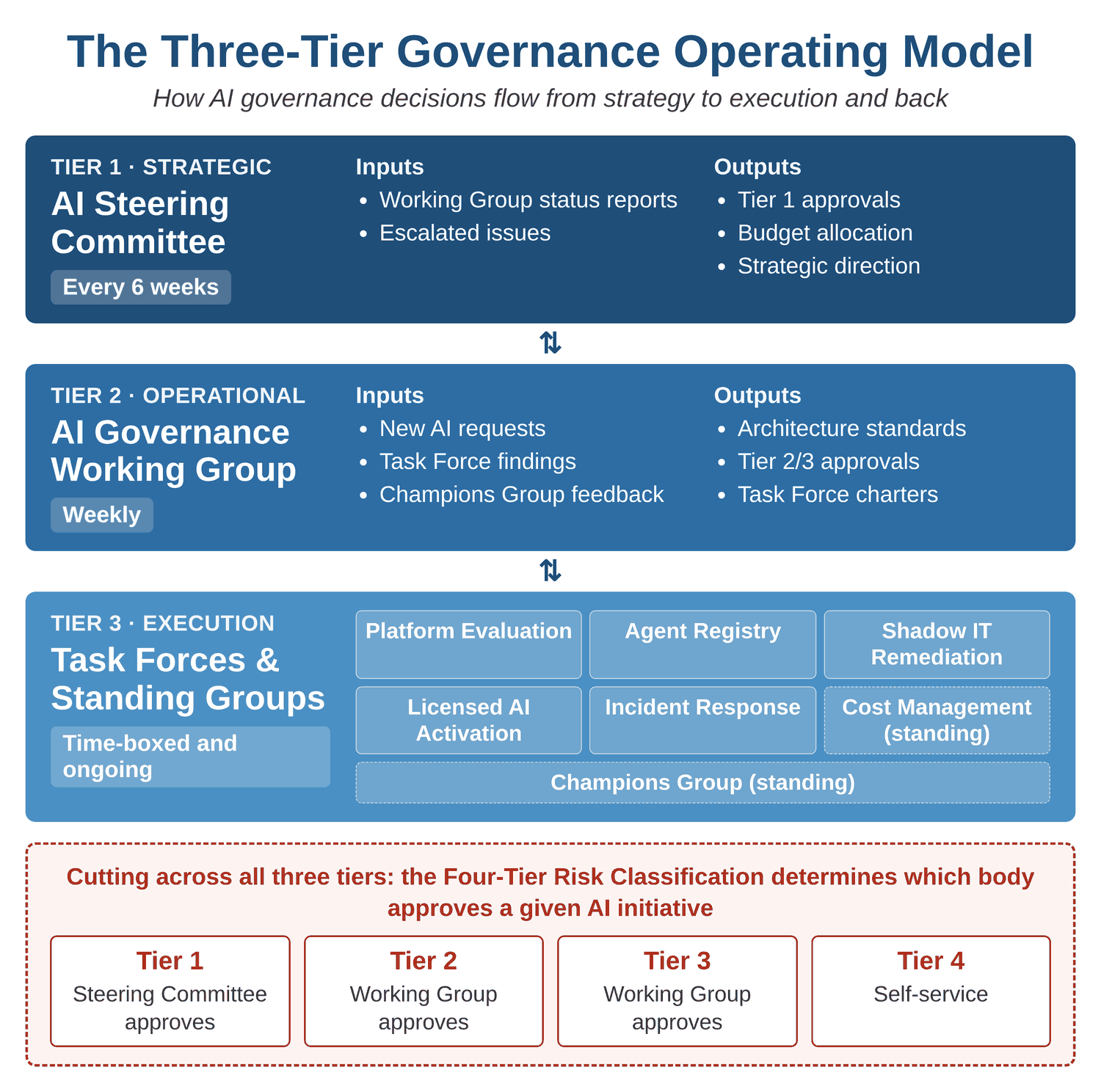
The diagram above shows how AI governance decisions flow from strategy to execution and back, across three horizontal tiers. The AI Steering Committee (Tier 1, strategic, meets every six weeks) receives Working Group status reports and escalated issues, and issues Tier 1 approvals, budget allocation, and strategic direction. The AI Governance Working Group (Tier 2, operational, meets weekly) receives new AI requests, Task Force findings, and Champions Group feedback, and issues architecture standards, Tier 2/3 approvals, and Task Force charters. Task Forces and Standing Groups (Tier 3, execution) run the five typical Task Forces (Platform Evaluation, Agent Registry, Shadow IT Remediation, Licensed AI Activation, Incident Response) and two Standing Groups (Cost Management, Champions Group), feeding findings back up into the Working Group. The Four-Tier Risk Classification (Section 5.1) cuts across all three tiers, since risk tier determines which body has approval authority for a given AI initiative: Tier 1 to the Committee, Tiers 2 and 3 to the Working Group, Tier 4 self-service.
Frequently Asked Questions
Why do AI governance committees fail to make decisions?
Most enterprise AI governance committees fail because they combine strategic direction and tactical decisions in a single body that meets infrequently. Stakeholders often describe these committees as "book clubs" rather than decision-making groups. The root cause is structural, not personal: strategic oversight and operational decision-making require different cadences, different participants, and different decision authority. Separating them into two bodies, each with its own charter, resolves the bottleneck.
What is the difference between an AI Steering Committee and an AI Governance Working Group?
An AI Steering Committee provides strategic oversight, meets roughly every six weeks, and decides what the organization will pursue and why, including Tier 1 approvals, budget allocation, and strategic direction. An AI Governance Working Group makes binding operational decisions weekly, deciding how, including architecture standards, Tier 2 and Tier 3 approvals, and Task Force charters. The Committee sets direction; the Working Group executes against it.
Why does AI risk tiering accelerate delivery instead of slowing it down?
A one-size-fits-all review process forces every initiative through the highest-risk pathway. When sandboxed prototypes wait alongside credit decisioning models, everything slows to match the most stringent requirements. Risk tiering solves this by matching governance intensity to actual risk level. Low-risk work moves quickly through streamlined approval, while appropriately rigorous review applies only where consequences justify it.
How long should each AI risk tier take to approve?
Tier 1 (critical systems like credit decisions) requires four to six weeks with Steering Committee, CDO, and Legal sign-off. Tier 2 (customer-facing but non-financial) takes two to four weeks through the Working Group. Tier 3 (internal-facing) requires one to two weeks from domain leads. Tier 4 (sandboxed prototypes) clears in under one week via self-service registration.
What percentage of generative AI projects are abandoned after proof of concept?
Gartner predicted in July 2024 that at least 30 percent of generative AI projects would be abandoned after proof of concept by the end of 2025, citing poor data quality, inadequate risk controls, escalating costs, and unclear business value. In knowledge-intensive enterprises these are governance failures rather than model failures, which is why governance structure determines whether AI pilots ever reach production.
How long does it take to stand up an AI governance operating model?
Roughly 12 weeks. Phases A through F of the governance maturity roadmap (operating model and oversight, financial engineering, platform rationalization, data classification and lineage, legal and cost attribution, and vendor management and incident response) stand up the decision-making structures a broader 12-month AI roadmap depends on. Full maturity through Phase K, covering documentation and access control, runs eight to nine months.
What should an enterprise do in the first week of an AI governance program?
Five actions require no budget, no procurement, and no technology decisions: ratify the three-tier governance structure by circulating the charter to Committee members; hold the first Working Group meeting by converting an existing standing meeting into a structured working session; start a spreadsheet-based agent registry; draft a one-page AI tooling evaluation template; and initiate activation of already-licensed but dormant AI capabilities.
What is an AI agent registry?
An AI agent registry is a central inventory of every AI model, tool, and agent running in an enterprise, recording who owns each one, what data it accesses, and which business unit it belongs to. Without a registry, an organization cannot attribute AI spend, detect shadow AI, or answer basic audit questions about which systems influenced a decision. A spreadsheet-based first version takes one person one day.
What is retrieval risk in enterprise AI?
Retrieval risk is the possibility that an AI system retrieves content that is accurate in general but wrong for the specific situation: a procedure written for a different equipment model, firmware version, or jurisdiction. It is unique to systems built on retrieval-augmented generation (RAG), and it is among the most consequential risks in knowledge-intensive enterprises because a non-expert cannot easily detect a plausible but misapplied answer.
Why is shadow AI a governance problem rather than an IT problem?
Shadow AI, meaning AI tools adopted without review, is usually caused by governance failure rather than malicious intent. When users are told "no" without being offered a sanctioned alternative, they find solutions outside the governance perimeter, creating uncontrolled data exposure, regulatory risk, and architectural fragmentation. Blocking tools drives usage further underground. Effective governance provides a structured path to "yes" through evaluation and approval, not only a path to "no."
What does Earley Information Science mean by governance that enables?
Governance that enables is governance measured by outcomes rather than activity. If a governance framework cannot demonstrate measurable improvement in delivery velocity, shadow AI reduction, cost attribution, and compliance within 90 days, it needs to be adjusted. Governance for its own sake is overhead. Governance that enables is infrastructure, making AI deployment faster and safer at the same time.
Sources and Further Reading
- Gartner. "Gartner Predicts 30% of Generative AI Projects Will Be Abandoned After Proof of Concept By End of 2025." Gartner Newsroom, July 29, 2024 https://www.gartner.com/en/newsroom/press-releases/2024-07-29-gartner-predicts-30-percent-of-generative-ai-projects-will-be-abandoned-after-proof-of-concept-by-end-of-2025
- MIT Project NANDA. "The GenAI Divide: State of AI in Business 2025." 2025
- Gallagher. "2026 AI Adoption and Risk Benchmarking." Arthur J. Gallagher & Co., 2026 https://www.ajg.com/news-and-insights/features/ai-adoption-and-risk-benchmarking-2026/
- The Purple Book Community. "State of AI Risk Management 2026." March 2026 https://www.thepurplebook.club/state-of-ai-risk-management-2026