
1. Introduction: Why Content Readiness Is the Hardest Part of AI Adoption
When technical organizations begin exploring generative AI and Retrieval Augmented Generation, their first assumption is usually that the model will be the most challenging part of the deployment. In reality, the model is the easiest element. The difficult work sits underneath the application in what many teams treat as an afterthought: the content.
RAG depends on accurate, structured, validated, and context-rich information. If the content supporting your products, processes, compliance requirements, and service operations is inconsistent or unclear, the AI system reflects those weaknesses back at scale. RAG does not fix bad content. It amplifies it. When retrieval accuracy caps at 70 percent, the system's overall performance cannot exceed 70 percent regardless of how capable the underlying model is, and the failure shows up as a confident wrong answer rather than a visible error.
This is not a hypothetical risk. MIT's NANDA initiative, in its 2025 study The GenAI Divide: State of AI in Business 2025,[2] found that 95 percent of enterprise generative AI pilots failed to deliver measurable return, and traced the gap to the surrounding systems, including how content and workflows were structured, rather than to model quality. Separately, Gartner surveyed 1,203 data management leaders in July 2024 and reported that 63 percent of organizations either do not have, or are unsure whether they have, the data management practices AI requires; on that basis Gartner predicts organizations will abandon 60 percent of AI projects lacking AI-ready data support through 2026.[1] Both findings point at the same layer of the stack, and it is not the model.
Content is the foundation of AI readiness because content represents the lived knowledge of your organization. It expresses the details that experts rely on and the constraints they follow. It carries the specificity that technicians, analysts, engineers, service staff, and compliance teams need to perform their work safely. When content is unstructured or unclear, AI systems lose the ability to reason with it.
In many organizations, content readiness becomes the single largest component of a successful AI deployment. It requires structure, consistency, metadata, version control, rewriting, normalization, and alignment with the organization's terminology, taxonomies, and ontologies. It is the part of the work that determines whether RAG becomes accurate and reliable or unpredictable and unsafe.
This page describes what content readiness means, why it matters, how RAG depends on it, and how Earley prepares content so AI can operate safely and predictably in knowledge-intensive environments.
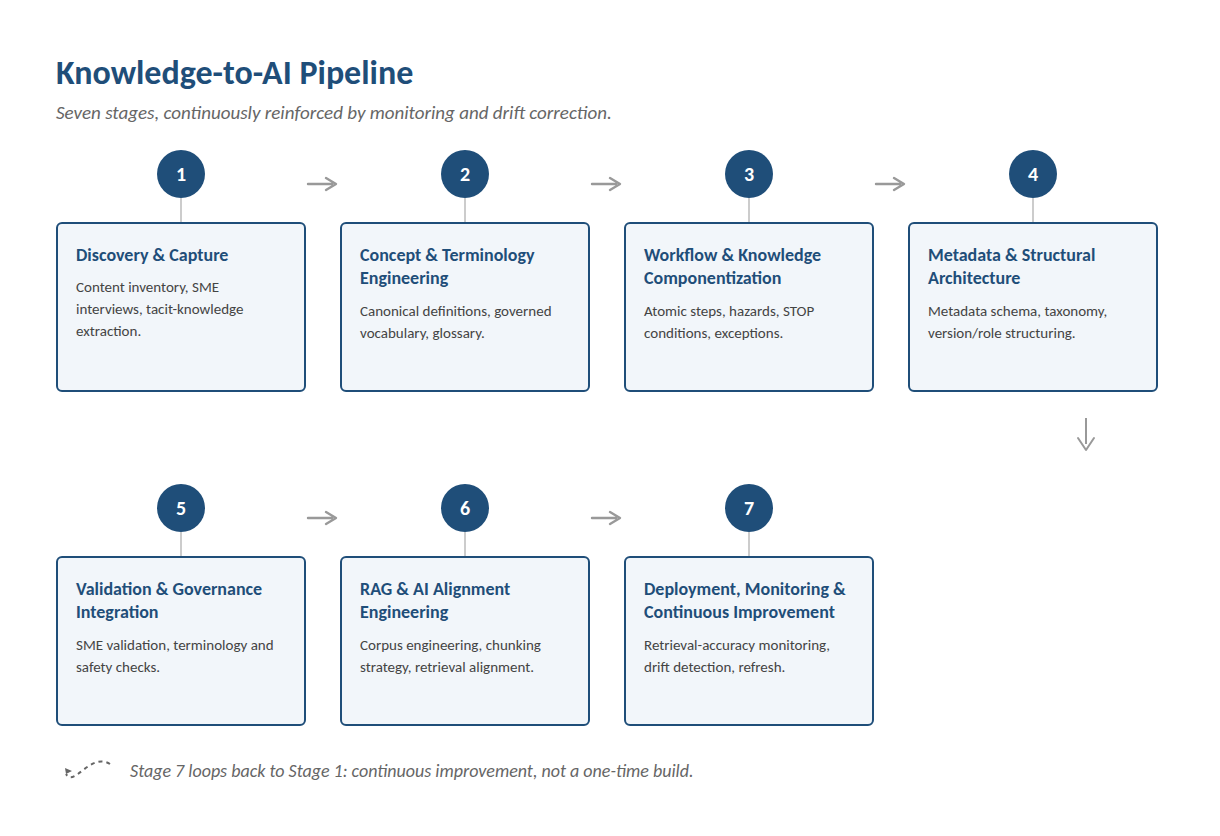
The Knowledge-to-AI Pipeline: seven stages, continuously reinforced by monitoring and drift correction.
2. Why Content Readiness Matters in a RAG Environment
RAG works by retrieving relevant content and using that content to generate answers. Retrieval quality determines reasoning quality. That means the structure and clarity of your content directly affect how the AI system behaves. Content readiness ensures the AI retrieves the right information and applies it accurately.
2.1 AI Cannot Interpret Raw Documents the Way Humans Do
Human readers bring years of experience to bear when interpreting documentation. A technician looking at a scanned PDF can interpret ambiguous phrasing, resolve conflicting statements, ignore outdated screenshots, or infer missing steps. AI systems cannot do this. They require explicit meaning and consistent structure.
2.2 RAG Requires Granular, Precise, and Contextualized Content
Long documents that contain multiple topics without clear boundaries cannot support accurate retrieval. RAG performs best when content is broken into meaningful segments with clear applicability and structure. Content readiness provides this segmentation.
2.3 AI Must Be Grounded in Accurate and Current Information
If the content feeding the RAG system does not reflect the current state of operations, products, regulations, or procedures, the AI will generate outdated or unsafe guidance. Content readiness ensures that only validated and current material is used.
2.4 Content Without Metadata Becomes Invisible
Metadata tells the system what a document is, what it applies to, when it was created, where it should be used, and what rules govern it. Without metadata, RAG retrieves based on linguistic similarity, which can lead to inaccurate or irrelevant answers.
2.5 Ambiguous Language Causes AI Confusion
Language that relies on human inference creates problems for AI. Expressions such as "if appropriate" or "adjust as needed" or "follow standard process" reflect incomplete definitions. RAG systems require explicit instructions and clearly defined exceptions.
Content readiness eliminates ambiguity and prepares information for accurate retrieval and reasoning.
4. Understanding the Difference Between Raw and Engineered Content
Successful RAG deployments depend on engineered content, not raw content.
4.1 Raw Content is Unpredictable
Raw content includes long text blocks without structure, documents with unclear steps, inconsistent terminology, content with embedded images that convey meaning not visible to AI, ambiguous instructions with implied meaning, contradictory statements across documents, varied formats and layouts, and incomplete steps or missing exceptions.
AI systems cannot reliably interpret raw content.
4.2 Engineered Content Supports Accurate Retrieval
Engineered content is content that has been systematically prepared so AI systems can interpret it correctly and retrieve it predictably. It is not simply cleaned or rewritten. It is structured, segmented, tagged, and aligned with the organization's information architecture. This makes engineered content fundamentally different from raw content, which may be readable to humans but lacks the clarity, structure, and context that RAG systems depend on. When content is engineered, every segment has a clear purpose, a defined relationship to other content elements, and a consistent meaning that supports accurate retrieval.
To understand why this matters, consider how RAG systems evaluate similarity. They do not look at documents in their entirety. They analyze segments of content and calculate which segments are most relevant to the question. Engineered content ensures that each segment represents a meaningful, coherent idea. Without engineering, content segments may contain multiple ideas, unclear boundaries, or ambiguous language. This makes retrieval unpredictable. AI may select a segment that contains a few matching terms but lacks the full context needed to answer the question correctly. Engineered content solves this problem by creating clear semantic boundaries and aligning content with metadata and taxonomy structures.
Imagine a scenario in a manufacturing environment where a technician asks the AI assistant for guidance on a specific assembly. If the original documentation contains a long PDF with many different procedures combined in a single section, RAG may retrieve the wrong part of the document simply because it contains similar language. This can result in the AI recommending steps that apply to a different model or configuration. When content is engineered, each step is separated, labeled, and tagged with model applicability. As a result, the AI retrieves the correct content, applies the correct procedure, and avoids dangerous or costly errors.
Consider an example from the life sciences industry. A standard operating procedure may include notes, exceptions, and steps interwoven across several pages. Human readers can interpret this structure, but RAG systems cannot. Without engineering, the AI may retrieve instructions that omit a crucial safety step or misinterpret a note intended for a specific scenario. Engineered content separates each component, clarifies applicability, and ensures that safety steps are always associated with their relevant procedures. This prevents the AI from generating incomplete or unsafe recommendations.
Engineered content also improves reasoning. When content is segmented into coherent units, RAG systems can combine the right pieces into accurate, structured outputs. This is particularly important for complex troubleshooting, diagnostic logic, and compliance-driven tasks. By giving the AI a clear foundation, engineered content elevates the system from simply retrieving text to supporting consistent, trustworthy decision-making.
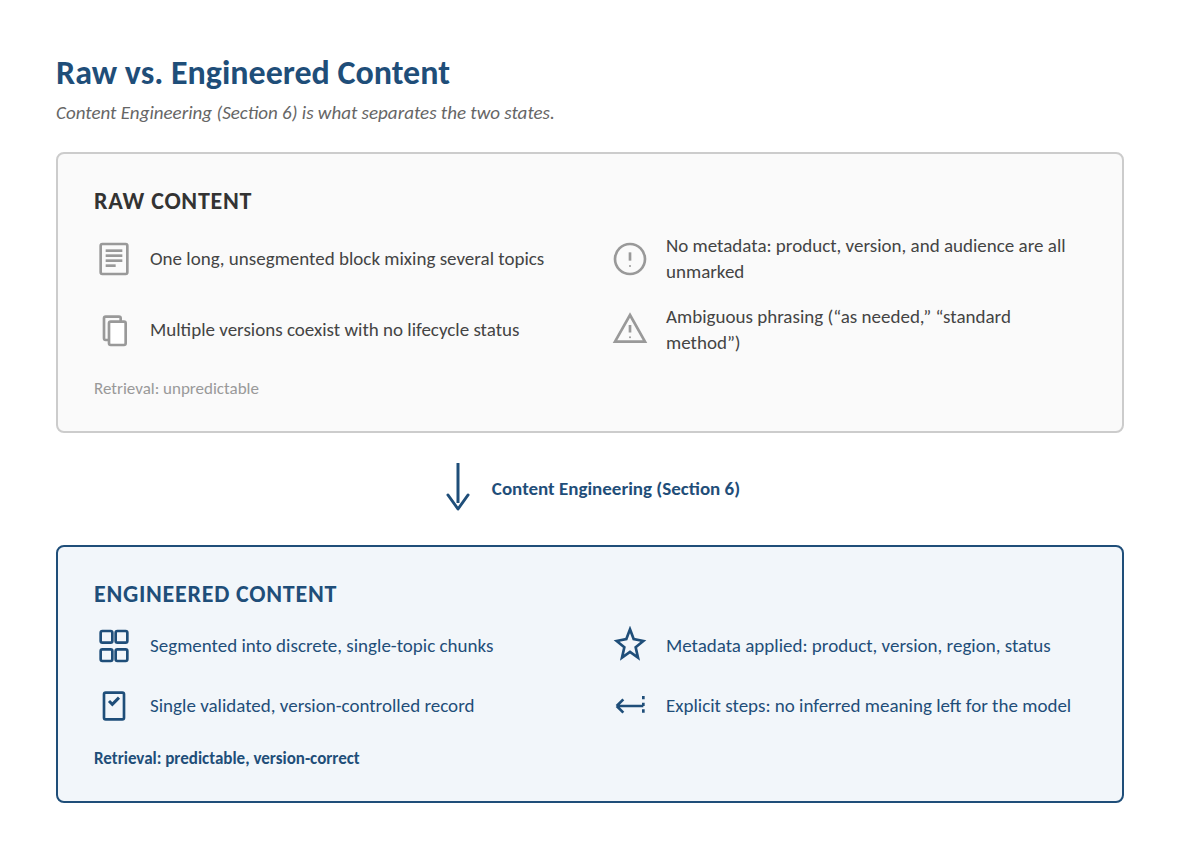
Raw vs. engineered content: Content Engineering (Section 6) is what separates the two states.
5. Content Audit and Inventory: Understanding the Landscape
A content audit reveals the true shape of an organization's information environment. It identifies where content resides, what condition it is in, and how well it supports the organization's AI goals. Many organizations underestimate the complexity of their content ecosystems until they complete this audit. They often discover significant inconsistencies, duplications, outdated information, and undocumented knowledge that must be addressed. The audit becomes the blueprint for engineering content and preparing it for AI.
5.1 Identifying Sources
Organizations typically store content in multiple systems that evolved separately over time. Shared drives, legacy document management systems, field service portals, engineering repositories, content management tools, and personal collections all contain valuable information. Identifying these sources is critical because RAG cannot interpret content that it cannot find. Many organizations discover that key documents exist only in email attachments or personal folders. These sources must be surfaced before content readiness work begins.
A real-world example illustrates this challenge. A global electronics manufacturer had more than twenty repositories where product documentation was stored. Each region maintained its own version of the same guides, and many documents were labeled inconsistently or saved without metadata. Technicians often relied on personal folders that contained annotated versions of documents no one else could access. The audit revealed a landscape far more fragmented than anyone realized. Only after documenting all sources could the team even begin structuring content for RAG.
5.2 Auditing Content Quality
Quality varies dramatically across documents. Some are well structured, while others contain vague steps, unclear diagrams, or inconsistent terminology. Content quality must be evaluated using a consistent framework that looks at clarity, structure, accuracy, currency, completeness, and alignment with current practices. AI performance will reflect the quality of the content it retrieves. If steps are unclear or terms are ambiguous, the AI will produce equally unclear or ambiguous answers. A thorough audit uncovers these weaknesses.
In a field service organization supporting industrial equipment, the audit revealed that troubleshooting procedures written ten years ago were still in circulation. These older documents referenced retired parts and obsolete processes. AI systems pulling from such sources would have provided guidance that no longer matched the actual equipment. This risk remained invisible to leadership until the audit revealed how many outdated documents were still in active use. The audit became the catalyst for prioritizing content normalization.
5.3 Mapping Content to Use Cases
Once content quality is assessed, the next step is to map content to high-value AI use cases. Not all content needs to be prepared at the same time. Instead, the focus should be on the content that supports the organization's most important workflows. Use case mapping ensures that readiness work aligns with operational goals and business value. It also clarifies which content types require deeper engineering.
For example, a life sciences company aiming to deploy a RAG system for QA support discovered that the majority of its SOPs were not AI-ready. Many contained narrative sections that intertwined steps, exceptions, and rationale in ways that were difficult for a model to interpret. By mapping content to the RAG use cases, the team identified exactly which procedures required engineering and which documents could be deprioritized. This created a clear, efficient path to deployment.
5.4 Identifying Gaps and Risks
A content audit invariably reveals gaps. There may be missing procedures, undocumented steps, or contradictory instructions across documents. Many organizations also find that SME knowledge exists only in conversations, not in any documented form. Identifying these gaps is crucial, because RAG depends on a complete and coherent content foundation. If key information is missing, the AI will produce incomplete or inaccurate answers.
In one insurance organization, a risk assessment revealed that underwriting guidelines were significantly different across regions, with conflicting interpretations of the same policies. RAG systems retrieving from these sources would have produced inconsistent results depending on the region. By identifying these conflicts early, the team was able to unify terminology, resolve discrepancies, and create a single source of truth before engineering content for AI.
6. Content Engineering: Preparing Content for RAG
Content engineering transforms raw content into a structured, consistent, and semantically clear format that RAG can interpret. This is often the largest component of AI readiness work. It requires careful analysis, rewriting, segmentation, and alignment with both metadata and ontology structures. The goal is to create content that is not only readable but operationally aligned with how experts use information and how AI systems retrieve it.
6.1 Normalizing Document Structure
Normalization creates consistency across documents. It ensures that headings follow predictable conventions, that steps are numbered consistently, that warnings and notes appear in the same format throughout all content, and that sections follow a logical sequence. This consistency is essential for RAG because it gives the system a recognizable structure. AI systems look for patterns, and normalization provides those patterns.
To see how normalization affects AI performance, consider a chemical processing company where maintenance procedures were written by dozens of authors over more than fifteen years. Some documents used numbered steps; others used bullets; others embedded steps in paragraphs. Warnings appeared inconsistently, sometimes in parentheses, sometimes buried in text blocks. RAG systems struggled to interpret these documents because the structure varied so widely. After normalization, content followed consistent templates with clear formatting for steps, warnings, and conditions. RAG retrieval accuracy increased dramatically because the content became predictable in structure.
6.2 Chunking Content Into Meaningful Segments
Chunking is the process of breaking long documents into smaller, self-contained segments. These segments represent units of meaning that RAG can retrieve independently. Chunking is essential because AI systems perform poorly when content contains multiple topics or steps in a single block. Segmentation improves retrieval granularity and accuracy.
Imagine a 250-page equipment manual containing dozens of procedures. If the AI retrieves an entire section that combines three unrelated tasks, users will receive answers containing irrelevant or confusing instructions. This can create operational risk. When the manual is chunked into clear segments reflecting individual tasks or concepts, RAG can retrieve only the relevant segment. Chunking also enables firm applicability tagging so the AI never provides instructions for the wrong model or configuration.
A real-world example comes from a global manufacturer whose service manuals were often more than 400 pages long. After chunking the content into discrete tasks, the RAG system could retrieve guidance for a specific task within seconds. Customer satisfaction increased, technician training times decreased, and inconsistent troubleshooting dropped significantly.
6.3 Rewriting for Explicit Meaning
Many documents rely on implied meaning or shared context. Humans can interpret this, but AI cannot. Rewriting content ensures that each step or instruction contains explicit meaning, with clear definitions, unambiguous sequence, and explicit conditions. This rewriting often involves unpacking phrases like "as needed," "use standard method," or "follow best practices." Such phrases assume knowledge the AI does not have.
In a field service environment, a procedure once stated, "Adjust the alignment according to the standard method." This was obvious to senior technicians but incomprehensible to AI. Rewriting required asking SMEs what the "standard method" involved. The result was a clear, step-by-step description that the AI could retrieve and explain. This improved accuracy and reduced safety risks.
6.4 Applying Metadata
Metadata is the key to retrieval accuracy. It identifies the content, defines applicability, and provides the contextual filters RAG uses to select the right segment. Metadata often includes attributes like model number, product family, version, regulatory relevance, region, safety classification, and audience.
Without metadata, RAG retrieves based on linguistic similarity alone. This leads to errors.
A manufacturing company learned this firsthand when the RAG system repeatedly retrieved procedures applicable to older product models because the newer models shared similar terminology. Once metadata was applied consistently, the AI retrieved only the relevant procedures, eliminating the confusion.
6.5 Semantic Tagging
Semantic tags connect content to ontology terms. They allow RAG to understand meaning beyond surface language. For example, tagging content with "failure mode," "diagnostic step," "safety hazard," or "regulatory requirement" gives AI tools the relational guidance they need to select the correct content segments.
In one insurance organization, semantic tags helped RAG interpret underwriting guidelines by clarifying which parts of a document related to specific policy types or risk categories. Without these tags, the AI retrieved inconsistent guidance.
6.6 Aligning Content With Taxonomies
Taxonomy alignment ensures content is placed in the correct category and follows the organization's conceptual hierarchy. Misaligned content leads to retrieval failures. Taxonomies help the AI understand the organizational structure of knowledge and distinguish related but distinct concepts.
A life sciences company found that its procedures were inconsistently classified. Some documents were placed under "quality," others under "operations," even though both sets covered similar steps. After aligning content with a clear taxonomy, retrieval accuracy improved and compliance risk decreased.
6.7 Ensuring Version Control
Version control is critical. RAG cannot distinguish between old and new content unless versioning is explicitly structured. Deprecated documents must be archived, and only approved versions should be included in the RAG repository.
A medical device company discovered that RAG was retrieving outdated cleaning procedures because the older versions contained more detailed language. Once version control rules were enforced and metadata applied, RAG consistently retrieved only approved content.
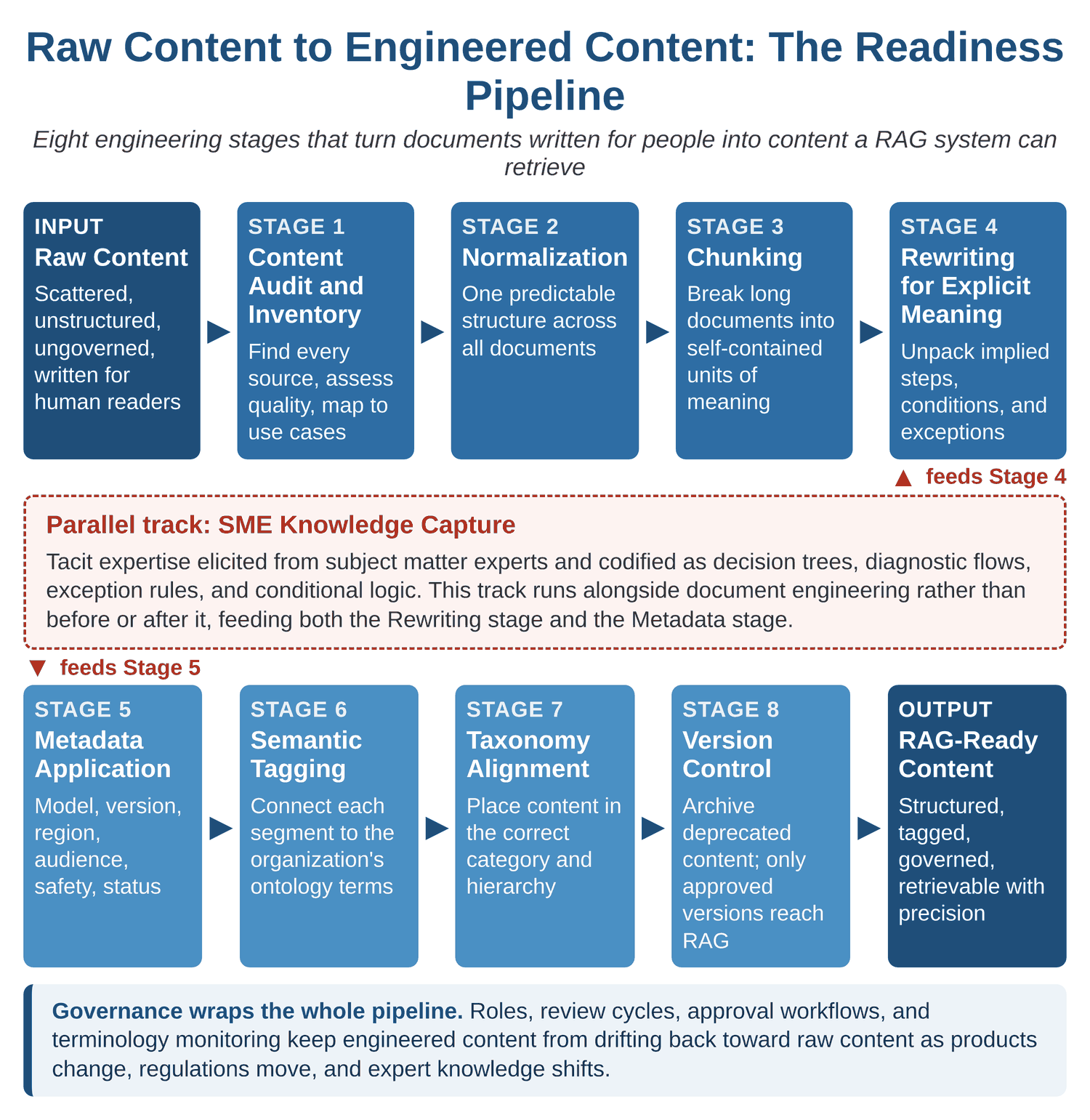
The readiness pipeline: eight engineering stages that turn documents written for people into content a RAG system can retrieve, with SME knowledge capture running as a parallel track and governance wrapping the whole sequence.
7. Metadata: The Signal That Guides Retrieval
Metadata is one of the most important components of accurate RAG performance. It serves as the signal that tells the AI system what a piece of content is, when it applies, who should use it, and under what conditions it is valid. Without metadata, RAG systems are reduced to using linguistic similarity as their primary retrieval method, which often results in retrieving content that sounds similar but does not apply to the specific task or scenario. Metadata creates structure in an environment where textual similarity alone cannot provide reliable guidance.
Metadata is also the mechanism through which organizations express the relationships within their content ecosystem. When metadata is applied consistently and correctly, it helps RAG systems filter out irrelevant content and surface only what is most applicable. This increases accuracy and reduces the possibility of inappropriate or unsafe guidance. For example, metadata that indicates which product model a procedure applies to will prevent the RAG system from recommending steps intended for a different model with similar language. This relevance filtering is essential for organizations with many product variants or configuration options.
Metadata also supports lifecycle management. It indicates which documents have been replaced, which are currently valid, and which have been retired. AI systems need this information to ensure they draw from the most up to date versions. Many organizations keep older versions of content for historical, regulatory, or audit purposes. Without metadata, RAG cannot distinguish those versions from current guidance. Metadata enables version control by clearly marking the authoritative version for AI consumption.
Metadata also enhances compliance by enabling traceability. It allows organizations to track who approved a document, when it was reviewed, and what regulatory requirements it aligns with. This is especially important in regulated industries such as life sciences, insurance, and financial services. AI systems must operate within these constraints. Metadata ensures that the content RAG retrieves adheres to the controls set forth in regulatory frameworks.
7.1 Example: Metadata Misalignment in a Manufacturing Environment
A multinational equipment manufacturer deployed a RAG-based assistant to support field technicians. In the early pilot, the system frequently retrieved outdated instructions, even though updated procedures existed. The problem was not the AI model. The issue was metadata. The older documents contained language that was more descriptive, so the RAG system incorrectly prioritized them. The newer documents had fewer descriptive keywords and lacked detailed metadata fields that indicated applicability and version. As a result, RAG retrieved the wrong procedures simply because linguistic similarities outweighed structural cues.
To fix this, the organization implemented a metadata framework aligned with its product hierarchy, regulatory requirements, and content lifecycle stages. Each content chunk received metadata identifying product model, configuration, region, version, safety relevance, and document status. After reprocessing the content with metadata applied consistently, the RAG system retrieved the correct procedures with high precision. Technicians reported fewer errors, and the AI became a trusted element of daily operations. This example shows how essential metadata is to accurate retrieval.
7.2 Example: Metadata and Compliance in Life Sciences
A life sciences company needed its RAG system to retrieve only validated and approved procedures. During testing, the AI occasionally surfaced draft documents that had been uploaded to a shared workspace but had not yet passed QA approval. The team realized that while human authors understood which documents were drafts, the system had no way to distinguish them. The content lacked metadata indicating approval status. After implementing a controlled metadata framework that captured document state, approval authority, review cycle, and regulatory applicability, the RAG system retrieved only validated content. This change reduced compliance risk and increased auditor confidence in the AI deployment.
7.3 Example: Metadata Improves Customer Service Accuracy
An insurance company implemented RAG to support customer service representatives. Without metadata tags for policy type, region, and regulatory constraints, the AI frequently returned guidance meant for different jurisdictions. Customer service staff had to manually interpret the results, which slowed response times. After implementing metadata aligned with the company's policy taxonomy and regulatory requirements, the RAG system returned accurate results tailored to the specific customer's region and policy. This improved service consistency and reduced the training burden for new staff.
8. Real-World Examples of Content Readiness Across Industries
Content readiness varies significantly across industries, but the underlying challenges are similar: unclear content, inconsistent structure, lack of metadata, outdated documents, and missing SME knowledge. These examples illustrate how content readiness influences RAG performance and why it is essential for AI deployment in technical and regulated environments.
8.1 Manufacturing Example: Addressing Legacy Manuals and Variant Confusion
A global manufacturer had decades of equipment manuals stored in PDF format. Many were scanned copies of older documents with inconsistent formatting and unclear diagrams. Product variants added another layer of complexity. Even though the content was technically correct for specific versions, technicians often received instructions that did not match the equipment they were working on because the RAG system retrieved segments based on shared language across variants.
When the organization undertook content readiness, they divided manuals into discrete sections, applied metadata for product version and applicability, added semantic tags for common component types, and normalized terminology. They also rewrote ambiguous steps that relied on legacy terminology. After content engineering, RAG retrieval accuracy improved dramatically. Technicians received instructions tailored to the exact product version. This reduced troubleshooting time, improved safety, and significantly increased trust in the AI assistant.
8.2 Field Service Example: Capturing SME Knowledge and Reducing Ambiguity
In a field service environment supporting medical equipment, the content audit revealed that senior technicians relied heavily on tacit knowledge. Many of the most useful troubleshooting steps existed only in personal notebooks or informal communications. Formal procedures contained vague phrases like "use the standard adjustment technique," which meant different things to different technicians.
Content readiness required interviewing SMEs to capture tacit knowledge, rewriting procedures to make implicit steps explicit, and structuring diagnostic flows into clear decision trees. After engineering the content, RAG could retrieve specific troubleshooting steps based on symptoms. The AI identified failure modes with much greater precision and provided consistent guidance across the technician workforce. This lowered error rates, reduced escalations, and shortened service times.
8.3 Life Sciences Example: Preparing Regulated Procedures for RAG
A life sciences company working in a regulated environment discovered that many of its SOPs intermingled steps, exceptions, and notes in a narrative format that was difficult for RAG to interpret. Critical safety steps were sometimes mentioned only in a footnote or described in ambiguous language. Additionally, multiple versions of the same procedure were scattered across different repositories.
Content readiness involved deconstructing each SOP into clear steps, separating notes and exceptions, applying metadata for regulatory requirement alignment, and ensuring version control was strictly enforced. This structured approach ensured that RAG retrieved only validated procedures and always included the appropriate safety instructions. The result was improved accuracy, reduced compliance risk, and a RAG system that regulators accepted as part of the organization's digital quality processes.
8.4 Insurance Example: Aligning Guidelines With Regulatory Variants
An insurance organization deployed RAG to help staff interpret underwriting guidelines. However, the initial deployment produced inconsistent answers because guidelines across regions used different terminology for similar concepts. Regulations varied by jurisdiction, and some exceptions were documented only in footnotes or cross-references that the AI struggled to interpret.
Content readiness required aligning terminology, rewriting guidelines for clarity, tagging content with region-specific metadata, and restructuring exceptions into clear conditional logic. After engineering the content, the RAG system delivered consistent guidance across regions and always returned content that matched regulatory requirements. This reduced compliance risk and improved the customer experience.
8.5 Financial Services Example: Resolving Conflicting Definitions
A financial services organization faced challenges when deploying RAG because policy definitions were inconsistent across documents. Terms such as "high-risk customer," "enhanced due diligence," and "suspicious activity" were used differently across departments. RAG could not interpret these differences and often returned content based on whichever document had the closest linguistic match.
Content readiness required building a controlled vocabulary, aligning terms with the organization's ontology, reworking conflicting definitions, and restructuring guidance to include clear applicability statements. After engineering the content, the RAG system retrieved the correct definitions based on context, enabling more consistent risk assessment and improving regulatory compliance.
9. SME Knowledge Capture: Transforming Tacit Expertise into AI-Ready Knowledge
Subject matter experts carry the most operationally valuable knowledge within an organization, but a significant portion of that knowledge never makes its way into formal documentation. Experts rely on experience, intuition, and pattern recognition developed over many years of working with products, customers, equipment, regulations, or claims. This tacit knowledge is essential for making accurate decisions, diagnosing complex problems, interpreting ambiguous situations, or identifying exceptions that standard procedures do not cover. RAG systems cannot replicate expert-level reasoning unless this tacit knowledge is captured, structured, and integrated into the content substrate that the AI relies upon.
SME knowledge capture is more than interviewing experts and writing down their advice. It requires systematically eliciting the underlying logic behind their decisions. Experts often carry assumptions that they do not articulate because they are second nature. They may skip steps when explaining a process because they subconsciously believe those steps are obvious. They may describe a task in high-level terms but omit specific conditions or qualifiers that affect how the task should be performed. These gaps are invisible to humans who share similar expertise, but they become major obstacles for AI systems that require explicit logic.
Effective SME knowledge capture uses deep elicitation techniques. This includes asking experts not only what they do but why they do it, when they take exceptions, what conditions alter their approach, and how they interpret ambiguous or conflicting signals. These insights are then transformed into structured content such as decision trees, troubleshooting flows, exception handling rules, and conditional statements that RAG systems can interpret. Without this level of detail, AI systems produce shallow answers that lack the nuance of true expertise.
9.1 Example: Tacit Knowledge in Field Service
A global medical equipment company discovered that its most experienced field technicians consistently outperformed newer hires when diagnosing equipment failures. When leadership dug deeper, they found that senior technicians used subtle indicators that were not documented anywhere. They listened for specific sounds, felt for unusual vibrations, and noted small temperature differences that indicated underlying mechanical issues. They also knew the history of certain equipment models and which components were prone to failure based on environmental conditions.
When the company began implementing RAG, the AI system could not match the performance of senior technicians because the diagnostic logic was incomplete. SME interviews revealed dozens of insights that had never been captured in any procedure. The content team worked with technicians to codify these indicators, describe the conditions in which they matter, and create decision trees that reflected expert reasoning. Once this tacit knowledge was engineered into the content substrate, the RAG system became significantly more accurate. Technicians reported that the AI was finally providing guidance that reflected real-world practice, not just textbook procedures.
9.2 Example: Underwriting Judgment in Insurance
In an insurance organization, underwriters often relied on personal judgment when evaluating risk. They had learned, through years of experience, how to interpret subtle details in applications that were not accounted for in formal guidelines. For example, certain combinations of claim history and customer behavior could signal an elevated risk level even though the guidelines did not explicitly state this. These insights lived exclusively in the minds of senior underwriters.
RAG systems could not replicate this judgment because the relevant logic was absent from the documentation. SME elicitation revealed numerous conditional factors, risk scoring patterns, and nuance-based triggers that experts considered when making decisions. These were formalized into structured rules and aligned with the organization's ontology for risk categories. After integrating this knowledge, the RAG system became much more consistent and made recommendations that aligned with the practices of senior underwriters rather than simply echoing the text of the guidelines.
9.3 Example: Process Expertise in Life Sciences Compliance
A life sciences company relied heavily on QA staff who understood not only the formal SOPs but also the rationale behind each step. Many of these reasons were not documented, such as why certain steps had to be performed in a certain order, which deviations were permissible under which conditions, and how specific environmental factors influenced quality. These details were critical to ensuring compliance but were not explicit in the documentation.
During SME knowledge capture, the team discovered multiple layers of reasoning that were missing from the SOPs. They codified these into structured logic, clarified conditional rules, and added explicit rationale to steps where it was previously implied. This transformed the content from simple instructions into a rich, contextualized knowledge source. When integrated into the RAG system, the AI became significantly more reliable and aligned with the organization's compliance requirements.
10. Governance: Sustaining Content Quality and AI Reliability
Governance ensures that content remains accurate, current, consistent, and aligned with organizational requirements over time. Without strong governance, even the best-engineered content degrades as products evolve, regulations change, and expert knowledge shifts. RAG systems depend on content that reflects the current state of the organization. Governance prevents drift by enforcing processes that maintain accuracy, completeness, and relevance across all content domains.
Governance includes roles, procedures, review cycles, approval workflows, and quality checks that ensure every content update follows a controlled process. It also includes the mechanisms that enforce version control so old or retired documents do not accidentally feed the AI system. Governance defines how changes are proposed, who evaluates them, and how they are validated before publication. It also establishes accountability by ensuring that content owners, SMEs, and reviewers understand their responsibilities. Without governance, organizations risk inconsistency, confusion, regulatory exposure, and erosion of trust in both content and AI outputs.
Governance also mitigates semantic drift, which occurs when terminology evolves over time. If a term's meaning changes but older documents remain uncorrected, RAG may retrieve conflicting or outdated definitions. Effective governance monitors terminology across content, ensuring alignment with the organization's ontology and controlled vocabulary. This creates a stable semantic environment for RAG and reduces the risk of inconsistent answers.
10.1 Example: Governance Breakdown in Regulated Environments
A pharmaceutical company discovered during an internal audit that multiple SOPs contained conflicting instructions. Some had been updated recently, while others had not been revised for years. Because the company lacked a formal governance process, teams across the organization created their own versions of procedures. The RAG system began retrieving outdated steps that did not comply with current regulatory requirements. This created significant compliance risk.
To correct the issue, the company implemented a governance framework that included version control rules, approval workflows, defined roles for QA reviewers, and mandatory metadata for document status. Content owners were assigned for every procedure, and update cycles were enforced. Once governance was in place, the RAG system reliably retrieved only validated, approved content. This reduced risk and improved the organization's compliance posture.
10.2 Example: Governance for Product Documentation
A manufacturer of industrial machinery had hundreds of product manuals that were updated inconsistently. When engineers made changes to equipment, the documentation did not always reflect the latest design. In some cases, older manuals were left in circulation because nobody was responsible for retiring them. RAG retrieved instructions based on these outdated manuals, resulting in incorrect or unsafe guidance.
Governance solved the problem by assigning clear ownership for each manual, implementing mandatory review cycles, and requiring engineering teams to submit documentation updates whenever a design change occurred. Metadata fields were added to track version status, and deprecated manuals were archived. As a result, RAG retrieval became consistent, and technicians no longer received instructions based on obsolete designs.
10.3 Example: Governance in Financial Services
Governance breakdowns of exactly this kind are not isolated to any one company. Gallagher's 2026 AI Adoption and Risk Benchmarking survey of risk and insurance professionals found that data protection and AI errors or hallucinations remain the top-cited unresolved challenges even at organizations reporting positive AI adoption results, suggesting that content and data governance is lagging adoption industry-wide, not only in isolated case studies.
A financial services organization discovered that different teams interpreted regulatory guidance differently because their documentation had diverged over time. One team updated definitions in their internal wiki, while another maintained older guidance in a separate system. This inconsistency created risk when the RAG system began retrieving guidance that differed by department.
Implementing governance brought consistency across teams. The organization created a central repository with controlled vocabulary, aligned taxonomy structures, and metadata tracking for regulatory applicability. Approval workflows ensured that updates were consistent across departments. The RAG system began returning unified guidance, improving compliance and reducing internal confusion.
11. Why This Compounds: The Cost of Skipping Content Readiness
The pilot-to-production gap is not primarily a modeling problem. MIT's NANDA research found 95 percent of enterprise generative AI pilots failing to reach expected returns in 2025, with enterprise integration flaws, not model quality, as the leading cause; the same research found internally built tools succeeding roughly a third of the time against roughly two-thirds for specialized vendor solutions built on engineered data. Gartner's 2024 data management leader survey found 63 percent of organizations lacking, or unsure whether they have, adequate data management practices for AI, and projected 60 percent of AI initiatives abandoned through 2026 for the same reason. Neither statistic describes a model failure. Both describe a content readiness failure that was visible at the pilot stage and ignored because the pilot corpus was small enough to manage by hand.
Applied Materials illustrates the alternative at scale. Field service technicians, spread across 3,000 people and fourteen disconnected systems, were spending up to 40 percent of their time locating the information needed to service a fabrication plant, a cost measured in tens of millions of dollars of held inventory and extended downtime on facilities that cost over a billion dollars to build. Three prior attempts to solve the problem failed. The fix was not a better search engine; it was an ontology and its subsidiary taxonomies, organizing information the way a chart of accounts organizes finance, so retrieval could be directed rather than guessed at. The result cut technician search time in half and saved tens of millions of dollars annually. Both cases point to the same conclusion: RAG scales whatever content quality already exists, and the organizations that treat content engineering as infrastructure, not a documentation cleanup project, are the ones whose pilots survive contact with production.
12. Frequently Asked Questions
What is IAD-RAG?
IAD-RAG (Information Architecture-Directed Retrieval Augmented Generation) is Earley Information Science's proprietary model for directing AI retrieval through structured knowledge and governed terminology rather than unstructured fragments. It organizes retrieval into layers, including Layer 1, Semantic Foundation (canonical definitions and concept boundaries), and Layer 5, Retrieval Layer Engineering (prioritization rules, relevance windowing, and negative knowledge cues that keep a model from retrieving content it should never touch).
What is the Knowledge-to-AI Pipeline?
The Knowledge-to-AI Pipeline is Earley Information Science's seven-stage process for turning raw enterprise content into AI-ready knowledge for Retrieval Augmented Generation. It begins with Stage 1, Discovery and Capture (inventorying content and capturing subject-matter-expert knowledge), continues through stages such as Stage 3, Workflow and Knowledge Componentization (converting prose into machine-actionable units), and ends in deployment monitoring and continuous improvement, looping back to Stage 1 rather than stopping at a one-time build.
What is Earley's is-ness and about-ness metadata framework?
Is-ness and about-ness are the two fields Earley Information Science uses to make content findable by Retrieval Augmented Generation systems. Is-ness classifies what type of document something is, such as a troubleshooting guide, specification, or manual. About-ness captures the attributes that distinguish it within that type, such as product model, version, region, or audience. Without both fields, a RAG system retrieves on linguistic similarity alone, which produces inaccurate results.
What is Component Engineering (Framework 6)?
Component Engineering, Earley Information Science's Framework 6, breaks a procedural step into atomic units instead of a paragraph that assumes a human reader's judgment. Each unit is classified as an action step, a measurement, a hazard, or a STOP condition. Artificial intelligence systems cannot infer missing steps or resolve ambiguous phrasing the way a human reader does, so this atomic structure is what lets a Retrieval Augmented Generation system retrieve procedures reliably and safely.
What is the Semantic Drift Prevention Loop?
The Semantic Drift Prevention Loop is Earley Information Science's method for keeping terminology and definitions stable as an organization's content changes over time. It works through terminology monitoring, definition evaluation, and cross-content alignment checks, catching inconsistencies before they reach the corpus a Retrieval Augmented Generation system indexes. Without it, outdated or conflicting definitions can produce unsafe or incorrect AI-generated guidance.
Why does RAG amplify bad content instead of fixing it?
Retrieval Augmented Generation retrieves and reuses whatever content already exists, so it reflects the accuracy of that content rather than correcting it. If retrieval accuracy caps at 70 percent because the underlying content is inconsistent or unclear, the system's overall performance cannot exceed 70 percent regardless of how capable the model is, and the failure shows up as a confident wrong answer rather than a visible error.
Why do enterprise AI pilots fail even when the underlying model performs well?
MIT's NANDA initiative found that internally built AI tools succeed roughly one-third of the time, compared with about two-thirds for specialized vendor solutions built on properly engineered data, tracing the difference to enterprise integration failures rather than model quality. A pilot corpus is small enough to control by hand; production content, left unengineered, is not, which is why the gap opens at scale rather than in the demo.
What percentage of enterprise generative AI pilots fail to reach expected returns?
According to MIT's NANDA initiative study "The GenAI Divide: State of AI in Business 2025" (August 2025), 95 percent of enterprise generative AI pilots fail to reach the revenue acceleration their sponsors expected. The study traced this gap to enterprise integration failures rather than the quality of the underlying AI model.
What percentage of organizations lack AI-ready data management practices?
According to a Gartner survey of 1,203 data management leaders (July 2024), 63 percent of organizations lack, or are unsure whether they have, the data management practices artificial intelligence requires. Gartner has warned that AI-ready data, not the model, is what most often determines whether an AI initiative reaches production.
How much time were Applied Materials' field technicians spending just to locate information?
Before Earley Information Science built an ontology for Applied Materials, a semiconductor equipment manufacturer, its field service technicians were spending up to 40 percent of their time simply locating the information needed to service a fabrication plant, according to the case study in Seth Earley's book "The AI-Powered Enterprise." The cost was measured in tens of millions of dollars of held inventory and extended downtime on facilities that cost over a billion dollars to build.
How much did building an ontology reduce Applied Materials' technician search time?
After three prior attempts had failed, Earley Information Science solved Applied Materials' information-access problem not with a better search engine but with an ontology and its subsidiary taxonomies, organizing field service knowledge the way a chart of accounts organizes finance. According to the case study in Seth Earley's book "The AI-Powered Enterprise," the result cut technician search time in half and saved tens of millions of dollars annually.
13. Sources and Further Reading
- Gartner, "Lack of AI-Ready Data Puts AI Projects at Risk," press release, February 26, 2025 (survey of 1,203 data management leaders, July 2024) https://www.gartner.com/en/newsroom/press-releases/2025-02-26-lack-of-ai-ready-data-puts-ai-projects-at-risk
- MIT NANDA initiative, *The GenAI Divide: State of AI in Business 2025*, August 18, 2025
- Earley Information Science, "Why RAG Fails Without Information Architecture: A Practical Framework," earley.com/insights
- Seth Earley, *The AI-Powered Enterprise* (LifeTree Media, 2020), Chapter 2, "Building the Ontology" (Applied Materials case)