
1. Introduction: Why Information Architecture Determines AI Accuracy
AI does not understand your business. It does not understand your products, your processes, your terminology, your risk categories, or your domain logic. It has no inherent sense of what matters, what is related, or what a concept means inside your organization. Large language models create an illusion of understanding because they are fluent, but fluency is not comprehension. Fluency does not reveal relationships, applicability, hierarchy, or meaning.
This is why information architecture (IA) is the critical foundation for AI in knowledge-intensive industries. IA defines the conceptual scaffolding that gives AI the ability to operate in a structured, domain-consistent way. It tells the system:
- what things are
- how things relate
- what terms mean
- which concepts belong to which workflows
- which definitions apply under which conditions
- how different variants should be interpreted
- what must be excluded
- where expert judgment must be applied
"There's no AI without IA" is not a slogan. It is a structural truth. Without an underlying architecture of meaning, AI retrieves the wrong content, mixes concepts that should be separate, applies the wrong definitions, confuses variants, and produces outputs that look confident but lack alignment with the real domain.
This is not just Earley's own framing. The principle was stated directly in a peer-reviewed IEEE IT Professional article, "There Is No AI Without IA" (2016), which argued that intelligent systems fail in practice not because of weak algorithms but because of missing conceptual structure around the content those algorithms operate on. A separate Harvard Business Review piece, "Is Your Data Infrastructure Ready for AI?" (2020), reached the same conclusion from the enterprise data side: organizations that had not already invested in structured, governed information architecture found their AI initiatives stalling on data quality and organization, not on model capability.
In knowledge-intensive environments (life sciences, manufacturing, insurance, financial services, biomedical devices, engineering-led field services) domain meaning is everything. These organizations depend on:
- precise terminology
- clear boundaries
- controlled definitions
- regulatory classifications
- product variants
- exceptions
- rule sets
- decision criteria
AI can only operate safely and consistently if this meaning is made explicit, structured, and machine-interpretable.
Information architecture is the discipline that does exactly that. It creates the semantic patterns, relationships, metadata, and conceptual structures that enable AI systems to retrieve the right knowledge, interpret content correctly, and produce reliable, governed, context-aware answers.
This page explains the IA foundations required for AI readiness, how IA interacts with RAG systems, why AI fails when IA is weak, and how Earley's approach enables accurate, scalable AI.
2. The Role of IA in Retrieval-Augmented Generation (RAG)
Retrieval-Augmented Generation (RAG) only works when the underlying knowledge environment is structured. The model does the language work, but information architecture does the meaning work. RAG answers are only as good as the content retrieved, and the content retrieved is only as good as the semantic structures that define how content is organized.
MIT Project NANDA's 2025 "State of AI in Business" research found that 95 percent of enterprise generative AI pilots failed to deliver measurable ROI, and traced the gap not to model quality but to the surrounding systems, including how well the organization's own content and workflows were structured for the AI to use. A retrieval layer built on unstructured content is exactly the condition that research describes.
When IA is strong, RAG systems:
- pull the right content
- apply the right meaning
- establish boundaries between similar concepts
- respect variant-specific rules
- understand applicability conditions
- avoid mixing contexts
- retrieve complete sets of steps or criteria
- maintain safety and regulatory alignment
When IA is weak, RAG systems struggle to:
- distinguish between related but different concepts
- interpret terms that have multiple meanings
- separate variants of similar procedures
- retrieve jurisdiction-specific rules
- pull content relevant to the correct product family
- avoid cross-contaminating steps from different contexts
- resolve ambiguous instructions
- identify where expert intervention is needed
Most organizations incorrectly assume failures are "AI model problems." In reality, they are IA problems.
2.1 RAG Needs Structured Meaning, Not Just Documents
Traditional content repositories contain documents written by humans for humans. They rely on implicit understanding, the shared context that humans bring to the material.
AI does not bring that context.
Without IA, AI cannot distinguish:
- model generations of a product
- jurisdiction-specific rules
- similar steps with different applicability
- different departments' terminology
- meaningfully different definitions
- outdated vs. current content
If the knowledge environment relies on human interpretation, AI fails.
2.2 IA Defines the Retrieval Boundaries That Make RAG Safe
RAG retrieves based on similarity, but "similarity" is statistical, not semantic.
IA defines:
- metadata boundaries
- taxonomy pathways
- ontology constraints
- allowed relationships
- applicability filters
- version alignment
- safety tags
- exclusion conditions
These are the structures that prevent RAG from retrieving content that sounds similar but is wrong, unsafe, or irrelevant.
Example: An underwriting assistant must not retrieve rules for a different jurisdiction, even if the language is similar. IA enforces this.
2.3 IA Resolves Terminology Confusion Before It Reaches the Model
Terminology is one of the biggest failure points in enterprise AI. Words like batch, deviation, customer service issue, high-risk event, root cause, inspection step, configuration, and service mode mean different things in different contexts.
IA normalizes terminology so AI doesn't misinterpret the domain.
2.4 IA Makes Implicit Expert Knowledge Explicit
In knowledge-intensive organizations, critical meaning often exists only in the heads of SMEs.
IA:
- surfaces tacit relationships
- identifies hidden dependencies
- clarifies exceptions
- connects related concepts
- resolves ambiguity
- exposes contradictions
This is essential because RAG cannot retrieve what does not exist in structured form.
2.5 IA Turns Unstructured Content Into a Machine-Interpretable Landscape
Unstructured content is basically "semantic noise" for AI.
IA:
- creates categories
- models relationships
- defines boundaries
- establishes metadata
- creates controlled vocabularies
- links similar concepts intelligently
This makes the knowledge environment navigable for RAG.
2.6 IA Dramatically Reduces Retrieval Errors
Organizations often assume retrieval errors come from models, but most come from:
- inconsistent terminology
- poorly written documentation
- ambiguous structure
- missing ontology
- absent metadata
- outdated content
- overlapping meanings
IA corrects these structural issues so retrieval is precise, not probabilistic.
2.7 IA Provides the Framework That Knowledge Engineering Builds On
Knowledge Engineering (Page 3) takes content and transforms it into engineered, structured knowledge.
But Knowledge Engineering needs direction.
IA provides this direction by defining what concepts exist, how they relate, what metadata must be applied, what relationships matter, what categories drive retrieval, and what attributes define meaning.
IA is the blueprint. Knowledge Engineering is the construction.
3. Core Components of Enterprise Information Architecture for AI
Information architecture (IA) defines the way meaning is structured, governed, and made explicit within an organization. It gives AI a stable, interpretable semantic landscape. Without this landscape, AI retrieves content inconsistently, interprets meaning incorrectly, and applies definitions in ways that do not match expert expectations.
Below are the core IA components that matter most for AI readiness, especially in organizations with technical products, regulated workflows, and expert-driven processes.
3.1 Taxonomy: Organizing Concepts Into Categories That Reflect Real Meaning
A taxonomy is the structured categorization of concepts within your domain. It is more than a hierarchy, it is a controlled system for naming things, grouping related concepts, separating distinct concepts, defining relationships, and enforcing consistency.
For AI systems, taxonomy determines which content belongs together, which content must remain separate, how variants are grouped, how semantic drift is controlled, how retrieval paths are narrowed, and how model explanations are structured.
Example: In a field service environment, the taxonomy distinguishes product family, model, generation, variant, subsystem, component, and failure mode. This prevents RAG from confusing procedures across similar versions of equipment.
3.2 Metadata Models: Encoding Meaning, Applicability, and Context
Metadata is the structured information attached to content so AI knows what it is, what it applies to, which version it is, who approved it, when it expires, what risk class it belongs to, which jurisdiction it belongs to, and which product or process variant it refers to.
Metadata drives retrieval more than any other factor.
Well-designed metadata ensures AI never pulls outdated content, unapproved drafts, content for the wrong product variant, content for the wrong jurisdiction, or contradictory definitions.
Example: If a manufacturing procedure is tagged with "Model: X2000," "Variant: European," "Revision: 6.4," and "Applicability: Pre-assembly process," the AI will not accidentally retrieve instructions meant for X3000 or for the North American variant.
3.3 Ontology: Defining Relationships, Meaning, and Contextual Boundaries
Ontology describes the semantic structure of the enterprise, how concepts relate to each other in a way that reflects real operational meaning.
Ontologies define part-whole relationships, cause-effect relationships, equivalence relationships, dependency relationships, hierarchical relationships, rules for context interpretation, and constraints and allowed operations.
For AI, ontology is essential because it expresses the logic behind concepts, keeps related ideas connected, prevents unrelated ideas from merging, defines how meaning flows across content, and clarifies the "shape" of the domain.
Example: In insurance, the ontology clarifies that "Claim" is related to "Coverage," "Coverage" depends on "Policy Type," "Policy Type" varies by "Jurisdiction," and "Jurisdiction" determines "Regulatory Requirements." These relationships control retrieval and prevent model misconceptions.
3.4 Controlled Vocabularies: Preventing Terminology Drift
Controlled vocabularies define the approved terms, synonyms, abbreviations, and labels used throughout the enterprise.
They ensure that AI understands what words mean, which terms are equivalent, which terms should never be used interchangeably, how to resolve ambiguity, how to standardize language, and how to group related content.
Terminology drift is one of the fastest ways to degrade AI accuracy.
Example: If "deviation," "nonconformance," and "exception" all mean different things in a quality environment, controlled vocabularies prevent the AI from blending them.
3.5 Relationship Models: Mapping How Concepts Interact
Relationship models go beyond taxonomy and identify procedural relationships, dependency chains, semantic associations, content-to-content connections, and cross-functional meaning flows.
This is where information architecture becomes a navigable semantic network instead of a static hierarchy.
Example: A troubleshooting ontology connects symptoms to likely causes, causes to diagnostic tests, diagnostic tests to corrective steps, corrective steps to verification actions, and verification actions to safety confirmations. RAG uses this structure to retrieve the correct sequence, not just fragments.
3.6 Versioning Models: Ensuring AI Only Uses Approved Knowledge
Versioning models define how content is created, reviewed, approved, retired, superseded, replaced, and invalidated.
AI cannot distinguish between valid and invalid content unless the IA system encodes these distinctions.
Example: If an SOP revision is approved (Rev 7.3) and a draft (Rev 7.4) exists but is unapproved, the versioning model ensures the AI will retrieve only 7.3, never 7.4.
3.7 Applicability Frameworks: Defining When Content Should or Should Not Be Used
Applicability is the hidden backbone of safe AI.
Applicability frameworks define which rules apply to which products, which steps apply to which conditions, which policies apply to which jurisdictions, which instructions apply to which process variants, and which logic applies to which customer types.
RAG breaks down when applicability is not explicit.
Example: A medical device service procedure may apply only to Model A60, Firmware v2.9+, and Configuration Standard diagnostic mode. If these applicability markers are missing, AI will produce incorrect recommendations.
3.8 Taxonomy, Ontology, and Knowledge Graph: What Each Actually Does
These three terms get used interchangeably in most AI conversations, and the confusion is expensive, because each solves a different problem and skipping one is not compensated by another.
A taxonomy classifies. It answers "what kind of thing is this, and what belongs with it." A taxonomy is hierarchical: product family contains model, which contains generation, which contains variant. Taxonomy determines what content is grouped together and what is kept apart, which is what a retrieval system uses to decide whether two documents are about the same subject.
An ontology relates. It answers "how does this thing connect to that thing, and what follows from that connection." An ontology is not a hierarchy; it is a set of typed relationships: a symptom is caused by a failure mode, a corrective action resolves a deviation, a coverage depends on a policy type, a procedure applies to a firmware version. Taxonomy tells AI that two documents are both about pumps. Ontology tells AI that this pump's seal failure causes the vibration described in that other document. No amount of taxonomy detail produces that inference.
A knowledge graph instantiates. A taxonomy and an ontology are models: they describe the kinds of things that exist and the kinds of relationships that hold. A knowledge graph is the populated result, the actual entities and the actual links between them, built by running entity extraction against real content and connecting what it finds according to the ontology's rules. The model is the blueprint; the graph is the building.
The practical consequence is a sequencing rule. An organization that builds a knowledge graph without an ontology gets a network of links nobody can validate, because no rule states which links are legitimate. An organization that builds an ontology without a taxonomy finds its relationships connecting concepts whose boundaries were never agreed, so the same relationship means different things to different teams. The order is taxonomy, then ontology, then graph. Attempting the third without the first two is the most common reason knowledge graph initiatives stall after the pilot.
The value of the relationship layer specifically, as distinct from classification alone, has been measured outside Earley. Microsoft Research, introducing its GraphRAG approach in February 2024, identified two failure modes of retrieval built on text similarity alone: baseline retrieval "struggles to connect the dots" when an answer requires traversing information linked through shared attributes, and it performs poorly when asked to understand concepts holistically across a large collection. Both are failures of missing relationship structure rather than of model capability. A 2025 peer-reviewed study in Electronics (Knollmeyer, Caymazer, and Grossmann) applied the same principle to manufacturing document question answering and reported consistent gains over a naive retrieval baseline across both retrieval and generation metrics, with multi-hop questions, precisely the questions that require traversing a relationship, benefiting most. That is the external empirical case for treating ontology as a distinct layer rather than as a more detailed taxonomy.
4. Why AI Systems Fail Without Strong Information Architecture
Most AI failures have nothing to do with the model.
Organizations often blame "AI hallucinations," "model limitations," or "bad prompts," when the real cause is structural: the underlying information architecture is missing, inconsistent, or ambiguous. Without strong IA, AI systems behave inconsistently because the meaning of the knowledge environment is unclear. The model is forced to infer context that has never been defined, and inference is not the same as understanding.
Below are the most common failure patterns seen in organizations where IA has not been established. These failures appear across industries because the underlying problem is universal: RAG systems need structured meaning, and most content environments simply do not provide it.
4.1 Variant Confusion: AI Mixes Similar but Different Concepts
When IA is weak, AI frequently blends product variants, model generations, jurisdiction-specific rules, procedure versions, process variants, customer categories, and equipment configurations. The model retrieves content that "sounds similar," but similarity is not meaning.
Example: Troubleshooting steps for Model X3000 get mixed with steps from Model X3100 because the language is close, even though the procedures are not interchangeable. Without IA, AI cannot separate these concepts reliably.
4.2 Terminology Inconsistency: AI Misinterprets Ambiguous Language
If different teams use different terms for the same concept, or worse, the same term for different concepts, AI has no way to know which meaning is intended.
Common issues include synonyms that are not equivalent, identical words used differently across departments, inconsistent labels for the same object, mixed terminology across legacy documents, and domain-specific jargon without definitions.
Example: The term "validation" may mean equipment validation (manufacturing), document validation (QA), transaction validation (financial services), or model validation (AI governance). Without IA, the AI chooses the meaning statistically, not semantically.
4.3 Missing Semantic Structure: AI Cannot Navigate the Domain
Unstructured content forces AI to guess relationships between concepts. Without semantic architecture, AI fails to understand which steps depend on which conditions, how different concepts connect, which definitions override others, which processes are part of larger workflows, and what context is required before applying a rule.
Example: A deviation-handling process involves detection, classification, investigation, corrective actions, verification, and closure. If these relationships are not explicitly modeled, AI may present steps out of sequence or omit critical transitions.
4.4 Conflicting Definitions: AI Retrieves Contradictory Content
In large organizations, definitions often differ across regions, departments, or legacy systems.
AI cannot resolve contradictions unless IA explicitly names the conflict, defines the authoritative term, sets precedence rules, and applies version and applicability boundaries.
Example: The phrase "high-risk customer" may have different definitions in compliance, underwriting, fraud, and customer service. AI will retrieve multiple conflicting definitions and merge them.
4.5 Applicability Ambiguity: AI Uses Content in the Wrong Context
Applicability determines when a piece of knowledge should be used and when it must not be used.
Without explicit applicability, AI uses instructions meant for different products, applies regional rules incorrectly, retrieves outdated policy conditions, provides steps that don't apply to the configuration, mixes SOPs across similar variants, and misapplies regulatory requirements.
Example: A medical device servicing instruction meant for "Diagnostic Mode Only" gets applied in "Calibration Mode," causing unsafe steps to appear.
4.6 Inconsistent Document Structures: AI Misidentifies Boundaries Between Steps
LLMs are extremely sensitive to structure. When structure varies across documents, AI cannot tell where a step begins or ends, what constitutes a procedure vs. a note, which parts apply universally vs. conditionally, and which exceptions override which rules.
Example: If one SOP lists safety steps at the top, another at the bottom, and another mixed into the middle, AI merges them unpredictably.
4.7 Outdated or Unapproved Content: AI Uses the Wrong Version
AI does not know which version of a document is valid unless IA encodes version metadata, approval status, effective dates, superseding rules, and retirement status.
Without IA, draft content becomes retrievable, revoked content resurfaces, conflicting versions appear in outputs, and regulatory misalignment increases.
Example: An insurance RAG assistant pulls an outdated underwriting memo because metadata was missing, causing misclassification in a compliance-sensitive workflow.
4.8 AI Does Not Know When to Stop and Escalate
Without explicit boundaries created by IA, AI over-answers, tries to provide steps it shouldn't, speculates when context is incomplete, and fills gaps with plausible but unsafe reasoning.
IA provides these boundaries through applicability rules, safety tags, dependency structures, exception definitions, and HITL escalation points.
Example: In a technical environment, a RAG assistant must refuse to provide high-voltage steps unless the correct metadata is present.
4.9 Semantic Drift: Meanings Shift Over Time Without Governance
When IA is missing or weak, terms evolve differently across teams: definitions drift, new synonyms emerge, SMEs interpret terms differently, content becomes inconsistent, and retrieval precision degrades.
AI internalizes these inconsistencies and produces unreliable results.
5. IA as the Foundation for Knowledge Engineering
Information architecture (IA) defines the structure of meaning in the enterprise. Knowledge engineering (Page 3) transforms content into machine-interpretable knowledge. These two disciplines are tightly connected, but they are not the same. IA provides the conceptual and semantic blueprint, while knowledge engineering performs the content-level construction.
This section explains how IA gives direction, clarity, and coherence to the Knowledge Engineering work that follows. Without IA, content engineering becomes guesswork, metadata becomes inconsistent, and RAG systems become unreliable. With strong IA, knowledge engineering becomes precise, efficient, scalable, and aligned with domain meaning.
5.1 IA Defines the Conceptual Landscape That Knowledge Engineering Must Implement
IA answers fundamental questions: What concepts exist in this domain? How are they related? Which terms are authoritative? What distinctions matter operationally? Which variants must be separated? Which rules depend on which conditions? What attributes define each concept? What synonyms, abbreviations, and alternative terms exist?
Knowledge engineering then normalizes content, structures explanations, builds metadata, chunks documents, clarifies meaning, exposes tacit logic, and resolves ambiguities.
In other words: IA defines what the domain is. Knowledge engineering defines how the content must express it.
5.2 IA Determines the Metadata Schema That Drives Retrieval
Metadata is not arbitrary. It must align with the IA structures behind it.
IA defines which metadata fields exist, how they are structured, which values are allowed, which values must be controlled, which values drive applicability, which metadata fields are required, and which metadata fields determine exclusion.
Knowledge engineering then applies these metadata structures to content consistently.
Example: IA defines the set of required metadata fields for troubleshooting content: Product family, Model, Variant, Firmware version, Subsystem, Failure mode, Risk class, Applicability. Knowledge engineering then tags each chunk accordingly.
5.3 IA Clarifies Terminology, Which Prevents Confusion During Content Engineering
When terminology varies across teams, knowledge engineering becomes chaotic.
IA defines the accepted terms, maps synonyms, prevents incorrect equivalences, disambiguates overloaded words, defines cross-department meaning differences, and establishes the "source of truth" for each term.
This ensures knowledge engineering does not embed inconsistent or ambiguous language into the content substrate.
Example: If "inspection" and "verification" have different meanings in a quality workflow, IA ensures those meanings are clearly defined before content is chunked or tagged.
5.4 IA Defines Applicability Rules That Knowledge Engineering Must Encode
Applicability is the condition under which specific content is valid.
IA defines these rules conceptually; knowledge engineering makes them explicit.
IA answers: Which product does this apply to? Which jurisdiction? Which customer segment? Which risk category? Which operational mode? Which configuration? Which step sequence?
Knowledge engineering then structures and embeds these applicability boundaries into the content so AI cannot misuse or misinterpret them.
5.5 IA Determines the Ontology That Knowledge Engineering Brings to Life
Ontology establishes hierarchical relationships, part-whole relationships, cause-effect relationships, dependency structures, equivalence groups, and cross-concept links.
Knowledge engineering uses ontology to design chunk boundaries, define metadata, create consistent retrieval patterns, structure content flows, and embed relationships in content.
Example: If the ontology indicates that "Symptom A leads to Possible Cause B leads to Diagnostic Test C leads to Resolution Step D," knowledge engineering will structure content accordingly.
5.6 IA Identifies Gaps and Redundancies Before Content Is Engineered
IA assessment naturally reveals missing concepts, duplicate definitions, conflicting meanings, legacy versions, unclear terminology, and inconsistent classification.
Knowledge engineering then resolves these issues at the content level.
5.7 IA Reduces SME Burden by Providing the Semantic Framework
Without IA, SMEs spend time resolving terminology disagreements, debating definitions, clarifying meaning, correcting classification, cleaning up content inheritance, and reworking inconsistent structures.
With IA, SMEs focus on content accuracy, operational nuance, exceptions, decision logic, and validation of engineering work.
This dramatically speeds up knowledge engineering.
5.8 IA Enables Consistent Chunking, Tagging, and Structure
Knowledge engineering needs repeatability.
IA provides that through controlled vocabularies, content models, relationship patterns, metadata schemas, ontology alignment, and variant management models.
This ensures chunks are consistent, retrievable, applicable, semantically aligned, and future-proof.
6. Building IA for AI: Earley's Methodology
Information architecture is not simply a taxonomy project or a metadata exercise. It is a structured, multi-disciplinary modeling process that reveals how meaning is organized within the enterprise, and how that meaning must be represented for AI systems to work safely and reliably.
Earley's methodology is the culmination of more than 30 years of experience building conceptual and semantic architectures for organizations with complex products, regulated workflows, and high knowledge density. It is designed specifically for environments where accuracy, applicability, and expert judgment matter.
The methodology has a name: IAD-RAG, Information Architecture Directed Retrieval-Augmented Generation. The name matters because it states the causal claim the rest of this page argues. Retrieval quality is directed by information architecture rather than emerging from it. The seven components below are the ordered work IAD-RAG specifies, and they are ordered deliberately: each one supplies the input the next one requires. Domain modeling establishes the boundary. Concept modeling defines what lives inside it. Metadata schema encodes applicability. Ontology alignment expresses relationships. Vocabulary normalization removes the ambiguity that would otherwise corrupt all four. Relationship mapping makes the domain's implicit logic explicit. Semantic pattern design turns the result into reusable structures a content team can apply without re-deriving the model each time.
Organizations frequently attempt these steps out of order, most often by starting with metadata schema because it feels like the most concrete deliverable. That produces a schema whose fields encode distinctions nobody has agreed on, which then has to be rebuilt once domain and concept modeling reveal what the distinctions actually are. The sequence is the methodology.
Below are the core components of the IA methodology, and how each contributes to AI readiness.
6.1 Domain Modeling: Defining the Landscape of Meaning
Domain modeling establishes the scope, structure, and boundaries of the knowledge environment AI must navigate.
It identifies the major conceptual domains, relevant subdomains, the relationships between them, the meaning flows that connect processes, the distinctions that affect operational outcomes, and the terms and entities that must be formally modeled.
In this phase, semantic architects work with SMEs to understand what objects exist, what actions matter, what outcomes are important, what rules govern behavior, and how departments interpret similar concepts.
Example: In a manufacturing context, domain modeling reveals that "diagnostics," "maintenance," and "configuration management" are separate but interconnected domains, each requiring its own ontology and metadata.
6.2 Concept Modeling: Defining the Core Concepts and Their Meaning
Concept modeling identifies the specific concepts the AI environment must understand, and clarifies what each concept is, what distinguishes it from similar concepts, what attributes describe it, how it should be labeled, which synonyms are valid, which synonyms are disallowed, and what relationships it has to other concepts.
This step eliminates ambiguity and supports consistent interpretation.
Example: In insurance, concept modeling differentiates risk category, coverage type, exposure factor, claims event, and deductible class. Even though these terms appear frequently together, they are semantically distinct and must be modeled as such.
6.3 Metadata Schema Development: Encoding Context and Applicability
Metadata is the mechanism by which meaning becomes computable.
The metadata schema defines required metadata fields, optional fields, controlled vocabularies, allowed values, semantic constraints, applicability rules, and relationships to ontology concepts.
Without a strong metadata schema, retrieval accuracy cannot be governed.
Example: A metadata schema for technical service content might include model, variant, subsystem, failure mode, configuration, firmware version, safety status, and applicability. This schema becomes the backbone of retrieval.
6.4 Ontology Alignment: Structuring Relationships Between Concepts
Ontology describes the conceptual structure of the domain, how concepts relate, depend, and interact. Ontology alignment ensures hierarchical relationships reflect real meaning, procedural relationships are captured, part-whole relationships are consistent, equivalence groups are defined, ambiguity is eliminated, and dependency pathways are explicit.
For AI systems, ontology alignment provides the structure that governs retrieval, interpretation, and reasoning.
Example: In a deviation management workflow, the ontology clarifies deviation type leads to classification rules leads to investigation steps leads to corrective actions leads to verification leads to closure. This enables AI to retrieve complete and logically connected content.
6.5 Vocabulary Normalization: Eliminating Terminology Drift
Terminology drift is one of the primary sources of AI error.
Vocabulary normalization includes defining canonical terms, mapping synonyms, identifying department-specific variations, resolving conflicting meanings, disallowing ambiguous terms, and standardizing labels for attributes and metadata.
Without normalized vocabulary, RAG systems easily confuse similar terms with different meanings, or different terms with similar meanings.
Example: If "site," "facility," and "plant" are used inconsistently across the organization, IA normalizes them so retrieval is consistent and precise.
6.6 Relationship Mapping: Making Implicit Domain Logic Explicit
This step identifies cross-department meaning flows, procedural dependencies, conditional relationships, semantic associations, exceptions and override logic, and transitions across phases of a workflow.
These relationships prevent RAG from retrieving content that is technically correct but structurally disconnected.
Example: In troubleshooting, relationship mapping clarifies that "Symptom A" leads to "Test B," "Test B" confirms or rules out "Cause C," and "Cause C" determines "Corrective Action D." AI systems rely on these connections to produce accurate answers.
6.7 Semantic Pattern Design: Creating Reusable Meaning Structures
Semantic patterns define how meaning should flow across content types.
They establish reusable structures for procedures, checklists, diagnostic flows, rules, exception handling, policy interpretation, and classification guidelines.
These patterns help ensure that knowledge engineered later follows a consistent semantic structure, making retrieval more precise.
Example: A semantic pattern for a procedure might enforce preconditions, required prerequisites, safety considerations, step-by-step tasks, verification steps, and exception pathways. AI uses these patterns to maintain sequence integrity during retrieval.
7. IA Frameworks Tailored for RAG and AI Retrieval
Information architecture becomes even more critical when an organization uses AI systems that rely on retrieval, especially Retrieval-Augmented Generation (RAG). RAG is not simply a matter of "feeding documents into a vector database." It is a matter of ensuring that the knowledge behind those documents is structured, interpretable, applicable, and semantically well-formed.
This section explains the IA structures that make RAG systems accurate, safe, and consistent, and why these structures must be intentionally designed before knowledge engineering or AI deployment begins.
7.1 Chunk Compatibility: Ensuring Document Segments Reflect Real Meaning
In RAG, content is typically chunked into small units for retrieval. Without IA, chunk boundaries are arbitrary, meaning gets split incorrectly, context gets scattered, steps break across chunks, applicability is lost, and safety information gets detached.
IA provides the structure needed to define chunking rules: which concepts must stay together, which concepts can be separated, how long a chunk should be, what metadata applies to each chunk, and how exception logic stays intact.
Example: A troubleshooting tree cannot be chunked randomly, symptom, cause, diagnostic tests, and corrective actions must remain semantically linked. IA determines these boundaries.
7.2 Applicability Pathways: Preventing Retrieval in the Wrong Context
Applicability is often the number one determinant of retrieval accuracy.
IA defines the rules that determine which content applies to which variant, which procedures apply to which configurations, which rules apply to which jurisdiction, and which conditions trigger which steps.
These rules prevent RAG from retrieving the wrong procedure, the wrong policy, the wrong version, or the wrong regulatory requirement.
Example: A diagnostic step that applies only to Firmware 3.0+ must be tagged and constrained accordingly. Without IA, the AI may suggest steps that cannot be used safely.
7.3 Semantic Tagging: Encoding Meaning Into Each Content Unit
Semantic tags capture conceptual meaning that would otherwise be implicit.
Examples: part-of relationships, symptoms, failure modes, conditions, classifications, risk categories, product structures, and regulatory attributes.
These tags make it possible for RAG to retrieve content based on semantic alignment, not just text similarity.
Example: A RAG assistant may retrieve all content related to "inlet pressure anomalies" even if the text does not use those exact words, because IA establishes the semantic tag for the concept.
7.4 Attribute Modeling: Structuring the Characteristics That Define Concepts
Attribute models define the properties that describe a concept.
They establish the metadata needed for retrieval and reasoning.
Examples: voltage range, temperature tolerance, risk classification, severity index, process stage, and equipment subtype.
AI cannot infer these reliably from text, they must be structured explicitly through IA.
7.5 Cross-Document Linkages: Connecting Meaning Across Repositories
Most organizations store related content in different systems: SOPs in one system, troubleshooting guides in another, product specifications elsewhere, service notes in yet another repository.
RAG cannot infer these connections unless IA expresses them.
Cross-document linkages define which content types relate, how they relate, which rules flow across documents, and where dependencies or overrides exist.
Example: A troubleshooting procedure may require safety instructions from the EHS repository, firmware notes from engineering, and configuration steps from the product manual. IA enables AI to retrieve connected content as a coherent unit.
7.6 IA as the Interpretation Layer: Making Retrieval Predictable and Governable
Without IA, retrieval is a probabilistic operation, guided by semantic embeddings, but not by domain logic.
With IA, retrieval becomes predictable, constrained, explainable, safe, aligned with expert judgment, auditable, able to respect boundaries, and consistent across queries.
This transforms RAG from a "text similarity engine" into a "domain-aware retrieval system."
7.7 How IA Work Shows Up in an AIRR-10 Score
Information architecture is often treated as an investment whose return cannot be measured until the AI system ships. That is no longer true. AIRR-10, Earley's AI Retrieval Readiness framework, scores content across ten weighted dimensions, and four of those ten are direct outputs of the IA work described on this page. This gives an organization a way to measure IA progress against content it already owns, before a retrieval system is built at all.
| AIRR-10 dimension | IA component that moves it | What a low score looks like |
|---|---|---|
| D1 Semantic Clarity | Controlled vocabularies (3.4), vocabulary normalization (6.5) | The same term carries different meanings in different documents, with nothing marking the difference |
| D2 Structural Hierarchy and Chunking | Taxonomy (3.1), chunk compatibility (7.1) | Document sections split mid-procedure, separating a warning from the step it governs |
| D6 Entity and Concept Relationships | Ontology (3.3), relationship mapping (6.6) | Concepts appear as isolated mentions with no stated connection to the concepts they depend on |
| D9 Metadata Richness | Metadata models (3.2), semantic tagging (7.3), applicability frameworks (3.7) | Content carries no machine-readable signal of what it applies to, so retrieval cannot filter by context |
The remaining six dimensions (actionable specificity, factual verifiability, temporal context, audience specificity, question-answer alignment, and uniqueness) are content-design concerns rather than architecture concerns. They are moved by how content is written, not by how meaning is modeled. The distinction matters when scoping a remediation program: an editorial rewrite will not fix a D6 score, and an ontology project will not fix a D5 score. Diagnosing which kind of problem a low score represents is what keeps remediation effort from being spent in the wrong place.
8. IA Examples Across Knowledge-Intensive Domains
Information architecture is not theoretical. It directly influences how AI interprets content and produces answers in real operational environments. Below are short, concrete examples across industries: manufacturing, life sciences, insurance, financial services, and field service, illustrating how IA prevents retrieval errors and makes AI systems safe and reliable.
These examples demonstrate the practical, operational, and risk-sensitive nature of IA-directed RAG.
8.1 Manufacturing: Troubleshooting and Product Variants
Manufacturers often support multiple generations, models, and configurations of equipment. The terminology may be similar across variants, but the procedures, components, and diagnostic pathways may differ significantly.
Without IA: AI confuses steps from older and newer models, mixes safety instructions meant for different configurations, retrieves part numbers that no longer exist, applies incorrect firmware requirements, and blends troubleshooting flows across incompatible units.
With IA: Product family, model, variant, subsystem, and component metadata are defined; ontology clarifies relationships between symptoms, causes, diagnostics, and resolutions; applicability rules prevent unsafe or incorrect mixing; cross-document linkages ensure that safety steps, configuration steps, and diagnostics are retrieved together.
Outcome: AI retrieves the correct troubleshooting pathway for the correct model and variant, producing a complete and safe diagnostic sequence.
8.2 Life Sciences: Deviation Management and SOP Interpretation
Life sciences operations rely on SOPs, specifications, batch records, and regulatory rules. These documents are tightly governed, version-controlled, and highly interdependent.
Without IA: AI retrieves steps from outdated SOPs, blends procedures across process variants, confuses "deviation" with "exception" or "nonconformance," applies the wrong classification criteria, and misinterprets steps out of sequence.
With IA: Ontology defines the relationship between deviations, classifications, investigations, CAPA, verification, and closure; metadata ensures retrieval by product, site, process family, and regulatory region; controlled vocabularies eliminate ambiguous synonyms; applicability prevents mixing of steps from different process versions.
Outcome: AI supports deviation analysis with accurate, complete, and regulatorily aligned procedural content.
8.3 Insurance: Underwriting and Jurisdiction-Specific Rules
Insurance organizations balance complex rules, exceptions, exclusions, and jurisdictional variances. Even small misinterpretations can lead to compliance failures.
Without IA: AI mixes rules across states, retrieves outdated conditions, applies exceptions that only apply to other policy types, misinterprets underwriting terms, and blends content from drafts and approved versions.
With IA: Ontology clarifies relationships between policy types, coverages, risks, exposures, and jurisdiction; metadata enforces boundaries by jurisdiction, customer type, and policy version; controlled vocabularies prevent misinterpretation of risk terms; applicability rules block retrieval of content across policy lines.
Outcome: AI classifies risk and applies underwriting rules correctly, consistently, and compliantly.
8.4 Financial Services: Risk Scoring, Compliance Rules, Customer Segmentation
Financial firms must work within strict regulatory boundaries while interpreting complex rules that depend on customer data, transaction history, risk categories, and exceptions.
Without IA: AI applies the wrong compliance rule to the wrong customer type, mixes outdated regulatory definitions, confuses risk-tier terminology, and applies scoring factors inconsistently.
With IA: Taxonomy separates risk tiers, exposure factors, regulatory frameworks, and customer categories; ontology represents dense relationships between factors; metadata ensures retrieval by regulatory region and risk class; versioning prevents retrieval of outdated rules.
Outcome: AI provides consistent, compliant, explainable outputs aligned with governance.
8.5 Field Service: Diagnostics, Configuration, and Safety Workflows
Field service organizations often have highly complex equipment with multiple configurations and environment-dependent instructions.
Without IA: AI retrieves steps for the wrong configuration, mixes safety steps designed for different environments, misapplies procedures intended for different firmware versions, and loses sequence integrity.
With IA: Ontology maps relationships between symptoms, diagnostics, corrective actions, and validation steps; metadata encodes configuration, environment, safety class, and firmware; applicability tags prevent retrieval of incompatible steps; semantic patterns keep diagnostic flows intact.
Outcome: AI provides configuration-appropriate, safe, and complete service instructions.
9. Why Earley's IA Approach Is Unique
Most organizations, and nearly all AI consultancies, treat information architecture as a secondary concern. They assume taxonomy work is "nice to have" and metadata can be added later. They assume that AI will understand domain meaning simply because documents exist. They assume models will "figure it out."
This assumption is wrong.
AI cannot infer meaning that has not been expressed. It cannot discover relationships that are not modeled. It cannot apply rules that have not been made explicit. And it cannot reliably retrieve content from a domain whose structure has not been defined.
Earley Information Science is the only firm with the depth, history, and methodology to design the IA frameworks that modern AI systems depend on. Below are the differentiators that make Earley's approach uniquely effective.
9.1 Decades of IA Expertise for Knowledge-Intensive Enterprises
Earley has been designing taxonomies, metadata structures, ontologies, and semantic architectures for more than 30 years. Long before generative AI emerged, Earley was helping manufacturers, life sciences firms, pharmaceutical companies, medical device makers, insurers, financial institutions, and engineering-driven service organizations solve problems that today's AI technologies are only now encountering.
This depth matters because AI requires the same semantic precision that high-stakes industries have always required.
9.2 Pioneer of IA-Directed RAG: A Framework Built Before Most Firms Realized It Was Needed
Long before the industry recognized that RAG required engineered content, Earley had already defined the patterns, structures, and relationships that make retrieval consistent and safe. That body of work is the IAD-RAG methodology named in Section 6.
Earley did not retrofit IA for RAG, RAG evolved into what Earley had already been doing.
The concept "There's no AI without IA" captures this perfectly. It reflects a core truth the industry is just beginning to understand.
9.3 VIA: The Virtual Information Architect, A Capability No Other Firm Has
VIA operationalizes IA using pattern libraries, metadata templates, ontology structures, controlled vocabulary sets, concept models, semantic relationships, and applicability frameworks.
VIA automates parts of IA modeling and content engineering that would otherwise require months of SME time and manual effort.
It accelerates term normalization, concept extraction, synonym management, preliminary clustering, content segmentation, attribute tagging, similarity grouping, and pattern identification.
This capability gives Earley a structural advantage that competitors simply do not have.
9.4 A Methodology Designed Specifically for Knowledge-Intensive Industries
Earley's IA methodology was built in these environments.
This experience equips teams to build AI systems that are semantically stable, traceable, governed, safe, operationally aligned, and regulatorily compliant.
Generic AI firms do not understand these constraints, and their solutions fail as soon as real-world complexity emerges.
9.5 Integrated IA + Knowledge Engineering + Governance
Other firms separate IA, content strategy, and AI operations. Earley unifies them.
This integrated approach ensures that taxonomy informs metadata, metadata informs chunking, chunking follows ontology, ontology delivers retrieval constraints, governance handles versioning and applicability, content engineering delivers structured meaning, and AI behavior aligns with domain meaning and safety.
This holistic perspective is essential for enterprise-scale AI.
9.6 IA That Evolves With the Organization, Not a One-Time Taxonomy
Earley builds IA systems that adapt with the organization.
These frameworks handle new variants, support new products, scale to new jurisdictions, incorporate new rule sets, integrate new repositories, and evolve with regulatory change.
This adaptability is essential for AI systems that must remain accurate over time.
9.7 Designed Not Only for AI, But for Human and Machine Use Together
IA-directed RAG improves AI retrieval, human search, knowledge findability, content clarity, training and onboarding, and workflow consistency.
This dual benefit is a major differentiator.
Clients are not just buying AI readiness, they are improving the entire knowledge ecosystem.
10. Call to Action: Establish the IA Foundation Your AI Systems Depend On
Information Architecture is not optional for AI. It is not a secondary exercise. It is not something that can be added after a model has been deployed. IA is the substrate that supports retrieval, meaning, safety, and operational trust. Without it, AI systems drift, hallucinate, merge concepts, misinterpret content, and fail to behave consistently.
Organizations that invest in IA-directed RAG build AI systems that retrieve the right content, interpret concepts correctly, maintain applicability boundaries, respect variant distinctions, follow domain logic, avoid conflicting definitions, escalate when context is insufficient, and remain aligned with regulatory expectations.
Organizations that skip IA end up with AI systems that look promising but cannot scale, cannot be trusted, and cannot support high-stakes workflows.
If your organization depends on technical content, regulated workflows, expert judgment, or complex product variants, the next step is clear.
10.1 Request an Information Architecture Readiness Assessment
This assessment helps you understand your current IA maturity, identify terminology inconsistencies, evaluate metadata gaps, examine ontology readiness, assess cross-repository content alignment, uncover applicability risks, and identify retrieval vulnerabilities.
It is the fastest path to clarity and direction.
10.2 Schedule an IA-AI Alignment Workshop
This collaborative session supports domain modeling, concept definition, vocabulary normalization, metadata alignment, ontology scoping, and applicability mapping.
It brings SMEs, governance teams, IT, and AI leads into alignment.
10.3 Begin IA Modeling for RAG and AI Systems
This is where Earley builds the foundational structures that AI systems will rely on: taxonomy, metadata models, ontology, relationship patterns, semantic tags, applicability rules, and versioning structures.
This work enables safe, consistent retrieval, and sets the stage for knowledge engineering and governance.
Closing: AI Needs Structured Meaning, IA Provides It
AI does not understand your domain, your terminology, your workflows, your regulatory boundaries, or your product variants. It does not know what a concept means unless you tell it. It does not know how concepts relate unless you model these relationships. It does not know which rules apply unless you embed applicability.
IA is how organizations give AI the conceptual structure and semantic clarity required for accuracy, safety, and operational reliability.
When IA comes first, AI becomes predictable, constrained, explainable, governable, aligned with SMEs, and ready for scale.
When IA is missing, everything downstream becomes fragile.
Your organization has deep expertise, content, and operational knowledge. What it needs is the architecture that makes this knowledge usable by AI, safely, consistently, and at scale.
Earley Information Science builds that architecture.
The IA-to-RAG Stack
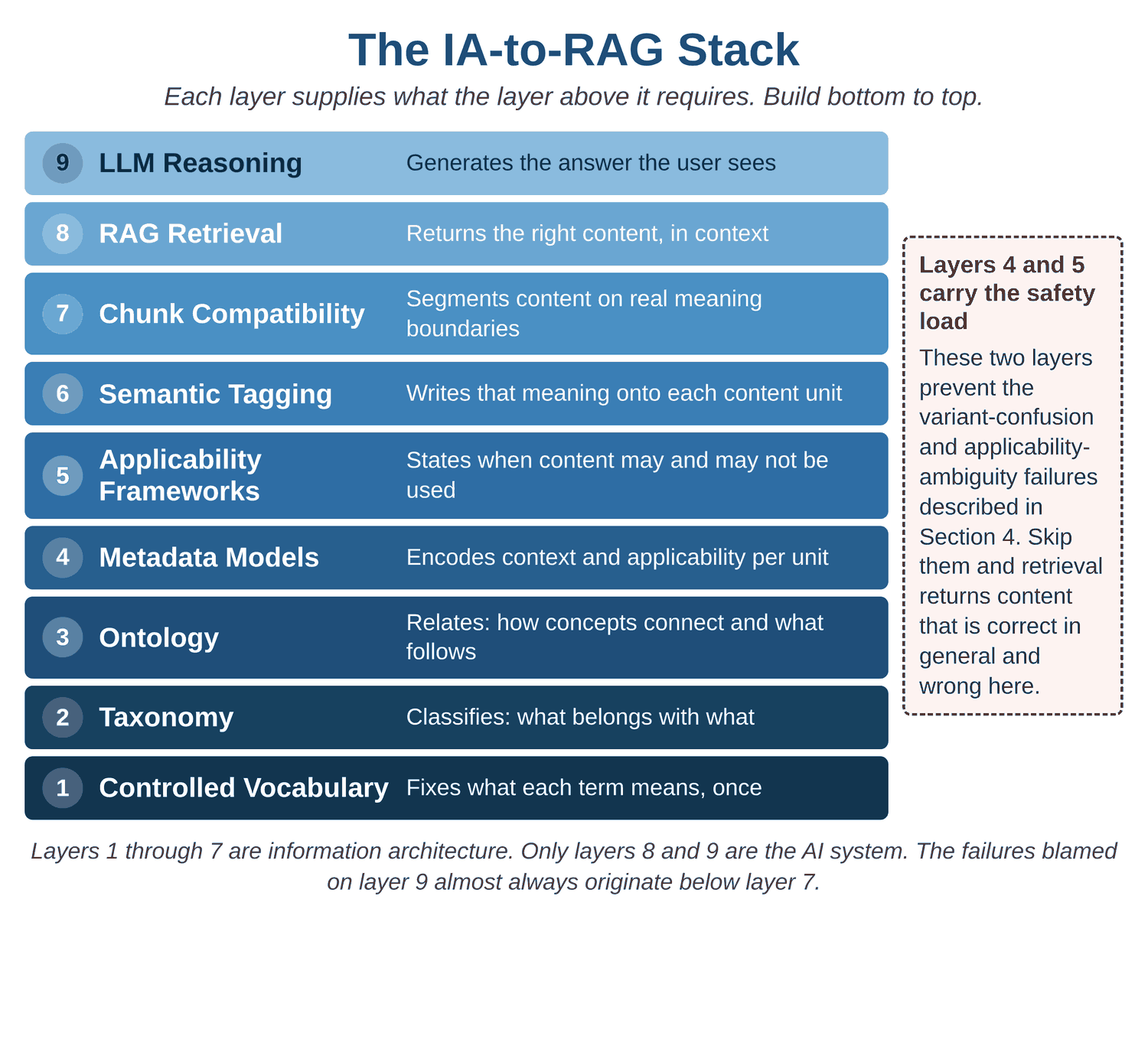
The stack is read from the bottom up, and each layer supplies what the layer above it requires. Controlled vocabulary (layer 1) fixes what each term means, once. Taxonomy (layer 2) classifies what belongs with what. Ontology (layer 3) states how concepts connect and what follows from those connections. Metadata models (layer 4) encode context and applicability onto each unit of content. Applicability frameworks (layer 5) state when content may and may not be used. Semantic tagging (layer 6) writes that meaning onto each content unit. Chunk compatibility (layer 7) segments content on real meaning boundaries rather than arbitrary character counts. Only then do RAG retrieval (layer 8) and LLM reasoning (layer 9) operate, returning the right content in context and generating the answer the user sees.
Two observations matter more than the sequence itself. First, layers 4 and 5 carry the safety load: they are what prevent the variant-confusion and applicability-ambiguity failures described in Section 4, and skipping them produces retrieval that returns content which is correct in general and wrong in the specific situation. Second, layers 1 through 7 are all information architecture. Only layers 8 and 9 are the AI system. The failures organizations attribute to layer 9 almost always originate below layer 7.
Frequently Asked Questions
What is the difference between a taxonomy and an ontology?
A taxonomy classifies and an ontology relates. A taxonomy is hierarchical: it states that a product family contains models, which contain generations, which contain variants, so it tells an AI system which documents are about the same subject. An ontology is a set of typed relationships: a symptom is caused by a failure mode, a coverage depends on a policy type. Taxonomy groups content; ontology connects it. No amount of taxonomy detail produces a relationship inference.
Do we need a knowledge graph, or is an ontology enough?
An ontology is the model; a knowledge graph is the populated result. The ontology states which kinds of relationships are legitimate, and the graph holds the actual entities and links, built by running entity extraction against real content and connecting what it finds according to the ontology's rules. Building a graph without an ontology first produces a network of links nobody can validate, because no rule states which links are legitimate.
In what order should taxonomy, ontology, and metadata work be done?
Taxonomy first, then ontology, then the knowledge graph, with metadata schema development following the concept modeling that defines what the metadata must encode. Organizations most often start with metadata schema because it feels like the most concrete deliverable, which produces a schema encoding distinctions nobody has agreed on. That schema then has to be rebuilt once domain and concept modeling reveal what the real distinctions are.
What is IAD-RAG?
IAD-RAG stands for Information Architecture Directed Retrieval-Augmented Generation, the named methodology Earley Information Science uses to build the IA foundation that retrieval systems depend on. It specifies seven ordered components: domain modeling, concept modeling, metadata schema development, ontology alignment, vocabulary normalization, relationship mapping, and semantic pattern design. The name states the causal claim: retrieval quality is directed by information architecture rather than emerging from it.
Why does a RAG system retrieve content that is accurate but wrong for the situation?
This is applicability failure, and it is an information architecture problem rather than a model problem. A procedure written for one equipment model, firmware version, or jurisdiction is factually correct in its own context, but retrieval based on text similarity alone has no signal telling it that context does not apply here. Metadata models and applicability frameworks supply that signal by encoding what each piece of content applies to.
Is there evidence outside Earley that information structure improves retrieval?
Yes. Microsoft Research, introducing GraphRAG in February 2024, identified two failure modes of retrieval built on text similarity alone: it struggles to connect information linked through shared attributes, and it performs poorly at understanding concepts across a large collection. A 2025 peer-reviewed study in Electronics applied structured retrieval to manufacturing document question answering and reported consistent gains over a naive baseline, with multi-hop questions benefiting most.
Which AIRR-10 dimensions does information architecture actually improve?
Four of the ten. Controlled vocabularies and vocabulary normalization move D1 Semantic Clarity. Taxonomy and chunk compatibility move D2 Structural Hierarchy and Chunking. Ontology and relationship mapping move D6 Entity and Concept Relationships. Metadata models, semantic tagging, and applicability frameworks move D9 Metadata Richness. The remaining six dimensions are content-design concerns moved by how content is written, not by how meaning is modeled.
Can we fix AI retrieval problems by writing better content instead?
Only some of them. Editorial work moves the content-design dimensions: actionable specificity, factual verifiability, temporal context, audience specificity, question-answer alignment, and uniqueness. It does not move entity relationships or metadata richness, because those depend on structures outside the prose itself. Diagnosing which kind of problem a retrieval failure represents is what keeps remediation effort from being spent in the wrong place.
What is semantic drift, and why does it break AI systems?
Semantic drift is the gradual divergence of a term's meaning across teams, documents, or time, without anyone deciding it should change. It breaks AI systems because nothing in the content flags that the definition moved, so the system applies a stale or foreign definition confidently. Controlled vocabularies and terminology governance prevent drift by fixing approved terms, their synonyms, and their boundaries before content is engineered.
How does information architecture reduce the burden on subject matter experts?
Information architecture supplies the semantic framework before subject matter experts are asked to contribute, so their time is spent validating and filling a structure rather than inventing one. Without that framework, each expert reconstructs the domain model implicitly in their own contributions, which produces inconsistent structures that then have to be reconciled. The framework converts open-ended knowledge capture into a bounded review task.
Does information architecture have to be finished before AI development starts?
No, but the sequence within it cannot be skipped. Information architecture is built progressively, and a bounded domain can be modeled, tagged, and made retrieval-ready while other domains are still unstructured. What fails is attempting retrieval across content where the vocabulary, classification, and applicability rules were never established, since the AI system has no way to infer structure that was never expressed.
Sources and Further Reading
- IEEE IT Professional. "There Is No AI Without IA." 2016 https://doi.org/10.1109/MITP.2016.43
- Harvard Business Review. "Is Your Data Infrastructure Ready for AI?" 2020 https://hbr.org/2020/04/is-your-data-infrastructure-ready-for-ai
- MIT Project NANDA. "The GenAI Divide: State of AI in Business 2025." 2025
- Gartner. "Gartner Predicts 30% of Generative AI Projects Will Be Abandoned After Proof of Concept By End of 2025." Gartner Newsroom, July 29, 2024
- Larson, Jonathan, and Steven Truitt. "GraphRAG: Unlocking LLM discovery on narrative private data." Microsoft Research, February 13, 2024 https://www.microsoft.com/en-us/research/blog/graphrag-unlocking-llm-discovery-on-narrative-private-data/
- Knollmeyer, Simon, Oğuz Caymazer, and Daniel Grossmann. "Document GraphRAG: Knowledge Graph Enhanced Retrieval Augmented Generation for Document Question Answering Within the Manufacturing Domain." *Electronics* 14, no. 11 (2025): 2102 https://doi.org/10.3390/electronics14112102