
1. Introduction: Why Knowledge Engineering Determines AI Success in Complex Environments
Organizations that design, operate, or support complex products and technical services run on knowledge. That knowledge lives in the experience of engineers, technicians, scientists, analysts, and specialists who understand the relationships, conditions, variations, and exceptions that define real-world operations. When these organizations adopt generative AI, they are often surprised to discover that the technology does not automatically reflect the depth of reasoning their people demonstrate every day.
The market data confirms what we see in the field. MIT’s Project NANDA analyzed 300 public AI deployments and found that 95 percent of enterprise generative AI pilots deliver no measurable impact on the P&L[1]. Gartner predicts that through 2026, organizations will abandon 60 percent of AI projects that are not supported by AI-ready data, and reports that 63 percent of organizations either lack, or are unsure they have, the data management practices AI requires[2]. McKinsey’s most recent global survey found that 88 percent of organizations now use AI in at least one business function, yet only 7 percent have fully scaled it across the enterprise[3]. Adoption is nearly universal. Value at scale is rare. The difference is the knowledge foundation underneath the model, and that foundation must be engineered.
The gap is predictable. AI systems can generate language, but they cannot generate expertise. Expertise must be engineered: structured, validated, and organized in a way the AI system can interpret. Without this foundational work, Retrieval Augmented Generation (RAG) systems retrieve the wrong content, interpret language incorrectly, or produce unsafe and inconsistent outputs.
We have argued this principle for more than a decade: there is no AI without IA. We introduced it in IEEE IT Professional in 2016[4], IBM’s CEO repeated it at the World Economic Forum in Davos in 2019, and The AI-Powered Enterprise (LifeTree Media, 2020) developed it into a complete operating method built on the ontology, the master knowledge scaffolding of the organization[5]. RAG has made the principle operational. A retrieval system is only as trustworthy as the knowledge substrate it retrieves from, and that substrate does not build itself.
Knowledge Engineering is the discipline that fills this gap. It transforms raw, inconsistent, and dispersed information into the structured, governed substrate that RAG systems depend on. This page explains what Knowledge Engineering is, why it is essential for RAG, how it supports expert-level reasoning, which Earley frameworks make it repeatable (IAD-RAG, the GEO Pillar Model, the Component Engineering System, and the Knowledge-to-AI Pipeline), and how Earley delivers this work as part of your AI Readiness Architecture Pilot.
2. What Knowledge Engineering Means in a RAG Context
Knowledge Engineering (KE) is the systematic organization of an organization’s expertise, terminology, content, relationships, rules, and operational logic. The goal is a structured environment where AI can retrieve information accurately and apply it consistently across contexts.
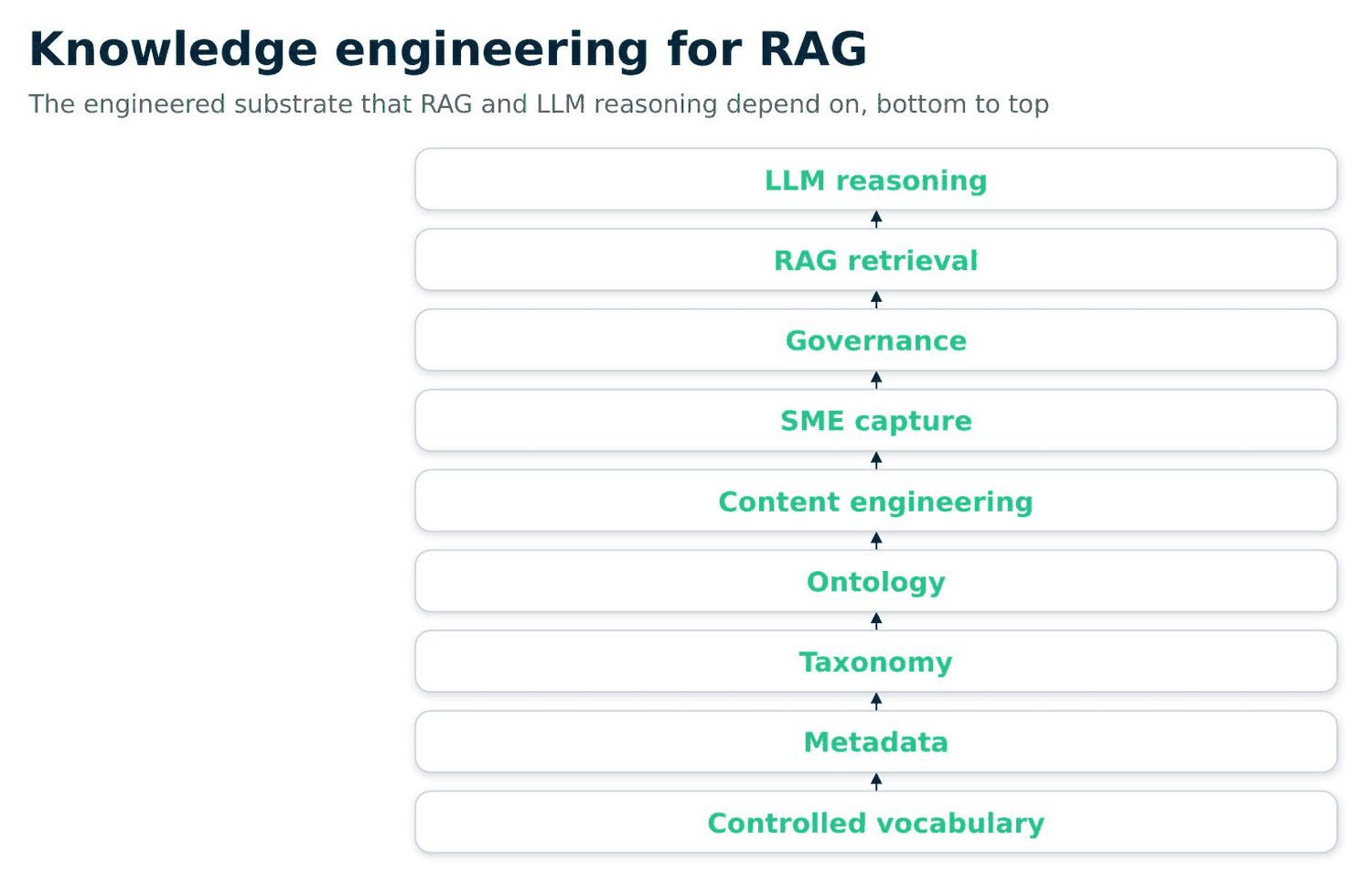
RAG systems need three things: the right content, the right structure, and the right semantic meaning. Knowledge Engineering provides all three. It converts unstructured content into governed knowledge, and it defines how knowledge elements relate to one another so retrieval and reasoning become predictable. Seven interdependent disciplines make up the practice.
2.1 Ontology Development
An ontology describes how concepts relate. It is the structural model of your technical domain: how equipment assemblies relate to subassemblies, components, attributes, functional roles, and conditions, and how causes, effects, dependencies, constraints, and sequences connect. In The AI-Powered Enterprise we define the ontology as the master knowledge scaffolding of the organization, a complete, consistent model of the customers, products, processes, and relationships that make a business work[5].
A senior finance executive at one client once asked why his company needed taxonomies and an ontology instead of “just getting Google.” Our answer was another question: would he get rid of his chart of accounts and just get Google? He laughed at the idea. The ontology does for enterprise knowledge what the chart of accounts does for financial information. It supplies the organizing principles that separate signal from noise, and it gives both people and machines a consistent way to interpret the business.
The ontology also acts as the translation layer between systems that change at different speeds: fast-moving marketing and engagement platforms on one end, slow-moving ERP and quality systems on the other. Most enterprises already have “accidental” ontologies, fragmented structures that grew out of ungoverned changes, acquisitions, and vendor defaults. Accidental ontologies present many conflicting views of the truth. A deliberately engineered ontology presents one. Without it, an AI system cannot tell the difference between concepts that look similar in language but perform very different functions in practice.
2.2 Taxonomy Creation
A taxonomy is a structured, hierarchical classification of concepts and content that reflects how experts navigate the domain: product families, service topics, failure categories, regulation types, technical domains. Taxonomies answer two questions about any piece of information. What is it (its “is-ness”): a procedure, a hazard advisory, a specification? And what is it about (its “about-ness”): which product, which version, which region, which task? These hierarchies give AI consistent signals about what content belongs where, and they give retrieval a structure that matches the user’s mental model. In complex environments the scale is significant. One semiconductor equipment client required more than 30 interrelated taxonomies, with tens of thousands of terms and hundreds of thousands of relationships, to represent its knowledge domain (see Section 5).
2.3 Metadata Schema Design
Metadata gives content the identity and context AI systems rely on: product applicability, version, safety classification, regulatory requirement, audience, lifecycle stage, geographic relevance. When metadata is missing or inconsistent, RAG retrieves inaccurate or outdated content. Schema design also has to hit the metadata sweet spot. Too little metadata and the AI cannot find or filter content; too much and no one will apply it consistently. The schema is designed against actual retrieval use cases, not against an abstract ideal.
2.4 Controlled Vocabulary and Terminology Management
Technical environments depend on precise language, and language drifts. A term accumulates synonyms, abbreviations, and variants over time, and different teams use the same word to mean different things. Knowledge Engineering harmonizes terminology so the words used by engineers, technicians, and customers map to the same underlying concepts. This is also what makes intent recognition work. When a user reports that “the unit is not connecting,” the system needs governed equivalences (“cannot connect,” “unable to connect,” “will not connect”) to extract the entities and symptoms, resolve the intent, and retrieve the right diagnostic path.
2.5 Content Engineering and Componentization
Content must be prepared for retrieval before a RAG system can use it. Raw documents rarely qualify. Content engineering normalizes formats, chunks long documents into structured fragments, clarifies ambiguous sections, resolves contradictions, adds semantic tags, and aligns everything to the taxonomies and ontology.
Earley’s Component Engineering System takes this further by decomposing narrative content into eight governed component types: action steps, measurements and thresholds, hazards, STOP conditions, confirm/deny tests, variations, exceptions, and dependencies. Consider a technician’s verbal description: “To check the pump, stop the system, open the panel, measure the voltage, and if it’s low the capacitor is probably bad.” Componentization converts that sentence into a STOP condition, an action step, a measurement with an explicit threshold (voltage below 4.8V indicates a fault), a confirm/deny test, and an electrical hazard. Prose became machine-actionable knowledge, and the AI can no longer improvise the steps.
2.6 SME Knowledge Capture
Experts hold knowledge that has never been documented: diagnostic flows, decision criteria, conditional reasoning, exception patterns, experiential insight. This tacit knowledge is essential for accurate problem solving, and it is usually the difference between an answer that is plausible and an answer that is correct. Knowledge Engineering uses structured interviews, workshops, observation, and deep elicitation methods to capture it, then validates it with the experts who supplied it before it enters the substrate.
2.7 Knowledge Governance
Knowledge evolves as products, regulations, and environments change. Governance establishes the roles, processes, rules, and quality controls that keep the substrate accurate: validation workflows, version control, review cycles, accountability structures, audit processes. In Earley’s GEO Pillar Model (Governance, Engineering, Operations), governance is the first pillar because it creates semantic stability, the precondition for safe AI. Gartner’s analysis reaches the same conclusion from the data side: AI-ready data is a practice that requires continued investment and ongoing maturity, not a one-time cleanup[2]. Without governance, the knowledge base decays, terminology drifts, and yesterday’s accurate answer becomes tomorrow’s compliance exposure.
3. Why Knowledge Engineering Is Mandatory for RAG Performance
RAG combines retrieval of source content with generative reasoning, so its performance depends entirely on the structure and quality of what it retrieves. The industry statistics above describe the symptoms. These are the failure mechanisms we see inside unengineered corpora.
3.1 Retrieval Becomes Unreliable
If content lacks structure, metadata, or taxonomy alignment, RAG retrieves documents that are linguistically similar but operationally wrong. Vector similarity is not operational relevance. The result misleads users, increases risk, and erodes trust.
3.2 Answers Become Inconsistent
When source content is inconsistent or contradictory, RAG generates different answers to similar questions. Users notice within days, and adoption stalls.
3.3 Domain Language Gets Misinterpreted
Terms used by engineers and technicians carry precise meanings. Without controlled vocabularies, AI collapses terms that experts keep distinct, which produces incorrect conclusions or unsafe recommendations.
3.4 Product Variants Get Confused
Complex technical organizations manage product families with many configurations. Without engineered relationships, the AI blends steps from Version 2 into a Version 3 procedure, and neither the model nor the user can tell.
3.5 Historical Documentation Causes Drift
Legacy content carries outdated instructions, retired processes, and superseded guidelines. Without version metadata and lifecycle governance, RAG treats the obsolete and the current as equals.
3.6 Missing Relationships Force AI to Guess
Experts reason with causal and conditional relationships that unstructured text does not state. AI systems cannot infer what was never written down. Knowledge Engineering models these relationships explicitly, or the model fills the gap with a guess.
4. How Knowledge Engineering Enables Expert-Level Reasoning
Human experts do not reference documents blindly. They apply structured reasoning, contextual judgment, and mental models built through years of experience. RAG cannot replicate this unless the underlying knowledge encodes the same six structures, and each maps directly to component types in our engineering method:
- Causal relationships. Cause and effect patterns, such as a vibration signature that indicates a bearing failure, modeled as symptom-to-cause mappings and confirm/deny tests.
- Procedural steps. Ordered sequences with dependencies and safety requirements, modeled as atomic action steps with explicit sequencing.
- Conditional logic. The conditions that alter a procedure or introduce exceptions, modeled as variation and exception components.
- Contextual awareness. What information matters in which situation, modeled through metadata for role, environment, version, and operating mode.
- Exceptions and edge cases. Captured explicitly so the AI does not misapply general rules.
- Risk and safety constraints. Hazards, STOP conditions, and inhibitors encoded so the AI can never generate around them.
By engineering these structures, Knowledge Engineering turns RAG from a linguistic tool into an operational decision support system.
5. Proof in the Field: The Applied Materials Case
This discipline predates the current generation of language models, and the strongest evidence for it comes from production systems that have run for years. The AI-Powered Enterprise opens its ontology chapter with one of them[5].
Applied Materials builds the equipment used to produce most of the world’s advanced chips. A semiconductor fabrication plant costs over a billion dollars, and a down fab can cost its owner millions of dollars per day. The company’s 3,000 field service technicians carried that pressure into ultraclean environments where some customers prohibited laptops entirely, which meant a technician had to assemble everything they might need before entering the plant. The knowledge required to keep fabs running was scattered across 14 systems, and technicians spent up to 40 percent of their time searching for information. They hedged by stocking service vehicles with costly components, tying up tens of millions of dollars in inventory. The company attempted to solve the problem three times over five years. All three attempts failed.
The missing piece was not another search engine. It was the organizing layer. We built the ontology and its subsidiary taxonomies: more than 30 vocabularies covering platforms, processes, assemblies, products, plants, configurations, severities, and regions, with the relationships among them mapped explicitly. That semantic layer unified all 14 systems under a common framework, drove consistent tagging of parts and troubleshooting documents through text analytics, and let technicians retrieve content grouped the way they actually thought about problems. Search time fell by half. The company estimated savings in the tens of millions of dollars per year, reduced component and replacement part inventories, and faster turnaround on down fabrication plants.
Every element of that solution (governed vocabulary, explicit relationships, metadata-driven retrieval, content structured around the user’s mental model) is what a RAG system requires today. The retrieval technology has changed. The foundation has not.
6. IAD-RAG: Information Architecture-Directed Retrieval Augmented Generation
IAD-RAG is Earley’s proprietary method for building RAG systems on structured knowledge, governed terminology, and engineered content components. Typical RAG retrieves unstructured fragments and relies on the model to sort them out. IAD-RAG retrieves knowledge deliberately shaped for machine understanding, within defined boundaries, with the right context attached. The model consists of seven engineered layers:
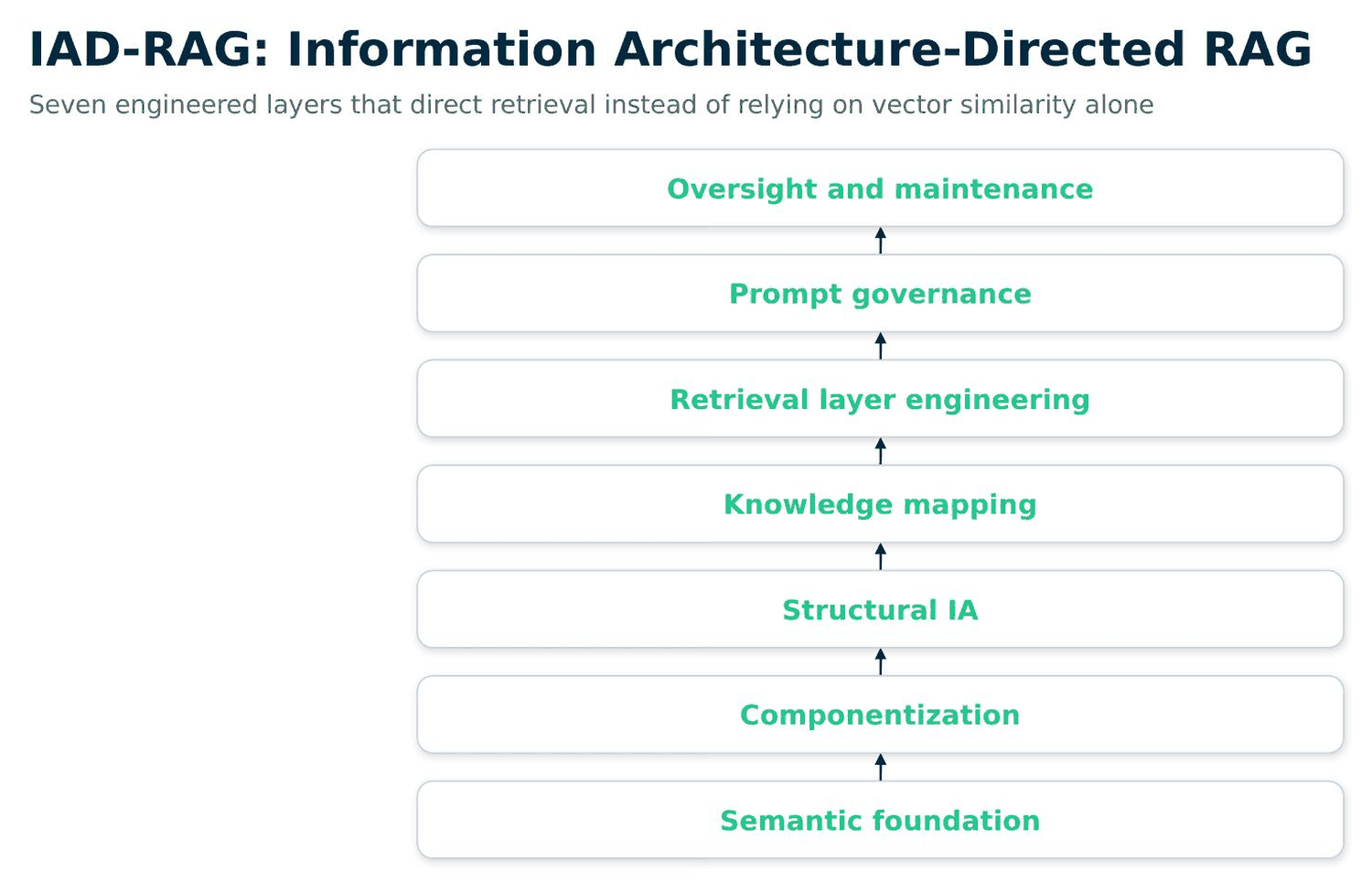
- Layer 1, Semantic Foundation: canonical definitions, concept boundaries, governed terminology, domain models, and ontological relationships, so the AI knows what things mean.
- Layer 2, Componentization: atomic steps, hazards, STOP conditions, measurements, confirm/deny tests, exceptions, and variants, so prose becomes machine-actionable.
- Layer 3, Structural IA: taxonomies, sub-taxonomies, metadata schema, retrieval-relevance rules, and governance rules, so the AI finds the right content.
- Layer 4, Knowledge Mapping: components linked to workflows, hazards to mitigations, symptoms to causes, with version-specific and environment-specific mapping, so answers stay contextually correct.
- Layer 5, Retrieval Layer Engineering: prioritization rules, content bundling, relevance windowing, boundary enforcement, and negative knowledge cues (“do not retrieve”), so irrelevant or invalid content stays out of the context window.
- Layer 6, Prompt Governance: structured prompt templates, role-based access, parameterized constraints, and retrieval validation, so the AI responds within a defined semantic lane.
- Layer 7, Oversight and Maintenance: knowledge refresh cycles, version control, semantic drift monitoring, error case review, and retrieval accuracy evaluation, so the system improves over time instead of degrading.
Each layer answers a specific enterprise failure. AI gives different answers to the same question? Canonical terminology plus retrieval boundary rules. AI retrieves outdated content? Version boundaries plus lifecycle metadata. AI invents procedural steps? Componentized workflows with STOP conditions. AI ignores safety considerations? Explicit hazard components with protective measures. Users do not trust the system? Transparent logic they can verify against engineered constraints.
7. The Knowledge-to-AI Pipeline: From Chaos to Corpus
IAD-RAG is the architecture. The Knowledge-to-AI Pipeline is the operating process that gets an organization there: the seven-stage transformation Earley runs in engagements and pilot deployments.
- Stage 1, Knowledge Discovery and Capture: content inventory, SME interviews, tribal knowledge extraction, variation and hazard discovery. Output: a raw knowledge repository and a gap analysis.
- Stage 2, Concept and Terminology Engineering: canonical definitions, terminology normalization, synonym and homonym mapping, governed vocabulary. Output: the glossary and concept boundaries that create semantic stability.
- Stage 3, Workflow and Knowledge Componentization: decomposition into atomic steps, hazards, STOP conditions, thresholds, tests, exceptions, and variants. Output: the component library. This is the core of IAD-RAG readiness.
- Stage 4, Metadata and Structural Architecture: schema definition, taxonomy and ontology refinement, component tagging, version and role structuring. Output: retrieval relevance rules and version boundaries, the ability to find the right thing rather than everything.
- Stage 5, Knowledge Validation and Governance Integration: SME validation loops, safety and compliance checks, content quality enforcement. Output: validated, governed, versioned content models.
- Stage 6, RAG and AI Alignment Engineering: corpus engineering, chunking strategy, context window tuning, embedding optimization, negative knowledge cues, boundary enforcement. Output: the RAG-ready corpus and semantic alignment layer.
- Stage 7, Deployment, Monitoring, and Continuous Improvement: retrieval accuracy monitoring, drift detection, lifecycle management, feedback and correction loops. Output: stable AI performance that strengthens with use.
8. VIA: Accelerating Knowledge Engineering at Scale
The pipeline above once demanded months of manual effort. Earley’s Virtual Information Architect (VIA) compresses it to weeks. VIA is not a chatbot. It is an engineered environment that operationalizes 30 years of Earley methodology and applies it consistently at scale through six integrated modules:
- Concept Modeling Engine: extracts concepts from existing content, flags duplicates and contradictions, proposes canonical definitions and boundaries, and detects gaps.
- Workflow Componentizer: converts paragraphs and SME descriptions into steps, hazards, STOP conditions, thresholds, confirm/deny tests, dependencies, and variants.
- Metadata Schema Generator: applies recommended fields, enforces consistent tagging, and aligns documentation to taxonomy categories.
- Variation and Boundary Engine: models the factors that change meaning or procedure (environment, version, firmware, role, configuration, mode) so the AI never blends incompatible paths.
- Hazard and Risk Interpreter: extracts and formalizes hazards, triggers, mitigations, prohibited actions, and escalation conditions, embedding safety into AI output.
- Consistency, Drift, and Alignment Monitor: flags inconsistent terminology, detects semantic drift, checks governance alignment, and suggests corrections.
VIA generates structured proposals that SMEs review rather than author. That cuts the expert time commitment dramatically and removes the single biggest bottleneck in enterprise knowledge programs.
9. Keeping AI Trustworthy Over Time: Two Continuous Loops
Enterprise AI systems degrade unless they are maintained, and the degradation is silent. Two Earley frameworks keep engineered knowledge healthy in production.
9.1 The Semantic Drift Prevention Loop
Semantic drift accumulates quietly. A new SME uses different terminology. A product update changes a threshold and the documentation lags. Regions adapt content independently. Then the AI begins retrieving contradictory versions. The loop runs six continuous phases: terminology monitoring, definition and meaning evaluation, cross-content alignment, knowledge engineering correction, SME validation and governance approval, and AI alignment update. A concrete example: a diagnostic procedure defines “low flow” as under 2.0 L/min, and a product update moves the threshold to 1.8 L/min. Without the loop, field technicians receive unsafe guidance for months. With it, monitoring detects the change, engineering updates the componentized threshold, SMEs validate, the corpus reindexes, and the AI reflects the correct threshold immediately.
9.2 The Retrieval Accuracy Improvement Loop
Where drift prevention protects meaning, this loop protects performance. It runs five recurring phases: monitor (which chunks are retrieved, whether hazards consistently appear, whether versions match the question), diagnose (metadata gaps, terminology inconsistencies, chunking problems, boundary failures), correct (re-tagging, splitting oversized components, adding negative retrieval cues, removing deprecated content), optimize (retrieval parameters, ranking logic, synonym handling, metadata weighting), and validate (SME confirmation, regression and edge-case testing, safety verification). Retrieval becomes a living capability with a scorecard, not a one-time integration.
10. Where You Stand: The AI Readiness Maturity Model
Executives need a shared language for what “AI-ready” actually means. Earley’s five-level maturity model provides it, ordering the work and exposing the gap between where an organization is and what reliable AI requires.
| Level | Stage | Characteristics | AI Impact |
|---|---|---|---|
| 1 | Ad Hoc and Unstructured | Knowledge scattered and narrative; tribal knowledge dominates; no metadata standards or content lifecycle | Unreliable, contradictory outputs; RAG ineffective; frequent hallucination |
| 2 | Aware and Emerging Structure | Early metadata and terminology efforts; high variability; no componentization or hazard modeling | Retrieval still noisy; improvement is incremental, not structural |
| 3 | Structured and Governed | Canonical definitions; terminology and metadata governance; documented workflows; defined lifecycle | Retrieval improves substantially; hallucinations decrease; SME load drops |
| 4 | Engineered and Componentized | Fully componentized workflows; hazard and STOP modeling; version and variation modeling; IAD-RAG corpus; VIA acceleration | Accurate, safe, context-aware AI; high retrieval reliability |
| 5 | Optimized and AI-Integrated | Governed and automated ecosystem; proactive drift detection; retrieval accuracy monitoring; continuous improvement loops | Role-appropriate, version-specific guidance; stable accuracy over time; AI as an operational asset |
Most enterprises assess at Level 1 or 2, which is consistent with the failure rates MIT and Gartner report[1,2]. Level 4 is where Earley differentiates, because few organizations have ever engineered knowledge to that standard. Level 5 is true AI readiness.
11. What a Knowledge Engineering Engagement Produces
A complete KE engagement delivers five classes of assets, each a durable investment that outlives any single model or vendor:
- Foundational structures: taxonomies, ontologies, metadata schemas, and controlled vocabularies.
- Engineered content: structured, normalized, chunked, tagged, and validated content designed for RAG.
- SME knowledge models: decision trees, logic flows, heuristics, conditional rules, and domain mappings.
- Governance frameworks: roles, processes, review cycles, validation methods, and change management.
- A structured knowledge substrate: the engineered foundation that allows AI systems to perform consistently and safely, reusable across assistants, search, service platforms, and analytics.
12. Why Earley Leads in Knowledge Engineering
Earley has organized and structured knowledge for technical organizations for more than thirty years, well before “RAG” had a name. Our record includes the development of formal knowledge structures in complex industries; the introduction of the principle that there is no AI without IA, published in IEEE IT Professional[4] and repeated by IBM’s CEO at Davos; The AI-Powered Enterprise, the book that established the ontology as the operating foundation of enterprise AI[5]; publication in Harvard Business Review and recognition by Gartner, Forrester, and IDC; hundreds of engagements across technical product and service environments, including the Applied Materials program described in Section 5; the development of VIA; and the creation of the IAD-RAG methodology. We treat information as an engineered system rather than as documentation, and that difference is measurable in retrieval accuracy, safety, and adoption.
13. How Knowledge Engineering Supports the AI Readiness Architecture Pilot
Knowledge Engineering is the foundation of the AI Readiness Architecture Pilot. Within the pilot it ensures that retrieval is accurate, reasoning is predictable, outputs are reliable, safety is preserved, compliance is maintained, expert logic is modeled, content is actionable, and knowledge is validated. It also ensures the pilot produces reusable assets: the ontology, component library, metadata schema, and governance model built for the pilot are the same assets that carry the system to production, which is precisely the step where 95 percent of pilots fail[1].
Without Knowledge Engineering, an AI pilot is an experiment. With it, the pilot becomes a reliable demonstration of value that can scale.
14. Next Step
See how Knowledge Engineering enables your AI Readiness Architecture Pilot. Request a briefing at earley.com/contact-us.
Frequently Asked Questions
What is the GEO Pillar Model in Knowledge Engineering?
The GEO Pillar Model is Earley Information Science’s framework for governing enterprise AI knowledge, organized around three pillars: Governance, Engineering, and Operations. Governance comes first because it establishes semantic stability, the precondition for safe AI; Engineering builds the structured knowledge substrate; Operations sustains it through validation, monitoring, and continuous improvement. The model gives organizations a shared structure for scaling Retrieval Augmented Generation (RAG) systems reliably.
What does Earley Information Science mean by “there is no AI without IA”?
“There is no AI without IA” is Earley Information Science’s founding principle that generative AI systems cannot perform reliably without a properly engineered information architecture (IA) underneath them. Seth Earley introduced the phrase in IEEE IT Professional in 2016, and IBM’s CEO repeated it at the World Economic Forum in Davos in 2019. Retrieval Augmented Generation (RAG) has made the principle operational: an AI system is only as trustworthy as the structured knowledge it retrieves from.
What is the difference between an ontology and a taxonomy in Knowledge Engineering?
A taxonomy is a hierarchical classification of content and concepts, such as product families or failure categories, that tells an AI system what a piece of content is and what it is about. An ontology is the broader structural model of how those concepts relate to one another: causes, effects, dependencies, and functional roles across an entire technical domain. In The AI-Powered Enterprise, Seth Earley describes the ontology as the master knowledge scaffolding that unifies an organization’s taxonomies into one consistent model.
What percentage of enterprise generative AI pilots fail to deliver measurable business value?
According to MIT Project NANDA’s 2025 analysis of 300 public AI deployments, as reported in Fortune, 95 percent of enterprise generative AI pilots deliver no measurable impact on the company’s profit and loss statement. Knowledge Engineering addresses the most common root cause: pilots built on unstructured, ungoverned content that cannot scale into a reliable production Retrieval Augmented Generation (RAG) system once the proof of concept ends.
What did Gartner predict about organizations without AI-ready data?
Gartner predicts that through 2026, organizations will abandon 60 percent of AI projects that are not supported by AI-ready data, and its research found that 63 percent of organizations either lack, or are unsure they have, the data management practices AI requires. Knowledge Engineering is the discipline that builds AI-ready data: governed taxonomies, metadata, and validated content that Retrieval Augmented Generation (RAG) systems depend on.
How many taxonomies did Applied Materials require to represent its knowledge domain?
Applied Materials, the semiconductor equipment manufacturer, required more than 30 interrelated taxonomies, covering platforms, processes, assemblies, products, plants, configurations, severities, and regions, to represent the knowledge domain behind its field service operations. Earley Information Science built these taxonomies along with the ontology that unified them, replacing 14 disconnected systems that had previously scattered the company’s service knowledge and slowed technician troubleshooting.
How much did Applied Materials save after Earley Information Science built its ontology and taxonomies?
Applied Materials estimated savings in the tens of millions of dollars per year after Earley Information Science built the ontology and taxonomies that unified its 14 disconnected knowledge systems. The company also reduced its inventory of components and replacement parts, which technicians had previously overstocked to compensate for unreliable search, and improved turnaround time on down semiconductor fabrication plants, where downtime can cost millions of dollars per day.
What does Earley Information Science mean by a “structured knowledge substrate”?
A structured knowledge substrate is the complete, governed foundation of taxonomies, engineered content, metadata, and validated subject matter expert (SME) knowledge that a Retrieval Augmented Generation (RAG) system retrieves from. Earley Information Science builds it as a durable, reusable asset: the same substrate that supports one AI assistant can also power enterprise search, service platforms, and analytics, rather than being rebuilt for each new AI initiative.
What is the “metadata sweet spot” in Knowledge Engineering?
The metadata sweet spot is the balance between too little metadata, which leaves an AI system unable to find or filter content, and too much metadata, which no team will apply consistently over time. Earley Information Science designs metadata schemas against actual retrieval use cases, such as product version, safety classification, or audience, rather than building an abstract ideal that looks thorough but goes unused in practice.
What is the AI Readiness Architecture Pilot?
The AI Readiness Architecture Pilot is Earley Information Science’s engagement model for proving that a Retrieval Augmented Generation (RAG) system can scale, not just work in a demo. Knowledge Engineering is its foundation: the ontology, component library, metadata schema, and governance model built during the pilot are the same reusable assets that carry the system into production, the exact step where most enterprise AI pilots currently fail.
Does Knowledge Engineering apply only to Retrieval Augmented Generation, or more broadly?
Knowledge Engineering predates Retrieval Augmented Generation (RAG) and applies wherever an organization needs AI or search systems to reason accurately over technical content. Earley Information Science’s Applied Materials engagement, for example, unified 14 knowledge systems for enterprise search and technician support years before RAG existed. RAG has made structured knowledge mandatory rather than optional, but the discipline itself supports any AI system that depends on retrieving and reasoning over enterprise knowledge.
What industries does Earley Information Science’s Knowledge Engineering for RAG work serve?
Earley Information Science applies Knowledge Engineering for Retrieval Augmented Generation (RAG) primarily in technical, regulated, and safety-critical industries: life sciences, manufacturing, industrial equipment, insurance, financial services, and energy. These industries share a common demand: complex products or services where an AI system’s retrieval mistakes carry real operational, safety, or compliance consequences, which is exactly the environment structured knowledge is built to prevent.
Sources and Further Reading
[1] MIT Project NANDA, “The GenAI Divide: State of AI in Business 2025,” as reported in Fortune, August 18, 2025 https://dc.fortune.com
[2] Gartner, “Lack of AI-Ready Data Puts AI Projects at Risk,” press release, February 26, 2025 https://gartner.com
[3] McKinsey & Company, “The State of AI in 2025: Agents, Innovation, and Transformation,” November 2025 https://mckinsey.com
[4] Seth Earley, “There Is No AI Without IA,” IT Professional, vol. 18, no. 3, 2016 https://ieeexplore.ieee.org
[5] Seth Earley, The AI-Powered Enterprise, LifeTree Media, 2020 https://earley.com