
What passed for a satisfying customer experience two years ago is today's baseline expectation. The mobile site that once felt innovative now frustrates users who expect seamless, personalized interactions across every device and channel. The e-commerce platform that impressed early adopters now feels generic if it fails to recognize a returning customer's preferences. Competitive advantage in customer experience is not a destination any organization reaches and holds. It is a position that must be actively defended and continuously advanced.
Across industries, the bar rises constantly. Convenience, accessibility, ease of use, and the ability to anticipate customer needs before they are expressed have become table stakes rather than differentiators. Whether the interaction happens on a website, a mobile app, a tablet, an in-store display, or through a customer service agent, buyers expect organizations to know them, remember them, and serve them with relevance at every step of the journey.
Technology Change Outpaces Organizational Learning
The rate at which new tools and technologies enter the customer engagement landscape makes it genuinely difficult for organizations to keep pace. Sustaining a competitive position requires building competencies and capabilities continuously, not just adopting platforms.
The digital experience is the primary interface between an enterprise and its market. Maturity in that experience encompasses both the technology that enables it and the organizational processes that drive it, including internal collaboration structures, content operations, data management practices, and the degree to which digital approaches are aligned with overall business strategy. It also includes something harder to quantify: how deeply various parts of the organization understand the tools available to them and the direction the industry is moving.
A marketing manager at a mid-sized organization put the problem plainly: her team had access to capable tools but lacked the organizational fluency to take full advantage of them. That gap between technological capability and organizational readiness is common, and it compounds over time as the learning curve steepens. This is part of why "digital transformation" carries the weight that it does. The word transformation is not an exaggeration. These initiatives touch every part of the enterprise and intersect with culture, embedded processes, and existing ways of working in ways that purely technical projects do not.
Confusing a Technology Purchase with a Capability
One of the most consistent mistakes leadership teams make is treating the acquisition of a technology as equivalent to acquiring the capability that technology is meant to enable. They are not the same thing.
Integrating a new tool into the daily work of an organization requires significant effort. For that integration to succeed, the new capability needs to fit within the organization's current level of maturity and offer a navigable path toward greater sophistication. When the gap between current state and required state is too large, or when the path is too disruptive to existing workflows, the organization ends up spending far more time and money racing through a compressed learning curve than it would have with a more measured approach.
Consider what is actually involved in delivering a personalized user experience through dynamic content and contextualized messaging. The technology layer requires a content delivery system capable of serving different combinations of content to different audiences, a rich media asset management system, and either a rules engine or a machine learning algorithm for interpreting user behavior and triggering appropriate responses. That is the comparatively straightforward part.
The harder work begins once the technology is in place. Organizations that have made substantial investments in these platforms often discover that the questions they then need to answer have nothing to do with software:
What specific messages should different customer segments receive? How should content and assets be structured so they can be assembled dynamically rather than published as static pages? How will the organization monitor, test, and refine these experiences over time?
Answering those questions requires organizational maturity across marketing strategy, audience segmentation, analytics, content operations, product information management, machine learning, and user experience design. A technology purchase does not supply any of that.
Knowing Where You Stand Before Deciding Where to Go
The most reliable way to distinguish between what is possible and what is actually achievable for a given organization at a given moment is to assess current maturity honestly and set targets based on that assessment rather than on aspiration alone.
A maturity model gives leadership a structured view of where the organization currently sits on its capability development curve, what competencies are already in place, and what would need to be true for a more advanced capability to be successfully deployed. That analysis enables more accurate budget allocation, more realistic project scoping, and clearer prioritization of the gaps that most directly affect the customer experience or the people responsible for delivering it.
The specific maturity stage an organization occupies is less important than understanding what stage is required to support the capabilities the organization intends to pursue. That target stage can be derived from competitive strategy, from go-to-market objectives, or directly from customer expectations and unmet needs.
Many maturity models exist, and most benefit from customization to reflect the specific context of the organization using them. The essential function of any model is to define the competencies required to support a desired capability and to make visible how large the gap is between where the organization stands today and where it needs to be.
A Five-Step Process for Applying Maturity Models to Customer Experience
Translating a maturity model from a diagnostic tool into an actionable planning framework involves five steps:
Step 1. Map the customer journey as it exists for your organization, from initial awareness through post-purchase engagement.
Step 2. Inventory the capabilities currently in place to support customer engagement at each stage of that journey.
Step 3. Identify where the experience breaks down or falls short and articulate what an improved future state would look like at each gap point.
Step 4. Locate your organization's current position on a customer experience maturity model (Table 1) and identify the target state required to deliver the intended experience.
Step 5. For each stage of the journey, identify the specific digital capabilities required and assess both the current and target maturity of each capability (Table 2).
Each capability gap has consequences for specific stages of the customer journey. Weak or unreliable site search, for example, tends to undermine the discovery and evaluation phases, making it harder for customers to find and choose the right product. An organization targeting maturity stage 3 for the "choose" stage of the journey will need to advance its maturity in product information management, content management, and search in parallel.
It is worth noting that customer journey maturity and digital capability maturity do not map to each other on a one-to-one basis. A single capability such as content management can affect multiple stages of the journey simultaneously. An organization may be at stage 2 for content management while operating at stage 3 for search. Each capability has its own trajectory.
Table 1 – Customer Journey Maturity
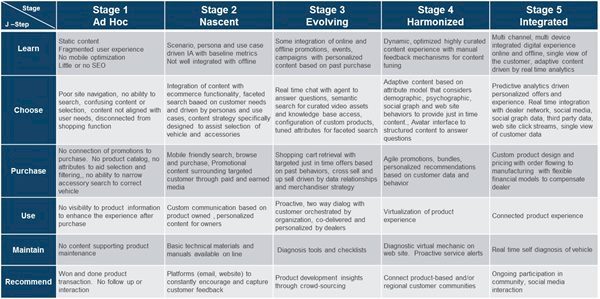
Table 2 – Digital Capability Maturity
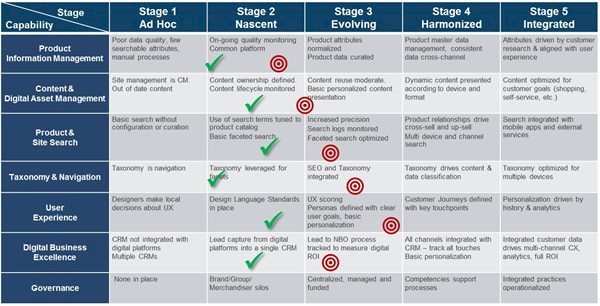
The tables use check marks to indicate current maturity state and target symbols to indicate the required maturity level for each capability. Digital capabilities should encompass any technology used to engage customers and can be extended to include tools specific to the organization's situation. More granular assessments are available for customer engagement, lead generation, and campaign management platforms, but most tools either leverage or can be mapped to the core capability categories in the tables.
What a Maturity Model Actually Buys You
The practical value of a maturity model is its ability to align technology and process investment with customer needs while grounding planning in organizational reality rather than vendor roadmaps or executive enthusiasm.
An organization currently operating at stage 1 that sets a target of reaching stage 3 needs to understand what that journey actually involves. If each of the supporting capabilities requires advancing two or three maturity levels, a three-month project with limited funding will not produce the intended outcome. For large enterprises, moving a single maturity level in a single capability area can easily take a year, depending on the complexity of the organization and the model being applied.
A maturity model makes the journey from current state to future state legible. It creates a shared picture of what is required, what it will cost, and how long it will realistically take. That shared picture is what makes it possible to set goals that are ambitious without being disconnected from what the organization can actually execute. Wherever a company sits on the maturity curve today, the model provides a structured path forward and supports the kind of grounded, well-funded planning that customer experience improvement actually requires.
This article was originally published on CMSWire and has been revised for Earley.com.